[HE#01] Systems' Blood Vessels: Defining Harness Engineering and Its Existential Mandate
[HE#01] Systems' Blood Vessels: Defining Harness Engineering and Its Existential Mandate
01. The Architecture of the Conduit: Harness Engineering Defined
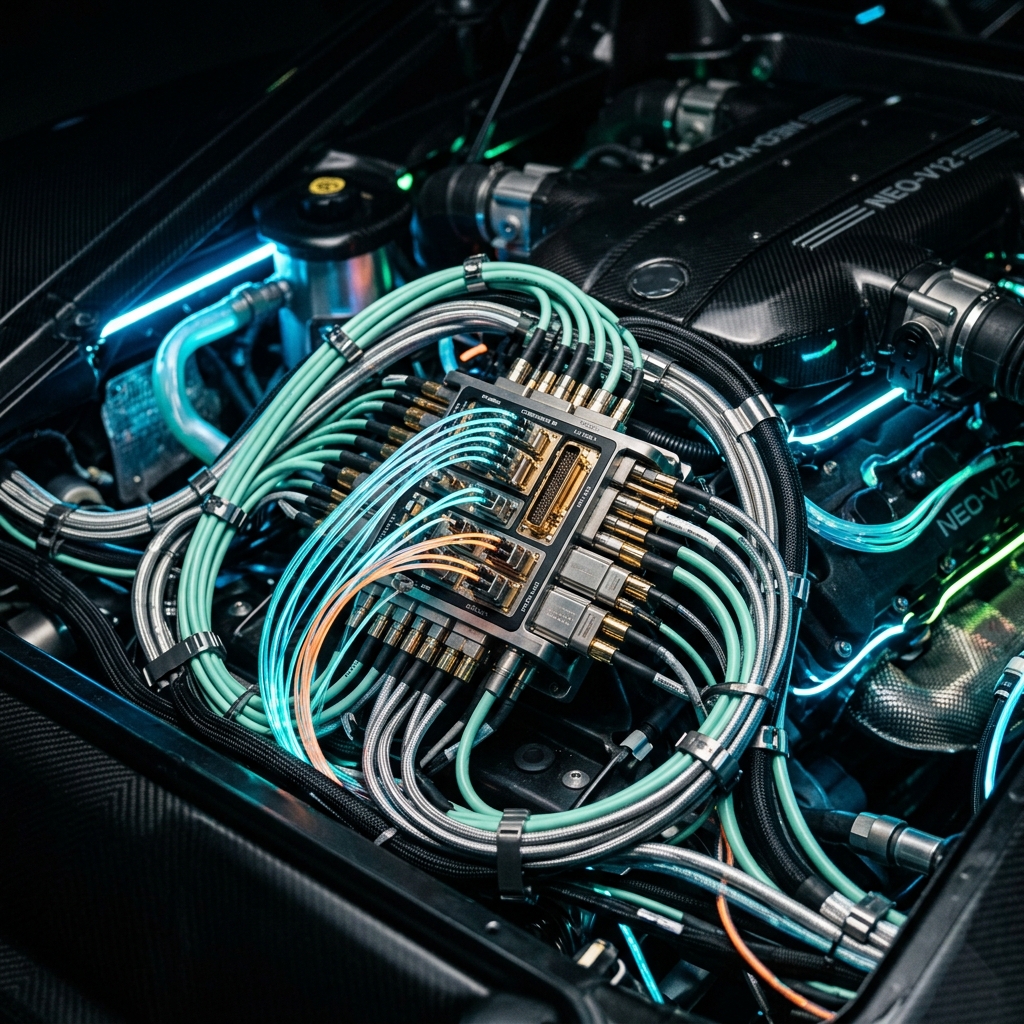
In the hierarchy of cybernetic and physical design, the most brilliant algorithm or the highest-density silicon is utterly inert without a reliable pathway for signal and power transmission. This is the starting point of Harness Engineering. A wire harness—or wiring assembly—is not merely a collection of copper cables wrapped in tape; it is the physical neural network of a machine. It is a highly optimized, dynamically balanced system designed to route hundreds of separate electrical pathways simultaneously through tight spatial boundaries, hostile environments, and variable thermal thresholds. To overlook the harness is to ignore the physical vessel that sustains systemic life.
Traditional manufacturing often treats wiring as an afterthought—an element to be "routed" after the mechanical components have been placed. In 2026, the Sovereign Architect rejects this linear model. The harness must be designed in tandem with the structural frame and the software architecture. A poorly integrated harness introduces massive spatial friction, electromagnetic interference (EMI), and assembly bottlenecking. We define Harness Engineering as the deliberate spatial and logical integration of electrical connections to minimize systemic entropy. We map connection paths with the same mathematical rigor that we apply to logic-layer software stacks.
By mapping out electrical pathways, a wire harness consolidates individual wires into a singular, protective sleeve. This bundling does not merely save space; it radically simplifies assembly, protects raw wires from mechanical friction, and insulates the system against environmental fatigue. A standard modern automobile contains over 3,000 separate wires extending across kilometers of distance. Without a highly engineered harness to bind these threads, assembly becomes biologically impossible, and troubleshooting becomes a forensic nightmare. Harness Engineering is the transition from localized wiring mess to a sharded, modular, and standardized infrastructure node.
A wire harness is never a passive asset. It is an active participant in systemic efficiency, determining signal latency, power distribution integrity, and the physical survival limits of the machine. If your physical conduits are fragile, your logical dominance is a illusion.
02. The Physics of Containment: Why Connective Failure is Existential
The physical environment is a reservoir of absolute entropy. Thermal expansion, vibration, humidity, and chemical exposure are constantly trying to degrade the electrical paths of your system. In high-performance aerospace, automotive, or industrial nodes, a single loose connector or a sharded terminal is an existential threat. A system failure does not occur in the cloud; it occurs when a physical contact point separates under vibrational stress. The physics of containment requires a deep understanding of terminal crimping, connector locking mechanisms, and sheath materials.
Consider the phenomenon of Contact Resistance. When a terminal is improperly crimped to a copper core, microscopic air gaps remain. When high current flows through this imperfect connection, resistance rises, creating localized heat. This thermal spike accelerates oxidation, which in turn increases resistance—creating a runaway thermal loop that terminates in physical meltdown or systemic combustion. Harness Engineering utilizes Micro-Aesthetics to ensure that every crimp is mechanically gas-tight, replacing localized air gaps with unified cold-welded metal bonds. This is molecular isolation against environmental degradation.
Furthermore, we must address Resonance and Vibration. A wire bundle has a natural harmonic frequency. If the harness is not properly secured to the chassis at calculated intervals, mechanical vibrations will cause the harness to rub against sharp metal edges, or create micro-movements within the connector terminals themselves. This micro-rubbing, known as fretting corrosion, strips away the precious tin or gold plating of the contact terminals, causing intermittent signal loss. These ghost faults are the most difficult to diagnose. Harness Engineering dictates the precise placement of mounting brackets, grommets, and strain reliefs to decouple the wiring core from the physical oscillations of the frame.
A single millimeter of loose harness is a vulnerability. The sheath must never touch a moving or hot part without defensive buffering. Every connection must be locked, every terminal sealed, and every path strain-relieved. Treat physical connections with the same zero-trust model that you apply to cybersecurity protocols.
03. Spatial Orchestration: The Micro-Aesthetics of Complex Interconnections
Designing a wire harness is a complex game of spatial geometry. You must route thousands of wires through a physical space that is constantly shrinking. In modern edge computing arrays, high-voltage battery enclosures, or advanced robotic limbs, space is the ultimate scarcity. We must design harnesses that can bend, flex, and adapt without stressing the core conductors. This is Spatial Orchestration—the art of finding the optimal routing topology that minimizes wire length, weight, and signal crosstalk.
To achieve this, we divide the harness into sharded branches stemming from a central trunk. Each branch is mathematically calculated to match the current-carrying capacity (wire gauge) and signal shielding requirements of its destination. The trunk acts as the main bus, while the branches serve as localized distribution nodes. We utilize specialized sheathing materials—from standard PVC tape to advanced braided fiberglass sleeves—to balance flexibility, weight, and mechanical protection. This modular architecture allows for the rapid replacement of isolated branches during maintenance, avoiding the need to tear down the entire machine.
Additionally, we must consider Connector Density. Modern micro-connectors squeeze dozens of pins into a square centimeter. If the harness is not designed with micro-aesthetic precision, the mechanical force required to plug in these dense connectors can bend pins or crack the connector housing. Harness designers use 3D CAD modeling and digital twin simulations to map the exact insertion angles and service loops. The goal is to ensure that every connection can be made effortlessly by assembly technicians, reducing human error to absolute zero. The design must feel natural, robust, and mathematically inevitable.
| Design Attribute | Legacy Wire Bundling | Sovereign Harness Engineering |
|---|---|---|
| Integration Timeline | Afterthought (Post-Mechanical Design) | Concurrent Design (Parallel with CAD/Software) |
| Failure Model | High fretting, open thermal loop risks | Zero-friction, gas-tight cold-welded terminals |
| Spatial Footprint | High chaos, bulky routing paths | 3D simulated trunk-and-branch topologies |
| EMI Mitigation | Ad-hoc shielding sleeves | Integrated differential pair routing & ground meshes |
04. Systemic Cybernetics: Bridging Physical and Logical Infrastructure
Harness Engineering is not just a hardware discipline; it is the physical foundation of Systemic Cybernetics. In a cyber-physical system, the physical wire harness and the logical software stacks are inextricably linked. If the software demands high-speed sensor telemetry, the physical harness must support the bandwidth and signal integrity required to deliver that data without packet loss. If the software executes a motor brake command, the power routing must handle the transient current spike without dropping the voltage to the logic controllers. The connection is absolute.
We look at this relationship through the lens of Signal Propagation Velocity. Signals traveling through copper wires travel at roughly 60-70% the speed of light. In high-frequency trading arrays, autonomous driving nodes, or closed-loop robotic systems, the physical length of the harness directly impacts the loop latency of the software. If your wiring is unnecessarily long, your software will execute actions based on stale data. Harness Engineering is the strategic reduction of physical latency. We design the physical paths to optimize the logical execution speed of the AI agent.
Moreover, we must manage the Electromagnetic Spectrum within the harness. When high-voltage power lines are bundled alongside sensitive high-speed data cables (like CAN Bus or Ethernet), inductive and capacitive coupling will occur. This is Crosstalk—a phenomenon where power surges infect signal lines, introducing digital noise and corrupting data frames. Traditional systems solve this by adding heavy shielding layers, which increases cost and weight. Harness Engineering solves this programmatically by separating power and signal trunks, using twisted-pair differential routing, and integrating dedicated grounding nodes directly into the connector geometry. The physical layout itself becomes the noise filter.
05. Dynamic Case Analysis: Tesla's Core Architectural Shrinkage
The ultimate validation of Harness Engineering as a core strategic discipline is observed in Tesla's radical automotive architecture evolution. In traditional automotive design, the wire harness is a massive, complex beast supplied by third-party vendors, routed manually by assembly line workers. When Tesla designed the Model S, the total wire length exceeded 3 kilometers, weighing over 50 kilograms. This complexity was a primary bottleneck in production scalability and a major source of warranty issues. It was a legacy model that could not scale.
To break this bottleneck, Tesla restructured its entire architecture. In the Model 3, they reduced the total harness length to 1.5 kilometers. In the Model Y, they went even further, target-designing a harness system of less than 100 meters. How did they achieve this? They did not simply use thinner wires; they executed a Decentralized Regional Node Architecture. Instead of routing every sensor and actuator wire back to a central processor, they placed regional computing nodes throughout the vehicle. These regional nodes communicate via a high-speed CAN/Ethernet backbone, handling local power distribution and signal routing locally. The wiring harness was transformed from a centralized mess to a clean, regionalized mesh.
Furthermore, Tesla pioneered the use of Rigid-Flex Harnesses. By replacing loose wires with flat, rigid-flex printed circuit boards (PCBs), they eliminated the manual routing process entirely. The wire harness became a structural, solid-state component that could be placed automatically by robotic arms in seconds. This transformation reduced weight, eliminated assembly errors, and stabilized signal integrity at a level legacy manufacturers have yet to replicate. This is Asymmetric Harness Innovation—a master class in decoupling systemic complexity from mechanical constraints.
Tesla did not solve their wiring problem by changing the software; they changed the physical layout of the machine. By modularizing compute regional nodes, they freed the logical software layers from the constraints of physical distance. Hardware is the bedrock of strategic agility.
06. The Sovereign Paradigm: Connectivity as the Ultimate Core Asset
As we conclude this first chapter of the Harness Engineering series, the Sovereign Architect must embrace the core paradigm: Connectivity is the ultimate asset. We must treat physical wire harnesses with the same respect, rigor, and design care that we apply to our software algorithms and financial hedging protocols. A robust, optimized physical network guarantees high-fidelity signals, uninterrupted power flow, and ultimate mechanical resilience. It is the bedrock of sovereign execution.
In the coming chapters, we will dive deeper into the technical mechanics of this discipline—exploring the micro-aesthetics of terminal crimping, the signal integrity of high-speed protocols under electromagnetic stress, the containment strategies for high-voltage systems, and the emerging paradigm of AI-driven harness design. Prepare your systems, audit your connections, and master the conduits of your empire. Welcome to the New Sovereignty of Connection.
Let your wires be straight, your terminals gas-tight, and your routes mathematically optimal. The blood of your system is the electrical current flowing through these copper and fiber lines. Guard it, protect it, and optimize it. The machine is only as strong as the connection that binds it.
A single millimeter of loose harness is a vulnerability. The sheath must never touch a moving or hot part without defensive buffering. Every connection must be locked, every terminal sealed, and every path strain-relieved. Treat physical connections with the same zero-trust model that you apply to cybersecurity protocols.
Let your wires be straight, your terminals gas-tight, and your routes mathematically optimal. The blood of your system is the electrical current flowing through these copper and fiber lines. Guard it, protect it, and optimize it. The machine is only as strong as the connection that binds it.


