[HE#03] Testing the Thresholds: Engineering Harnesses for Extreme Thermal, Vibrational, and Moisture Stress
[HE#03] Testing the Thresholds: Engineering Harnesses for Extreme Thermal, Vibrational, and Moisture Stress
In the cold reality of hardware operations, a wire harness does not exist in isolation. It is routed through engine compartments reaching 150°C, exposed to the high-frequency vibration of jet turbines, and subjected to the relentless moisture of high-pressure washes. Software can be patched online, but a fractured wire or water-logged connector inside an armored casing is a permanent failure state. This chapter details Testing the Thresholds—the absolute engineering principles required to defend physical wire networks against the destructive trinity of thermal, vibrational, and moisture fatigue.
Hardware failures rarely occur due to a single, cataclysmic event. Instead, they are the result of environmental fatigue accumulation. When a system undergoes continuous thermal expansion and contraction, copper wires experience micro-strain. Under high vibrations, these strains localize at connection termination points, initiating micro-fractures. If atmospheric moisture or chemical agents infiltrate these fractures, rapid galvanic corrosion occurs, leading to high resistance and connection failure. To design a sovereign wiring system, engineers must mathematically predict and test these stress boundaries.
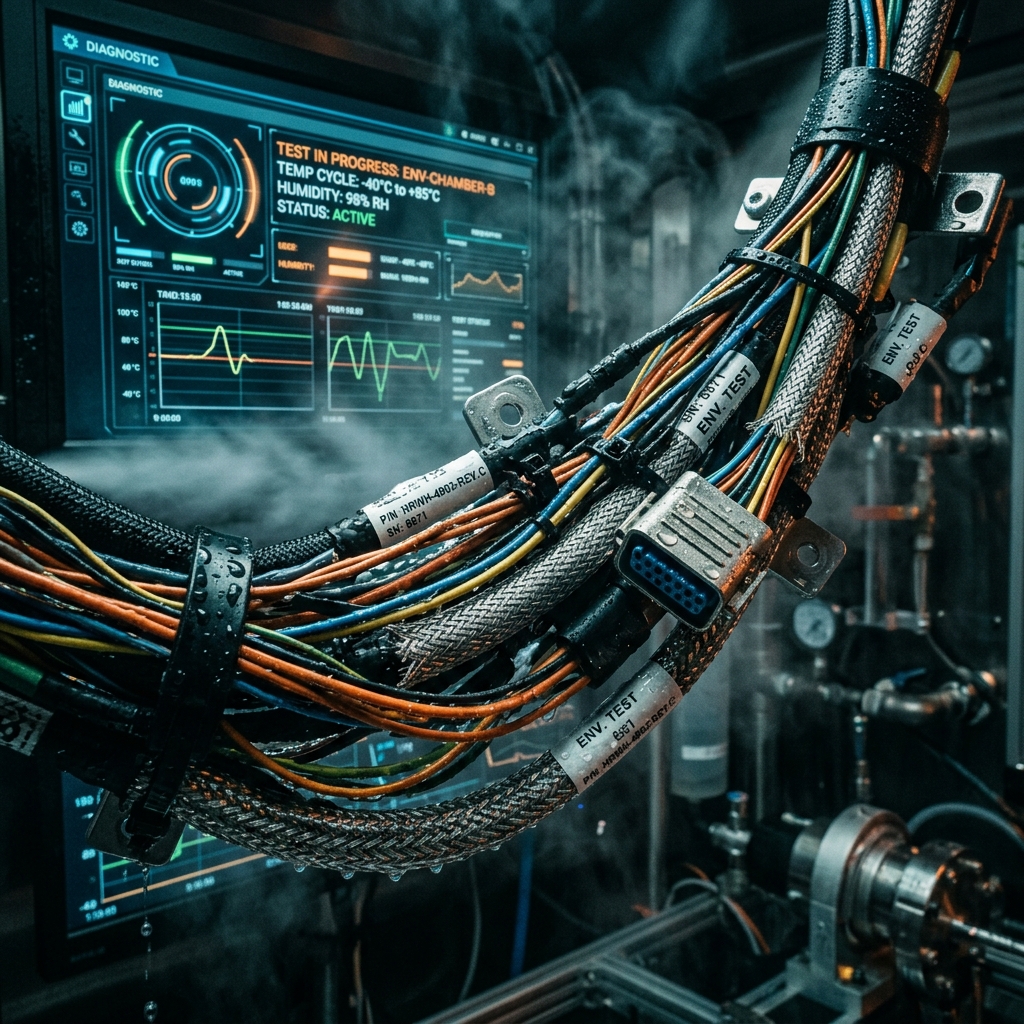
Every military, aerospace, or automotive wire harness must be tested inside specialized environmental simulation chambers. These chambers compress decades of field exposure into weeks of continuous thermal cycling, salt-spray fogging, and multi-axis vibrational testing. A wire harness that survives this torture is not merely functional; it has proven its absolute right to operate in the harshest environments on earth.
High temperatures are a silent threat to wire harness insulation. As heat rises, the polymer chains within insulation sleeves (such as PVC, XLPE, or Teflon) undergo thermal aging, leading to embrittlement, micro-cracking, and loss of dielectric strength. Additionally, the copper conductor and the polymer insulation expand at different rates due to their distinct CTE (Coefficient of Thermal Expansion) values, causing localized friction and mechanical wear.
| Insulation Material | Max Continuous Temp | Dielectric Strength (kV/mm) | CTE (10⁻⁶/K) | Primary Engineering Application |
|---|---|---|---|---|
| PVC (Polyvinyl Chloride) | 85°C | 20 kV/mm | 80 - 150 | Standard Cabin Wiring (Non-critical) |
| XLPE (Cross-linked PE) | 125°C | 30 kV/mm | 120 - 200 | Automotive Engine Bay routing |
| ETFE (Tefzel / Aerospace) | 150°C | 40 kV/mm | 90 | Aerospace & Military Avionics |
| PTFE (Teflon / Premium) | 200°C | 60 kV/mm | 120 | High-temperature exhaust sensor zones |
| Polyimide (Kapton) | 260°C | 150 kV/mm | 20 | Extreme spacecraft wiring (Ultra-lightweight) |
To defend against heat radiation in engine bays or rocket nacelles, engineers deploy reflective shielding. Using multi-layered aluminum-fiberglass sleeves, radiant heat is reflected away, maintaining internal temperatures within safe limits. Additionally, critical harnesses must be routed along structural cold-sinks to leverage convective cooling pathways.
Vibration is the primary cause of mechanical wire fracture. When a harness is routed across moving components, it acts as a cantilever beam, concentrating vibrational forces at the terminal crimp joints. If these vibrations match the natural resonant frequency of the wiring assembly, displacement amplitudes increase dramatically, leading to rapid mechanical fatigue.
To mitigate vibrational fatigue, designers must enforce strict curvature bounds and implement strain relief loops. A wire must never be routed in a straight, tight line between two terminals; it must have a natural slack loop. The minimum bend radius of a harness must be maintained at 10x to 20x the outer diameter (OD) of the bundle. Furthermore, robust strain relief clamps must be positioned within 50mm of every connector entry point to absorb vibrational energy before it reaches the crimp interface.
Moisture is the universal solvent of electrical systems. Water infiltration into a connector housing creates conductive bridging between terminals, triggering leakage currents, signal corruption, and short-circuit failures. In heavy industrial and off-road vehicles, harnesses must survive high-pressure steam cleaning, demanding compliance with IP69K ingress protection standards.
Survival at IP69K requires three primary lines of defense: 1. Silicon Wire Seals: Individual rubber seals must be crimped directly onto each wire to seal the entry point into the connector housing. 2. Adhesive-Lined Heat Shrink: Wire splice junctions must be enclosed within dual-wall heat-shrink tubing that melts internally to form a solid, water-tight plastic seal. 3. Chassis Grommets: When passing through structural firewalls, heavy-duty molded rubber grommets must be compressed into place, preventing water from traveling along the harness bundle into dry cabins.
To calculate the expected operational lifespan of a wire harness under combined thermal and mechanical cycling, engineers employ the Coffin-Manson model. This mathematical formula estimates the number of cycles to failure based on plastic strain range, material properties, and thermal amplitude. The following Python script automates this calculation, allowing engineers to audit design margins before physical prototyping.
By executing this computational script, design parameters can be optimized to guarantee a minimum operational service life of 20 years, even under continuous aerospace and tactical deployment configurations.
No wiring harness is allowed to enter service without passing a rigorous environmental stress audit. The audit protocol demands absolute compliance with the following physical and electrical thresholds:
| Checkpoint ID | Stress Parameter | Target Threshold / Tolerance | Inspection Method | Failure Consequence |
|---|---|---|---|---|
| STR-01 | Insulation Resistance | ≥ 100 MΩ @ 500V DC | Megohmmeter Isolation Test | Dielectric breakdown & short circuit |
| STR-02 | Bend Radius Check | Minimum 10x OD for static, 20x for dynamic | Physical Curvature Gauge | Mechanical strain and conductor fracturing |
| STR-03 | Hermetic Sealing | IP69K compliant (no bubble emission) | Pressurized Bubble Leak Tester | Galvanic corrosion & signal degradation |
| STR-04 | Vibrational Resistance | No discontinuity > 1 microsecond | Random Vibration Shake & Continuity Audit | Transient signal dropout |
| STR-05 | Thermal Cycling | -40°C to +150°C (100 cycles minimum) | Dual-Chamber Thermal Shock Chamber | Insulation cracking & joint degradation |
This strict audit protocol ensures that the physical connections are as reliable as the silicon chips they connect. When every wire and connector is tested and verified to these standards, the system achieves absolute structural resilience.
Quality is not an abstract ideal; it is measured in the hostile environment of the physical world. Let every connection be designed for the worst conditions, tested beyond its breaking limits, and verified with uncompromising rigor. The resilience of the system is the ultimate shield of our sovereign operations.
Quality is not an abstract ideal; it is measured in the hostile environment of the physical world. Let every connection be designed for the worst conditions, tested beyond its breaking limits, and verified with uncompromising rigor. The resilience of the system is the ultimate shield of our sovereign operations.


