[HE#04] Material Revolutions: Decoupling Weight from Efficiency in Complex Harness Architectures
[HE#04] Material Revolutions: Decoupling Weight from Efficiency in Complex Harness Architectures
In classical engineering, weight and efficiency were locked in a zero-sum death match. If you demanded higher current throughput or greater noise immunity, you wrapped the cables in heavier copper shields and increased core diameters. In the high-performance realms of 2026—aerospace avionics, competitive electric vehicles, and tactical edge computing chassis—this traditional brute-force methodology is no longer viable. This chapter details Material Revolutions—the materials science paradigms required to decouple physical harness weight from systemic data and power transmission efficiency.
Weight is the absolute enemy of range and acceleration. In modern aerospace systems, every kilogram of dead weight adds thousands of dollars in yearly fuel costs and directly limits payload capacity. In electric vehicles, an extra 50 kilograms of wiring harness forces a trade-off in battery capacity, reducing vehicle range. Traditional copper harnesses in a premium vehicle can easily weigh over 60 kilograms. Therefore, lightweighting the physical neural network is a critical engineering objective.
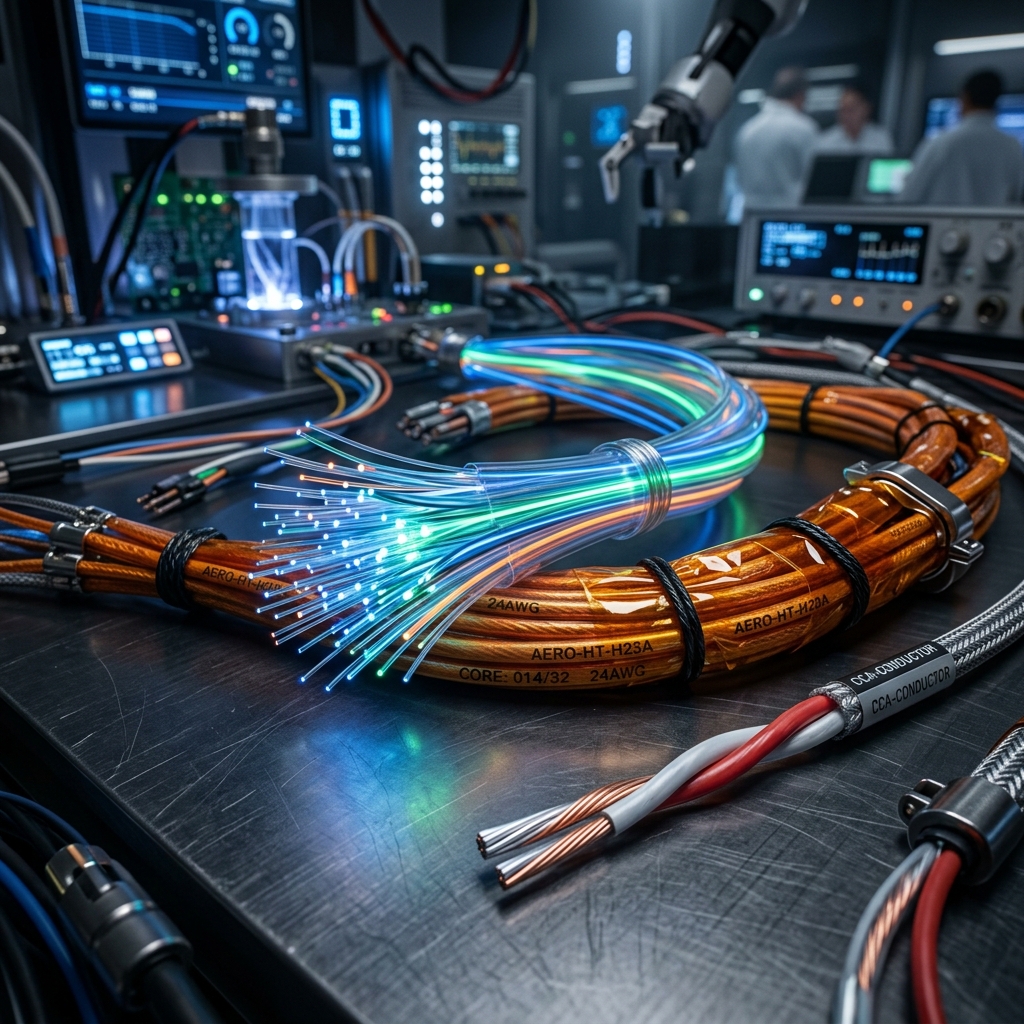
By shifting from copper to alternative conductors and replacing signal buses with ultra-lightweight glass fiber optics, engineers can compress the volumetric profile of wire bundles. This spatial shrinkage reduces the structural burden on vehicle chassis and simplifies automated manufacturing processes.
Copper has long been the gold standard of electrical conductors due to its excellent electrical conductivity. However, it is heavy and expensive. Aluminum and CCA (Copper-Clad Aluminum) have emerged as highly viable alternatives, offering substantial weight savings at the cost of slightly lower conductivity and increased termination complexity.
| Conductor Material | Electrical Conductivity (% IACS) | Density (g/cm³) | Relative Weight Ratio | Termination Challenge | Primary Engineering Application |
|---|---|---|---|---|---|
| Pure Copper (ETP) | 100% | 8.89 g/cm³ | 1.00 | Negligible (Standard Crimp) | High-current battery feeds & low-voltage signal lines |
| Pure Aluminum (1350) | 61% | 2.70 g/cm³ | 0.30 | High (Galvanic corrosion, creep) | High-gauge EV power cables (Static routing) |
| Copper-Clad Aluminum (CCA) | 65% | 3.63 g/cm³ | 0.41 | Medium (Skin-effect reliance) | High-frequency coax & medium-voltage power distribution |
| Carbon Nanotube (CNT) Yarn | 5% to 15% | 1.40 g/cm³ | 0.16 | Very High (Nanotextured interfaces) | Aerospace shielding & premium lightweight data buses |
While aluminum offers a 70% weight reduction compared to copper, it suffers from galvanic corrosion when it contacts other metals in the presence of moisture. Additionally, aluminum experiences mechanical creep—a gradual deformation under constant mechanical load—which can loosen terminal crimp connections over time. Therefore, aluminum terminations require specialized gas-tight seals and Terminals designed with integrated anti-creep geometries.
For data transmission, copper wires are increasingly being replaced by fiber optic cables. Instead of sending electrical currents through heavy copper strands, fiber optics transmit data as pulses of light through ultra-thin glass or plastic fibers. Glass fibers are completely immune to electromagnetic interference (EMI) and radio frequency interference (RFI), eliminating the need for heavy copper shielding braids.
A single optical fiber can replace dozens of shielded twisted-pair copper cables, dramatically reducing the weight and diameter of the harness bundle. Furthermore, optical fibers can support massive data rates over long distances with minimal signal attenuation. In premium aerospace systems, the transition from copper-based CAN bus architectures to fiber-optic Ethernet networks represents the ultimate leap in data density and weight reduction.
Insulation material is another major contributor to wire harness weight. Traditional PVC insulation is thick and heavy, requiring a large volume of material to achieve sufficient dielectric isolation. Modern high-dielectric polymers allow engineers to reduce insulation wall thickness by up to 50% without sacrificing electrical safety or mechanical durability.
Advanced polymers such as ETFE (Tefzel) and PEEK (Polyether ether ketone) possess exceptional dielectric strength and high temperature resistance. Their robust physical properties allow for thin-wall extrusion, resulting in a lighter and more flexible wire bundle. PEEK, in particular, offers excellent abrasion resistance, eliminating the need for heavy external protective conduits or corrugated tubing in many routing scenarios.
To evaluate the trade-offs between conductor weight, resistivity, and diameter, engineers can model material behaviors computationally. The following Python script calculates the physical mass and electrical resistance of a conductor based on its material properties, length, and gauge, allowing engineers to audit material selections before prototyping.
Executing this simulation confirms that while aluminum and CCA exhibit higher electrical resistance, their substantial weight savings allow designers to increase conductor gauge to offset resistance losses while still achieving a net mass reduction of over 40%.
To ensure that lightweight materials meet the strict performance standards of sovereign architectures, all conductor and insulation batches must pass a rigorous material verification protocol before assembly integration:
| Checkpoint ID | Verification Parameter | Target Threshold / Tolerance | Inspection Method | Failure Consequence |
|---|---|---|---|---|
| STR-06 | Galvanic Isolation | Zero current flow at aluminum-copper junctions | Electrochemical Potentiostat Test | Galvanic corrosion and joint breakdown |
| STR-07 | Creep Resistance | Less than 0.05% strain under constant load | Tensile Stress Creep Tester | Crimp loosening and high-resistance faults |
| STR-08 | Optical Attenuation | Less than 3.0 dB/km at 850nm | Optical Time-Domain Reflectometer (OTDR) | Signal degradation and data transmission loss |
| STR-09 | Abrasion Resistance | Greater than 500 scrape cycles to failure | Scrape Abrasion Tester (MIL-W-22759) | Insulation rupture and short-circuit faults |
| STR-10 | Outgassing Potential | TML (Total Mass Loss) less than 1.0% | Vacuum Thermal Desorption Chamber | Volatile outgassing and optical sensor fogging |
This comprehensive protocol ensures that every lightweight conductor, fiber optic core, and advanced polymer sleeve meets the highest levels of operational reliability, ensuring the absolute structural integrity of the physical network.
Innovation must be physically qualified. We do not accept weight as an inevitability, nor do we compromise on transmission efficiency. Let every material be audited, every connection be protected, and every asset be optimized to the highest technical standard. Physical excellence is the absolute foundation of our operations.
Innovation must be physically qualified. We do not accept weight as an inevitability, nor do we compromise on transmission efficiency. Let every material be audited, every connection be protected, and every asset be optimized to the highest technical standard. Physical excellence is the absolute foundation of our operations.


