[HE#05] Tesla's Disruptive Innovation: Structural Reduction via Localized Nodes and 48V E/E Architectures
[HE#05] Tesla's Disruptive Innovation: Structural Reduction via Localized Nodes and 48V E/E Architectures
In traditional automotive manufacturing, wiring harnesses have evolved into a monumental crisis of physical complexity. Over successive generations, legacy OEMs built centralized, hub-and-spoke networks, resulting in a single massive vehicle harness containing over 3 kilometers of copper lines. This massive bundle must be manually routed through tight spaces, raising manufacturing defect rates and introducing severe parasitic weight. This chapter details Tesla's Disruptive Innovation—deconstructing how localized node architectures and a 48V electrical grid system mathematically eliminate kilometers of wiring entropy.
A legacy vehicle wiring system is a masterpiece of manufacturing inefficiency. When every sensor, door latch, light bulb, and actuator must run a dedicated copper circuit back to a centralized body control module (BCM) in the cabin, physical complexity expands exponentially. The resultant harness becomes a thick, inflexible snake that is impossible to install via automated robotics. It must be manually taped, pre-bent, and threaded through structural pillars by human assemblers, making it the most defect-prone component in the entire vehicle assembly line.
This physical complexity also translates to severe mass. A standard luxury vehicle harness can weigh over 80 kilograms, making it the third heaviest component in the vehicle behind the engine/battery pack and the structural chassis frame. Stripping this mass requires a total paradigm shift in how electrical power and signaling are routed.
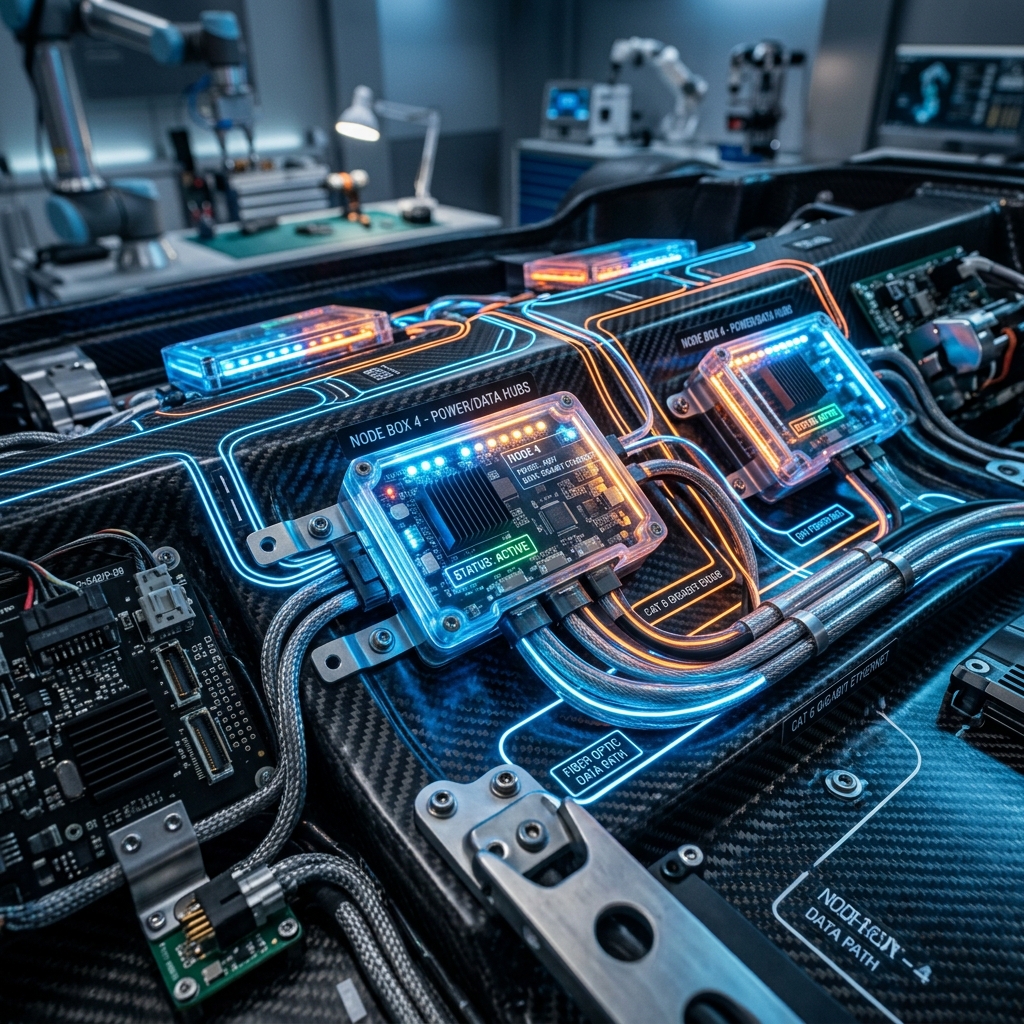
Tesla solved this bottleneck by implementing a decentralized, zone-based E/E (Electrical/Electronic) architecture. Instead of routing individual cables across the entire length of the vehicle, Tesla sharded the control logic into distinct localized micro-controller zones located directly adjacent to sensors and actuators (e.g. Front, Left, and Right Zone Controllers).
These local node controllers act as regional power and data hubs. For example, the Left Zone Controller manages the driver's door locks, left window motor, left mirrors, and left-side cabin speakers locally. It requires only a single high-voltage power trunk line and a shared data bus link to the main autopilot computer, replacing dozens of long, heavy analog wires with a clean, localized spider web of short, thin leads.
The transition to a 48V electrical grid (most notably deployed in the Cybertruck) is the most radical leap in modern harness engineering. Since the dawn of electric starting motors, passenger cars have relied on a nominal 12V electrical system. As vehicle power requirements have climbed, 12V grids have hit physical boundaries: to deliver high wattages at 12V, current (amperage) must rise, which in turn requires thick, heavy copper conductors to prevent high-temperature failures and extreme voltage drops.
By raising system voltage by a factor of four from 12V to 48V, a simple physical law is activated: Power (Watts) is the product of Voltage and Current (P = V * I). Therefore, to deliver the identical amount of power to a component, a 48V grid requires only 25% of the current compared to a 12V system.
| System Voltage Grid | Power Requirement | Current Draw (Amps) | Required Copper Gauge | Wire Mass Ratio | Parasitic Power Loss Ratio |
|---|---|---|---|---|---|
| Legacy 12V DC | 480 Watts | 40.0 Amps | AWG 8 (8.36 mm²) | 1.00 (Baseline) | 1.00 (Baseline) |
| Sovereign 48V DC | 480 Watts | 10.0 Amps | AWG 14 (2.08 mm²) | 0.25 (75% mass savings!) | 0.06 (94% loss savings!) |
| Industrial 110V AC | 480 Watts | 4.3 Amps | AWG 18 (0.82 mm²) | 0.10 | 0.01 |
Because resistance power losses scale exponentially with current (P_loss = I² * R), reducing current draw by 75% cuts parasitic heat and power losses within the harness by a staggering 93.75%. This massive thermal reduction allows designers to utilize incredibly thin, lightweight wires across the entire chassis grid, achieving unprecedented weight and material savings.
To communicate between localized zone controllers and the central computer core, traditional designs ran separate communication buses (such as low-speed CAN networks) for each subsystem. Tesla bypassed this clutter by establishing a high-speed, unified Ethernet ring topology.
An Ethernet ring loops around the entire vehicle, linking the front, left, right, and rear zone controllers in a continuous high-speed optical or copper loop. If a single segment of the ring is severed during a collision or mechanical stress event, data packets are instantly rerouted in the opposite direction along the loop, maintaining absolute system control. This ring eliminates thousands of individual signal lines, reducing data harness complexity to a single, shielded, highly survivable loop.
To mathematically quantify the thermal and physical advantages of transitioning from a legacy 12V grid to a modern 48V architecture, engineers can simulate wire behaviors under high electrical loads. The following Python script compares current draw, conductor area requirements, weight, and internal heat generation for both standards.
Running this script proves that increasing voltage mathematically reduces the required conductor mass by over 93% while simultaneously cutting line-level heat generation, demonstrating why the 48V shift is the most disruptive material engineering innovation in transit history.
To successfully deploy decentralized zone controllers and a high-voltage 48V architecture, every system interface must pass a strict cyber-physical validation checklist:
| Checkpoint ID | Validation Parameter | Target Threshold / Tolerance | Inspection Method | Failure Consequence |
|---|---|---|---|---|
| STR-11 | 48V Isolation Barrier | Resistance ≥ 500 kΩ to chassis | High-Potential (Hi-Pot) Isolation Test | Chassis short-circuits & shock hazards |
| STR-12 | Transient Spike Shielding | Withstand spikes up to 100V for 10ms | Transient Pulse Wave Generator | Microcontroller latch-up and zone failure |
| STR-13 | Ethernet Loop Latency | Ping round-trip time ≤ 2.5ms | High-Speed Protocol Logic Analyzer | Delayed actuation and control dropouts |
| STR-14 | Arc Flash Prevention | Zero arc formation during hot-unplugging | Arc-Fault Current Interrupter Audit | Terminal melting & vehicle fire risk |
| STR-15 | Zone Connector Sealing | Zero leakage under IP67 submersion | Air Pressure Ingress Chamber | Galvanic terminal wear & signal shorting |
By enforcing this automotive hardening protocol, designers can leverage the immense benefits of zone-based wiring and 48V power distribution with absolute physical security and operational reliability.
Complexity is a design failure. We reject legacy cabling chains and refuse to route redundant copper threads through our chassis. Let our systems be sharded, our nodes be localized, and our voltages be optimized. Decoupling structural weight from logical capability is the ultimate path to physical sovereignty.
Complexity is a design failure. We reject legacy cabling chains and refuse to route redundant copper threads through our chassis. Let our systems be sharded, our nodes be localized, and our voltages be optimized. Decoupling structural weight from logical capability is the ultimate path to physical sovereignty.


