[HE#09] Fault Isolation Protocols: Designing Programmatic Kill-Switches and Fault Isolation Protocols to Prevent Catastrophic Systemic Failure across Cybernetics
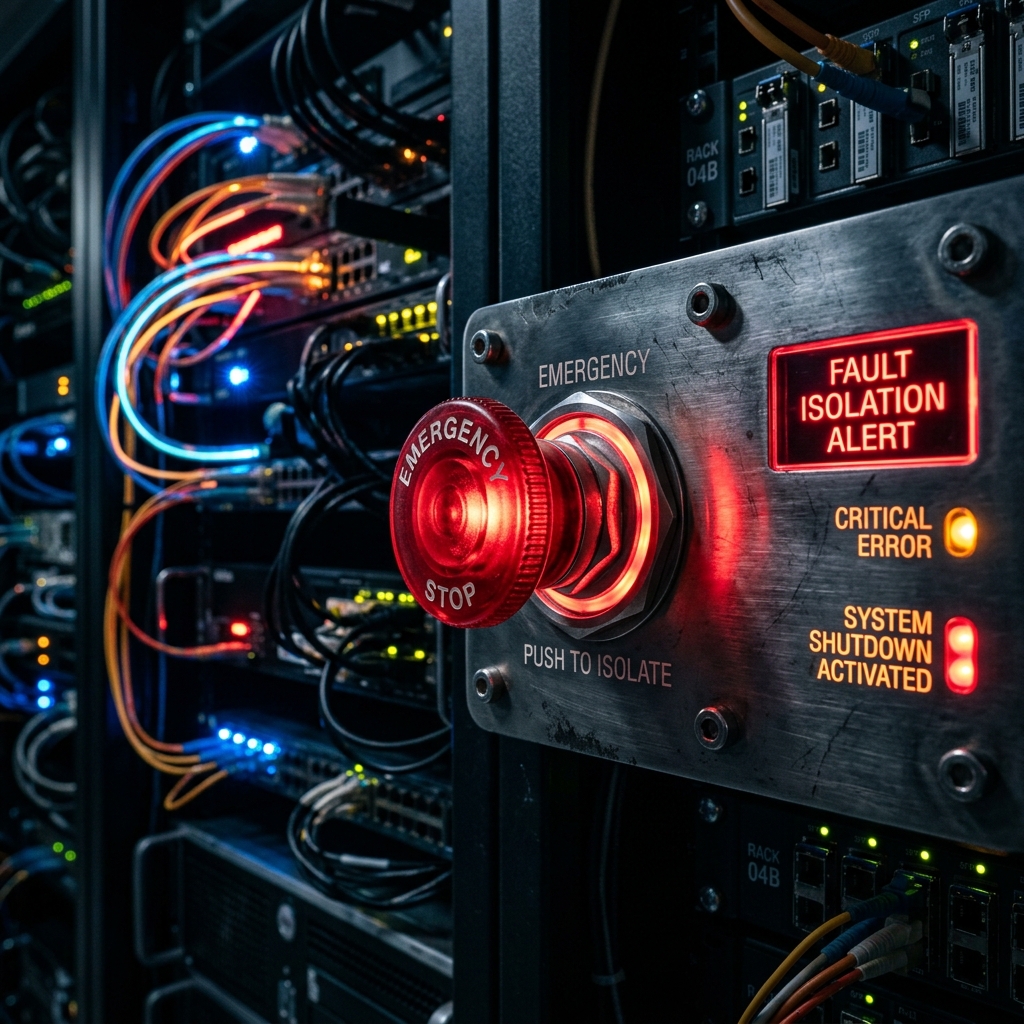
[HE#09] Fault Isolation Protocols: Designing Programmatic Kill-Switches and Fault Isolation Protocols to Prevent Catastrophic Systemic Failure across Cybernetics
In highly advanced cyber-physical machines, complex microservice arrays, and autonomous agent swarms, failure is an inevitability of nature. However, while an individual component failure is acceptable, allowing that failure to propagate throughout the system is completely intolerable. When a minor local fault escapes its boundary, it triggers a cascading systemic collapse. This chapter details Fault Isolation Protocols—how to architect microsecond-level pyrotechnic kill-switches, implement 2oo3 safety voting clusters, deploy independent hardware watchdog monitors, and secure logic boundaries against catastrophic runtime entropy.
A single-point failure in an un-isolated network is the cybernetic equivalent of a localized spark inside an un-compartmentalized ammunition store. Without thermal firewalls, that single spark spreads from box to box, culminating in a catastrophic explosion that obliterates the entire vessel. In complex software networks, a single thread hanging due to an unhandled memory leak can consume the system worker pool, bringing down the entire microservice cluster.
In hardware harness design, engineers partition wiring looms into isolated sub-circuits protected by individual thermal fuses. In software, we establish similar logical partitions using asynchronous decoupling, rate limiters, and hardware-level isolation layers to keep the core computational logic operational even when secondary sensor arrays crash.
When an emergency is detected, the system must possess the ability to sever connections instantly. This instant disconnect architecture is known as a programmatic kill-switch (the logical guillotine). A programmatic kill-switch operates on two distinct levels: software containment and physical pyrotechnic triggers.
In software, the kill-switch halts uncooperative worker threads, flushes system caches, and forces state machines into a predefined, safe passive mode. In physical power hardware, a software signal triggers a tiny pyrotechnic charge (pyrofuse). Within 3 milliseconds, the explosive charge physically blows apart a copper busbar, interrupting currents of up to 10,000 Amperes. This physical separation is absolute, ensuring that zero power can flow, completely neutralizing short-circuits.
Using a single sensor or a single processor to trigger a high-energy kill-switch introduces severe systemic risk. If that single sensor suffers from electronic drift or a transient noise spike, it will trigger a false-positive shutdown, paralyzing the system unnecessarily. To solve this, aerospace and high-alpha hardware architectures implement redundant safety voting.
In a 2oo3 (2-out-of-3) voting topology, three independent microcontrollers process the identical sensor streams and continuously vote on the safety state of the machine. The system remains operational as long as at least two of the three nodes agree that the state is safe. If one node fails or reports corrupted telemetry, the remaining two nodes override the failed unit, allowing the vehicle or mainframe to proceed to safety with zero interruption. This mathematical voting architecture completely eliminates single points of failure.
If the central operating system suffers a severe kernel panic or a thread deadlock, it can become entirely unresponsive, unable to execute software-level kill-switches. To defend against this absolute failure mode, engineers deploy low-level hardware watchdogs.
A watchdog is an entirely independent, low-complexity electronic timer integrated outside the primary CPU. As long as the CPU is executing its main loops correctly, it periodically sends a short electrical pulse (a "heartbeat") to reset the watchdog timer. If the CPU hangs and fails to send the heartbeat before the watchdog timer expires, the watchdog immediately asserts a physical reset line, rebooting the CPU and forcing all high-power safety relays to open, returning the system to a clean, isolated ground state.
| Isolation Mechanism | Typical Cutoff Latency | Verification Protocol | Target System Isolation Metric | Secondary Backup Path |
|---|---|---|---|---|
| Pyrotechnic Fuse (Pyrofuse) | ≤ 3 milliseconds | Programmatic current monitoring pulse | Physical busbar separation (> 10kV isolation) | Auxiliary magnetic contactor coils |
| 2oo3 Voting Engine | ≤ 10 milliseconds | Fault injection loop tests | Node-level majority agreement validation | Direct manual override backup line |
| Hardware Watchdog | ≤ 50 milliseconds | Thread deadlock simulation audit | CPU reset and safety contactor de-energization | Independent thermal backup switch |
| Software Ingress Guard | ≤ 1 millisecond | Validation schema constraint injection | Logical socket closure and rate limiter fuse | Container-level CPU throttling rules |
To implement redundant voting, heartbeat monitoring, and emergency programmatic kill-switches, developers can build a 3-node voter cluster. The following Python controller simulates three independent telemetry streams, evaluates votes, and executes a critical shutdown sequence when isolation boundaries are breached.
Executing this simulation demonstrates the absolute resilience of voting-based containment: a single-point failure (Scenario A) is successfully filtered and bypassed, while a multiple-point systemic threat (Scenario B) triggers microsecond-level physical isolation to protect the primary computing core from electrical destruction.
To qualify any high-speed containment or emergency isolation architecture, the system must comply with the following structural functional safety parameters:
| Checkpoint ID | Fault Isolation Parameter | Target Threshold / Tolerance | Verification Method | Failure Consequence |
|---|---|---|---|---|
| STR-31 | Pyrofuse Blow Latency | ≤ 3.0 milliseconds | High-Speed Current Transient Recorder | Busbar melting and cascading electrical fires |
| STR-32 | Watchdog Timeout Limit | ≤ 50 milliseconds pulse window | Digital Logic Analyzer pattern test | CPU hangs in deadlocks; system entirely frozen |
| STR-33 | 2oo3 Vote Validation | Validate votes within ≤ 5ms | Real-time OS task scheduling auditor | Slow fault response leading to core component damage |
| STR-34 | Dielectric Air Clearance | ≥ 15.0 mm after pyrofuse cut | 3D Laser Profilometry Metrology Scan | High-voltage arc re-strike across cutoff gap |
| STR-35 | Dual-MCPU Diagnostic | Cross-node sync drift ≤ 100 microseconds | Dual-channel Oscilloscope trace sync check | Desynchronized voting triggering false trips |
By enforcing this fault isolation protocol, our cyber-physical infrastructures achieve sovereign-grade containment, ensuring that any local failure is securely isolated and neutralized before it can touch our critical operational brains.
We refuse to allow local failures to rot our systemic cores. Let our nodes be redundant, our watchdogs be independent, and our physical kill-switches be microsecond-level fast. Drawing a hard line in the sand between failing local sensors and sovereign core survival is our ultimate cybernetic duty.
We refuse to allow local failures to rot our systemic cores. Let our nodes be redundant, our watchdogs be independent, and our physical kill-switches be microsecond-level fast. Drawing a hard line in the sand between failing local sensors and sovereign core survival is our ultimate cybernetic duty.


