[HE#10] Cyber-Physical Superposition: The Intersection of Physical Hardware Harnesses and Logic-Layer Software Stacks
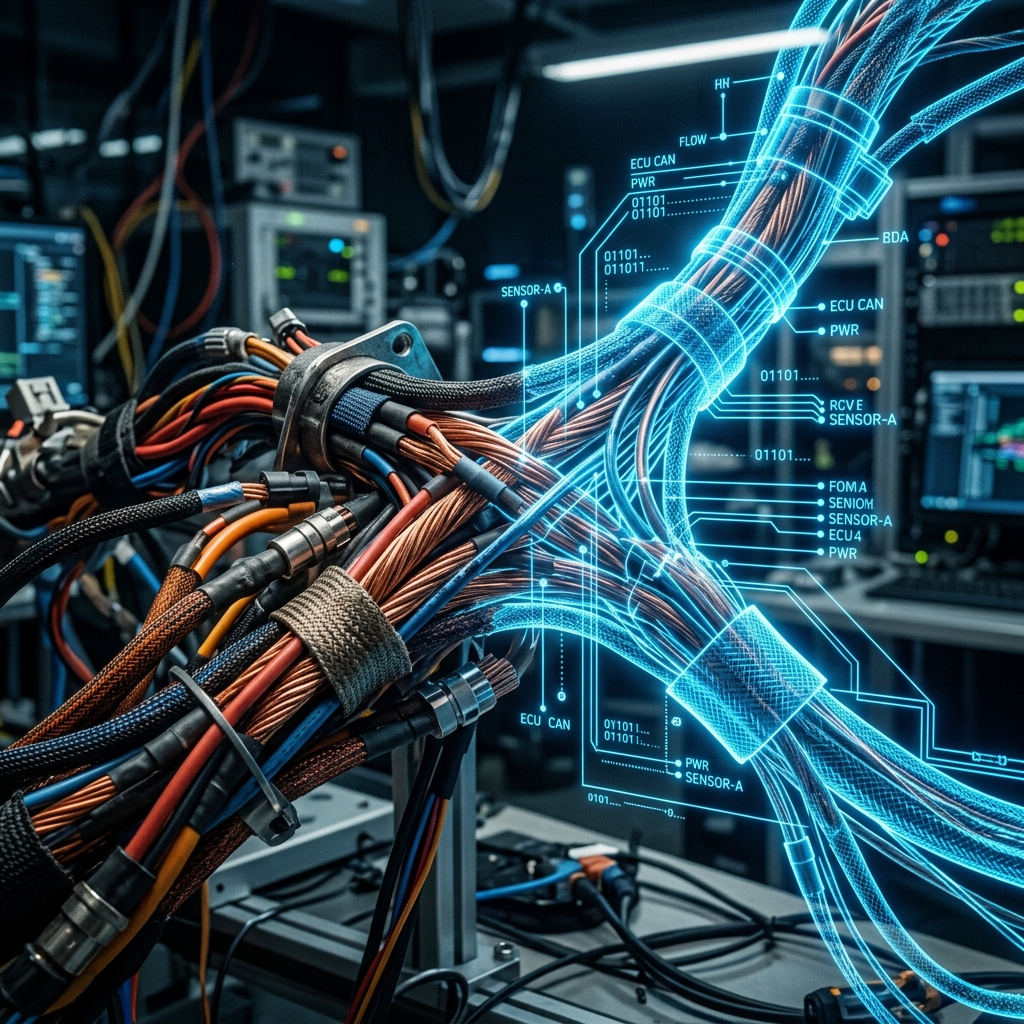
[HE#10] Cyber-Physical Superposition: The Intersection of Physical Hardware Harnesses and Logic-Layer Software Stacks
In modern engineering, hardware and software are no longer decoupled disciplines. They exist in a state of absolute Cyber-Physical Superposition. The physical copper wire dictates how fast a signal can travel, while the logic layer decides what that signal means. This chapter explores the ultimate intersection point: where analog voltages are converted into Boolean logic, how digital twins predict physical degradation, and how software hypervisors physically reroute massive electrical currents using solid-state semiconductor matrices.
The boundary between the physical world and the cybernetic realm is defined by the Analog-to-Digital Converter (ADC). In the physical harness, a thermistor changes resistance based on heat, altering an analog voltage. That voltage is fundamentally continuous and infinitely variable.
When the ADC samples the physical voltage (e.g., 2.75 Volts) and translates it into an 8-bit or 12-bit binary integer, the physical state achieves superposition with the software state. The accuracy of this superposition relies entirely on the resolution of the ADC and the sampling frequency of the logic controller.
Before thousands of miles of expensive copper wire are physically manufactured and routed inside a chassis, engineers build a Digital Twin—a mathematically perfect virtual replica of the harness architecture. This twin exists entirely in software but simulates the laws of physics.
To test the software against this virtual physics, engineers deploy Hardware-in-the-Loop (HIL) simulators. The actual physical microcontrollers (Electronic Control Units, ECUs) are plugged into a supercomputer. The supercomputer simulates the electrical resistance of the wire, the thermal heat of the engine bay, and the noise of the power inverters. It feeds these simulated analog signals into the physical ECU. The ECU believes it is driving a physical vehicle, allowing engineers to validate the logic layer's response to extreme physical conditions without risking physical hardware.
Historically, power routing was static. A fuse was a physical strip of metal; a relay was a physical magnetic switch. If a circuit needed to change, a mechanic had to physically re-wire it. Today, the harness has become Software-Defined Hardware.
Physical relays are being replaced by solid-state silicon MOSFETs (Metal-Oxide-Semiconductor Field-Effect Transistors). Unlike physical relays, MOSFETs have no moving parts, do not suffer from contact arcing, and can switch states in microseconds. A central hypervisor can update the software profile over-the-air (OTA), instantly reconfiguring which MOSFETs are active, thereby physically altering the power routing pathways across the vehicle without ever touching a wire. The physical hardware bends to the will of the software.
In cyber-physical systems, timing is everything. A signal traveling through a copper wire propagates at roughly 2/3 the speed of light (approximately 200,000 kilometers per second). From a physical standpoint, the latency across a 5-meter vehicle harness is a fraction of a nanosecond.
However, the true latency bottleneck lies within the logic layer. An RTOS (Real-Time Operating System) task scheduler may run on a 1 millisecond tick. Even though the physical electrical signal arrives instantly, it must wait in a hardware buffer until the CPU scheduler grants the software thread permission to read it. Managing the conflict between physical immediacy and computational scheduling delay is the defining challenge of cyber-physical architecture.
| Subsystem Component | Physical Domain Attribute | Logic Domain Representation | Conversion Latency | Failure Point |
|---|---|---|---|---|
| Thermistor Sensor | Variable Ohmic Resistance | 12-bit Digital Integer | ≤ 50 microseconds | ADC saturation or noise clipping |
| Solid-State Relay (MOSFET) | Drain-Source Silicon Channel | Boolean (True = ON) | ≤ 10 microseconds | Thermal breakdown of silicon junction |
| CAN Transceiver | Differential Voltage (0V / 2V) | CAN Frame Data Payload | ≤ 200 nanoseconds | Bit-timing synchronization drift |
| Hardware-in-the-Loop | Supercomputer Signal Generation | ECU Memory Registers | ≤ 1 millisecond sync | Simulator latency causing false faults |
To demonstrate Cyber-Physical Superposition, the following Python script simulates a software agent controlling physical hardware. The agent reads an analog thermistor value, digitizes it, and commands a solid-state MOSFET to throttle power delivery based on a programmatic thermal profile.
Executing this simulation proves the superposition feedback loop: the software agent's digital logic perfectly modulates the physical temperature of the hardware, preventing a meltdown entirely through code. The physical world and the digital world act as a single, unified entity.
To guarantee that the software logic layer accurately reflects and controls the physical harness, all cyber-physical integrations must satisfy the following validation thresholds:
| Checkpoint ID | Superposition Parameter | Target Threshold / Tolerance | Verification Method | Failure Consequence |
|---|---|---|---|---|
| STR-36 | ADC Conversion Latency | ≤ 100 microseconds max | Logic Analyzer SPI bus timing | Software reads stale physical data causing control lag |
| STR-37 | MOSFET Transition Time | Rise/Fall time ≤ 10 microseconds | High-Frequency Oscilloscope | Slow transitions causing silicon overheating (linear region) |
| STR-38 | HIL Simulation Fidelity | Digital Twin voltage matches physical ±0.05V | Differential comparators in loop testing | Invalid software calibration based on faulty physics model |
| STR-39 | Task Scheduler Jitter | RTOS execution jitter ≤ 50 microseconds | CPU cycle tracing and profiling | Missed hardware interrupts leading to frame drops |
| STR-40 | OTA State Synchronization | Solid-State profile update in ≤ 100ms | Network packet tracing | Hardware stuck in legacy routing profile during updates |
By enforcing this superposition validation protocol, engineers ensure that the logic layer and the physical harness remain perfectly synchronized, allowing software to dictate physical power routing with absolute authority and zero latency conflict.
We refuse to view hardware and software as separate entities. The copper wire is merely the physical manifestation of our digital intent. Let our ADCs be instantaneous, our digital twins be mathematically flawless, and our solid-state switches obey the logic layer without hesitation.


