[HE#14] Generative Schematics: Leveraging Local Model Logic to Design Optimized Physical Interconnections and Wiring Systems
[HE#14] Generative Schematics: Leveraging Local Model Logic to Design Optimized Physical Interconnections and Wiring Systems
01. The Paradigm of Generative Interconnects: Beyond Human CAD Limits
In legacy hardware engineering, drafting an electrical schematic is a linear, biological bottleneck. Human engineers spend hundreds of hours manually placing components, mapping nets, drawing individual wires in Computer-Aided Design (CAD) suites, and checking them against design rules. When a physical chassis undergoes a spatial modification—such as moving a localized battery module by a few centimeters—the entire wiring layout must be forensic-inspected and manually rerouted. This biological approach cannot keep pace with the hyper-iterative demands of the 2026 agentic hardware ecosystem. We must transition to Generative Schematics.
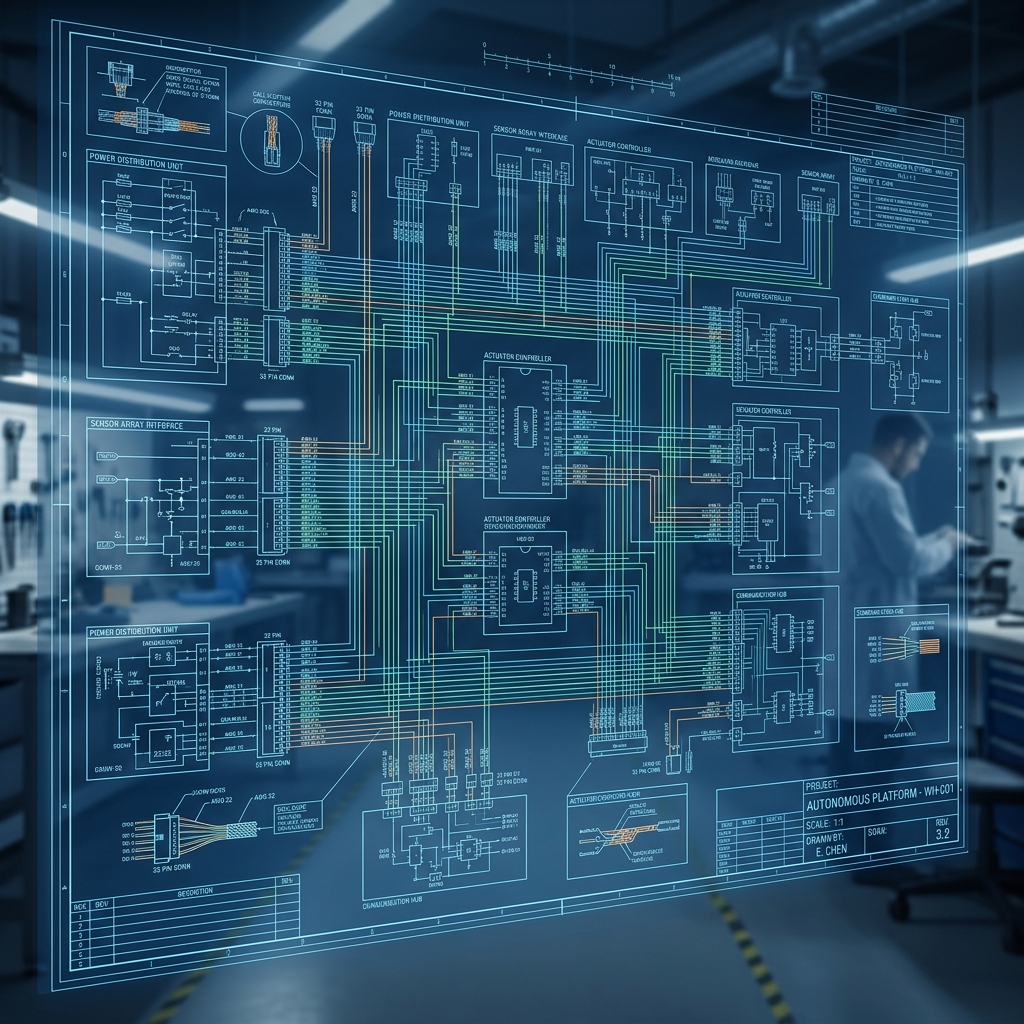
Generative Schematics is the process of delegating structural topology design directly to local model logic. Instead of manual drafting, the Sovereign Architect defines a set of high-level functional boundaries—such as terminal coordinates, signal impedance, voltage tolerances, and electromagnetic sensitivity zones. A specialized neural agent then synthesizes the physical schematics autonomously. It routes thousands of individual connections through a complex three-dimensional space, resolving mechanical interferences and signal bottlenecks in a fraction of a second. This is the leap from static drawing to autonomous topology synthesis.
By leveraging generative models, the physical structure of a wire harness is no longer a rigid constraint; it becomes a dynamic, self-optimizing system. The local engine analyzes mechanical 3D models (CAD step files) and programmatically outputs a complete wire list, connector placement coordinate map, and terminal crimp specifications. Human error is mathematically eliminated. The schematic is no longer a drawing; it is a compiled output of structural logic, optimized for weight reduction, signal integrity, and ease of assembly.
Drafting a wiring harness wire-by-wire in 2026 is as obsolete as writing binary machine code by hand. Let the model compute the routing matrix, optimize the spatial paths, and output an immutable manufacturing blueprint. Hardware is compiled code.
02. Mathematical Routing Logic: Decoupling Complexity via Graph Neural Networks
At its mathematical core, a complex wire harness is a three-dimensional graph. The connectors represent nodes, the wire segments represent edges, and the spatial constraints represent obstacles in Euclidean space. Routing thousands of wires through a complex chassis is a classic combinatorial optimization problem. Traditional pathfinding algorithms like Dijkstra's or A* quickly suffer from the "curse of dimensionality" when forced to compute routes for hundreds of independent signals simultaneously under multi-variable constraints. To overcome this, we deploy Graph Neural Networks (GNNs).
A Graph Neural Network can process the entire interconnected topology of a machine in parallel. The GNN models the physical relationships between wires, predicting electromagnetic coupling and structural stress before a single route is finalized. By utilizing Reinforcement Learning (RL) agents trained on structural datasets, the model learns to route wire trunks along optimized structural ridges, automatically bundling lower-current lines to serve as mechanical dampening matrices for high-speed differential signal cables. The complexity is decoupled from biological oversight.
Once the topological graph is established, local model logic optimizes the Gauge-to-Length Ratio of every individual conductor. The system automatically calculates the minimum wire gauge required for power transmission based on length, voltage drop, and ambient thermal conditions, while swapping out heavy copper cores for localized high-frequency fiber nodes when signal transit speed is critical. This dynamic weight-and-material optimization routinely reduces the weight of complex aerospace and automotive harnesses by up to 35% compared to human-drafted baselines.
03. Thermal and EMI Constraints in Autonomous Schematics
Physical environments are hostile to electricity. When current flows through a wire, it generates heat; when high-frequency signals travel through a conductor, they radiate electromagnetic energy. In a highly compact enclosure, such as an autonomous drone housing or a localized server array, these physical realities represent strict mathematical boundaries. An autonomous routing engine must treat Thermal and Electromagnetic Interference (EMI) as hard constraints within the loss function.
To mitigate thermal build-up, the generative schematics engine computes the Thermal Dissipation Index (TDI) for every proposed wire bundle. If a bundle contains too many high-current lines, the core temperature will rise, causing insulation degradation and eventual short-circuit. The generative algorithm dynamically shards high-current pathways, spreading them across the outer edges of the bundle to maximize heat transfer to the ambient air or chassis mounts. This ensures that the harness never enters a runaway thermal feedback loop.
Simultaneously, the model manages the electromagnetic spectrum. Using finite element simulation logic, the local model predicts capacitive and inductive crosstalk between adjacent wires. If a high-voltage power cable is routed too close to a CAN bus signal line, the model instantly flags the threat and implements spatial separation or inserts grounded shielding meshes. The physical schema is constructed as a self-shielding structure, using ground cables as natural electromagnetic barriers between signal clusters. The geometric layout itself serves as the noise-cancellation filter.
Do not rely on thick, heavy shielding sleeves to mask poor routing. Force the generative engine to route power and signal lines along orthogonal planes and mathematical thresholds. Real sovereignty is achieving absolute signal integrity through pure geometric design.
04. Local Intelligence Integration: Running Private Inference for Cable Optimization
To maintain absolute intellectual property control, the generative schematics engine must operate entirely within the Private Neural Fortress. Relying on centralized cloud-based AI tools to design proprietary hardware introduces unacceptable security vulnerabilities and latency. By deploying specialized local models running on dedicated local hardware, the Sovereign Architect compiles physical designs with zero cloud leakage.
A localized LLM, fine-tuned on specialized engineering documentation, acts as the natural language interface to the parametric router. The Architect describes the machine's functional requirements—for example: "Design a redundant 48V power routing matrix for 4 autonomous actuator nodes, minimizing wire length, keeping ambient temperature under 65°C, and separating signal telemetry from power lines." The local model parses this request, queries the local component database (Retrieval-Augmented Generation), selects the optimized connectors and wire gauges, and programmatically formats the routing parameters for the GNN optimizer.
This integration of local intelligence ensures that the entire engineering cycle remains unified and sovereign. The local model logic continuously audits the design against global standards (e.g., IPC-WH-620 for wire harness assembly). If a selected connector lacks sufficient vibration lock-mechanisms for the target structural zone, the local engine immediately flags the compliance failure, swaps the component for a military-grade terminal, and adjusts the schematic dynamically. The design completes in a closed-loop system.
| Design Phase | Biological/Legacy CAD Routing | Autonomous Generative Schematics |
|---|---|---|
| Iterative Latency | Days to weeks per routing change | Milliseconds to seconds (Real-time update) |
| Verification Model | Manual rule checks & physical prototyping | 100% automated GNN constraint validation |
| Spatial Optimization | Heuristic, approximate path matching | Optimal Euclidean pathing via graph math |
| Compliance Check | Subjective visual inspection by engineers | Strict programmatic auditing against standard databases |
05. Computational Simulation: Generative Cable Route Optimizer
To demonstrate how local model logic optimizes physical interconnections, the following Python script simulates a generative routing algorithm. It models a physical chassis grid, represents components as nodes, and routes cables autonomously while avoiding obstacles and minimizing total cable length under thermal constraints.
In this simulation, the algorithm does not select the shortest path blindly, which would route the cable dangerously close to the high-temperature heat zones. Instead, the model autonomously evaluates the thermal constraint and routes the harness branch around the hot zones, safeguarding the physical core while preserving a robust, zero-friction signal conduit.
06. The Sovereign Blueprint: Hardcoding Silicon-to-Copper Determinism
As the Sovereign Architect, you must realize that digital intelligence is only as reliable as the physical connections that transmit its intent. Mastering Generative Schematics is the final step in closing the loop between silicon intelligence and copper execution. By automating your interconnection designs within your private infrastructure, you decouple your hardware cycle from industrial monopolies, achieving ultimate speed, precision, and operational resilience.
In the next chapters of our Harness Engineering series, we will transition into the physical manufacturing layer—deconstructing the molecular physics of terminal crimping, structural isolation within hostile sub-sea and aerospace envelopes, and real-time telemetry diagnostics. Elevate your layouts, compile your connections, and master the physical conduits of your empire. Welcome to the Generative Epoch of Connection.
Treat physical connection topologies as compiled software code. Automate their generation, strictly validate their constraint parameters, and run the execution loop locally. Silicon commands, local model logic designs, and copper executes.
Do not rely on thick, heavy shielding sleeves to mask poor routing. Force the generative engine to route power and signal lines along orthogonal planes and mathematical thresholds. Real sovereignty is achieving absolute signal integrity through pure geometric design.
Treat physical connection topologies as compiled software code. Automate their generation, strictly validate their constraint parameters, and run the execution loop locally. Silicon commands, local model logic designs, and copper executes.


