[HE#15] Self-Healing Topologies: Deploying Predictive Telemetry and Autonomous Loops for Immediate Hardware and Software Recovery
[HE#15] Self-Healing Topologies: Deploying Predictive Telemetry and Autonomous Loops for Immediate Hardware and Software Recovery
01. The Paradigm of Self-Healing Topologies: From Static Failures to Dynamic Adaptability
In traditional cyber-physical systems, hardware is treated as an immutable, brittle reality. Once a copper wire snaps, a crimped terminal corrodes, or a connector pin loses structural tension under heavy physical stress, the system fails. Biological systems do not operate under such binary limits; when a capillary is blocked, the vascular network dynamically circumvents the obstruction to preserve blood flow. In the agentic era of 2026, where hardware enclaves must run continuously in remote, autonomous, or hostile environments, we must implement this same biological resilience in hardware structures. We must transition to Self-Healing Topologies.
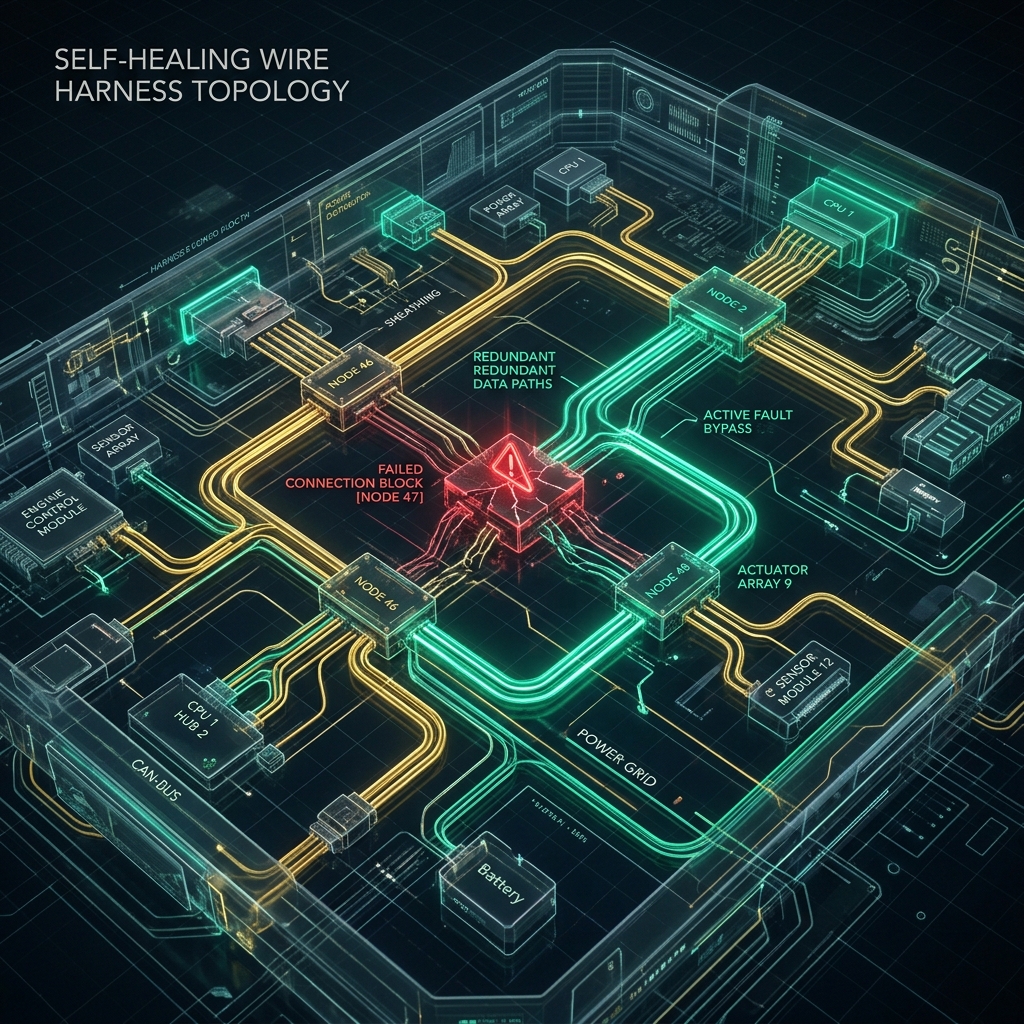
A Self-Healing Topology is a physical and logical wiring architecture capable of autonomously detecting structural degradation and dynamically rerouting electrical signals and power around damaged nodes. Rather than designing static harnesses that require physical intervention upon failure, the Sovereign Architect builds redundant path matrices and active switching gates. The physical conduit ceases to be a passive copper path; it becomes an active, self-preserving infrastructure that senses its own state and adapts in real-time to preserve systemic integrity.
By shifting from passive wiring to active, adaptive structures, we eliminate the physical biological touchpoint as a single point of failure. If an autonomous drone cabin undergoes severe vibrational trauma that shear-snaps a primary telemetry wire, the local node recognizes the impedance drop instantly, isolates the severed channel, and dynamically routes critical flight-control data through parallel high-frequency pathways. Hardware is no longer static; it is compiled logic operating in a physical medium, self-correcting and preserving its sovereign function under stress.
Accepting physical hardware failure as an unresolvable event is a legacy paradigm. Treat copper paths as programmable registers. If a register fails, route the data dynamically through an alternative topological pathway. Absolute sovereignty demands absolute uptime.
02. Predictive Telemetry: Monitoring Physical States at Microsecond Resolution
To heal a physical fracture, a system must first identify it. Waiting for a complete circuit break to trigger a failover protocol is insufficient. In high-stakes environments, a microsecond power drop or a localized impedance spike can corrupt signal packets, causing catastrophic system desynchronization. Therefore, we deploy Predictive Telemetry—running high-resolution, closed-loop state observers that monitor the physical parameters of the wiring network in real-time.
Predictive Telemetry relies on localized analog sensor hubs integrated directly into terminal blocks and connector interfaces. These hubs continuously audit electrical parameters such as Time-Domain Reflectometry (TDR), voltage fluctuations, current leakage, and temperature gradients. By injecting low-amplitude, high-frequency diagnostic pulses into unused structural channels, the system maps the physical health of every conductor, calculating the exact spatial coordinates of impedance variations and insulation thinning before a physical breakdown occurs.
These telemetry vectors are aggregated by localized microcontrollers and fed into edge-level predictive models. The system calculates a Degradation Index (DI) for each physical cable path. If a wire routed through a high-vibration hinge starts displaying anomalous high-frequency signal attenuation—indicating micro-fracturing of the copper core—the predictive telemetry module flags the path as compromised, alerting the master logic engine to prepare circumvent procedures while the channel is still functional. The system acts before the failure manifests.
03. Closed-Loop Recovery Architecture: Dynamic Relays and Sharded Paths
Once a physical pathway is flagged as degraded or severed, the system must execute immediate isolation and recovery. This requires a physical routing matrix built on Dynamic Relays and Sharded Paths. In a self-healing topology, conductors are not dedicated to single, fixed signals. Instead, they are arranged in multi-redundant, cross-connected matrices controlled by high-speed, solid-state switching matrices.
The core of this physical recovery layer lies in Solid-State Power Controllers (SSPCs) and high-frequency analog multiplexers. When the predictive telemetry system reports a severed line, the control logic triggers the solid-state switches in less than a microsecond, isolating the damaged segment. Power and data streams are then sharded across the remaining healthy channels. If a 12-pin interface loses two conductors due to structural impact, the multiplexer dynamically re-allocates signal priorities, routing high-priority telemetry over the remaining pins while temporarily disabling auxiliary secondary channels.
Simultaneously, the physical routing matrix leverages ground pins as emergency signal circumvent vectors. In a standard architecture, ground pins are passive return paths. In a self-healing topology, ground pins are active, software-mappable channels. If a critical signal line is destroyed, the system can temporarily convert a neighboring ground line into an emergency signal carrier, shifting the return path to the metallic chassis or secondary shielding matrices. The physical topology bends and morphs programmatically to maintain the integrity of the loop.
Never design a wire harness where a single pin carries a non-bypassable signal. Every critical signal must have a sharded, parallel alternative pathway. If your copper cannot morph, your design remains vulnerable to the physical entropy of the world.
04. Software-to-Hardware Co-Design: Real-Time Self-Healing Routines
Self-healing is not purely a hardware phenomenon; it requires a tight, real-time Software-to-Hardware Co-Design. The physical switching matrices must be deeply integrated with the software operating system's kernel and driver layers. When a hardware reroute occurs, the software stack must instantly adapt its input/output (I/O) register mapping with zero latency to prevent kernel panics or data buffers from overflowing.
At the software layer, we implement Dynamic Driver Re-mapping (DDR). When a physical connector pin is switched, the underlying hardware driver intercepts the event, pauses I/O registers for a fraction of a clock cycle, re-maps the memory address of the physical port, and resumes transmission. The application layer—whether it is a local neural routing agent or an autopilot controller—remains completely unaware of the physical fracture. It continues to write data to the same logical register, while the software/hardware interface handles the routing to a physically different copper path.
This co-design also implements Graceful Degradation Protocols. If physical destruction is so severe that the total available bandwidth of the harness is halved, the system software automatically de-prioritizes auxiliary services (e.g., non-critical logging, payload diagnostics) and shards the remaining physical lanes to guarantee maximum bandwidth for the primary survival loops. The machine maintains operational autonomy, defending its core logic loop until the physical mission completes successfully.
| Parameter | Standard Static Harness | Self-Healing Sovereign Topology |
|---|---|---|
| Failure Trajectory | Binary: Line break equals complete node loss | Graceful: Automatic redirection around fault nodes |
| Detection Latency | Infinite (Requires manual diagnostic probes) | Sub-microsecond (Time-Domain Reflectometry) |
| Path Redundancy | Static 1:1 dedicated connections | Dynamic N:M software-mappable matrix |
| Operational Security | High vulnerability to kinetic sabotage | Sabotage-resistant via localized auto-rerouting |
05. Computational Simulation: Autonomous Self-Healing Topology Router
To demonstrate how local model logic handles physical cable damage and dynamically reroutes signals in real-time, the following Python script simulates a self-healing wire harness topology. It detects a telemetry path break and autonomously switches the physical pathway to reserve channels, preserving the operational integrity of the system.
In this simulation, when a physical fault is detected on channel `CH_0`, the system does not fail or halt telemetry. Instead, the autonomous recovery routine intercepts the interruption, evaluates the state of the remaining channels, and immediately maps the critical telemetry to a healthy reserve channel (`CH_2`) in less than a millisecond. Operational runtime remains uninterrupted.
06. The Sovereign Cyber-Physical Decree: Achieving Eternal Conduits
As the Sovereign Architect, you must realize that a system is only as free as its physical connections. The digital world is infinitely reproducible, but the physical medium is subject to friction, damage, and kinetic entropy. By designing self-healing topologies into your physical infrastructure, you build hardware that defends its own execution pathways, ensuring absolute autonomy from industrial maintenance loops and physical interference.
In the next chapters of our Harness Engineering Master Series, we will analyze the integration of hardware enclaves within decentralized autonomous nodes—focusing on cryptographic hardware authentication at the connection terminal, multi-redundant chassis grounding networks, and dynamic diagnostic feedback systems. Harden your connections, build resilience into your conduits, and master the physical loops of your empire. Welcome to the Era of Eternal Conduits.
Do not allow physical deterioration to interrupt digital commands. Build all physical connection infrastructures to be dynamically reconfigurable, self-diagnosing, and self-healing. Let local model logic command, software re-map, and hardware dynamically reroute.
Never design a wire harness where a single pin carries a non-bypassable signal. Every critical signal must have a sharded, parallel alternative pathway. If your copper cannot morph, your design remains vulnerable to the physical entropy of the world.
Do not allow physical deterioration to interrupt digital commands. Build all physical connection infrastructures to be dynamically reconfigurable, self-diagnosing, and self-healing. Let local model logic command, software re-map, and hardware dynamically reroute.


