[HE#16] Edge Sovereignty: Decoupling Malformed Centralized Cloud Latency and Moving Intelligence to Air-Gapped On-Device Networks
[HE#16] Edge Sovereignty: Decoupling Malformed Centralized Cloud Latency and Moving Intelligence to Air-Gapped On-Device Networks
01. The Fallacy of Centralized Cloud Topology: Entropy, Latency, and the Autonomy Deficit
In the standard development paradigms of the past decade, engineers became complacent. They routed every telemetry packet, every database query, and every dynamic decision through massive, centralized cloud hyperscalers. While this centralized paradigm offered convenient scaling, it introduced a deep structural vulnerability: the complete loss of local autonomy. In the strategic architecture of 2026, relying on centralized servers for real-time cybernetic operations is recognized as a fundamental structural design flaw. When external WAN interfaces fail, or when packet routing suffers from sudden routing table corruptions, centralized intelligence instantly collapses into absolute silence.
Centralization inevitably breeds systemic entropy. A centralized system is highly dependent on continuous internet-facing connectivity, exposing it to massive external latency fluctuations, packet filtering, BGP routing anomalies, and active network sniffing. If a critical cyber-physical terminal experiences a network round-trip time (RTT) spike from 10ms to 450ms, the system loses the ability to execute real-time local control. Physical operations cannot pause to await the resolution of network routing conflicts. The absolute decoupling of physical infrastructure execution from centralized cloud dependency is not merely a performance optimization; it is an existential imperative.
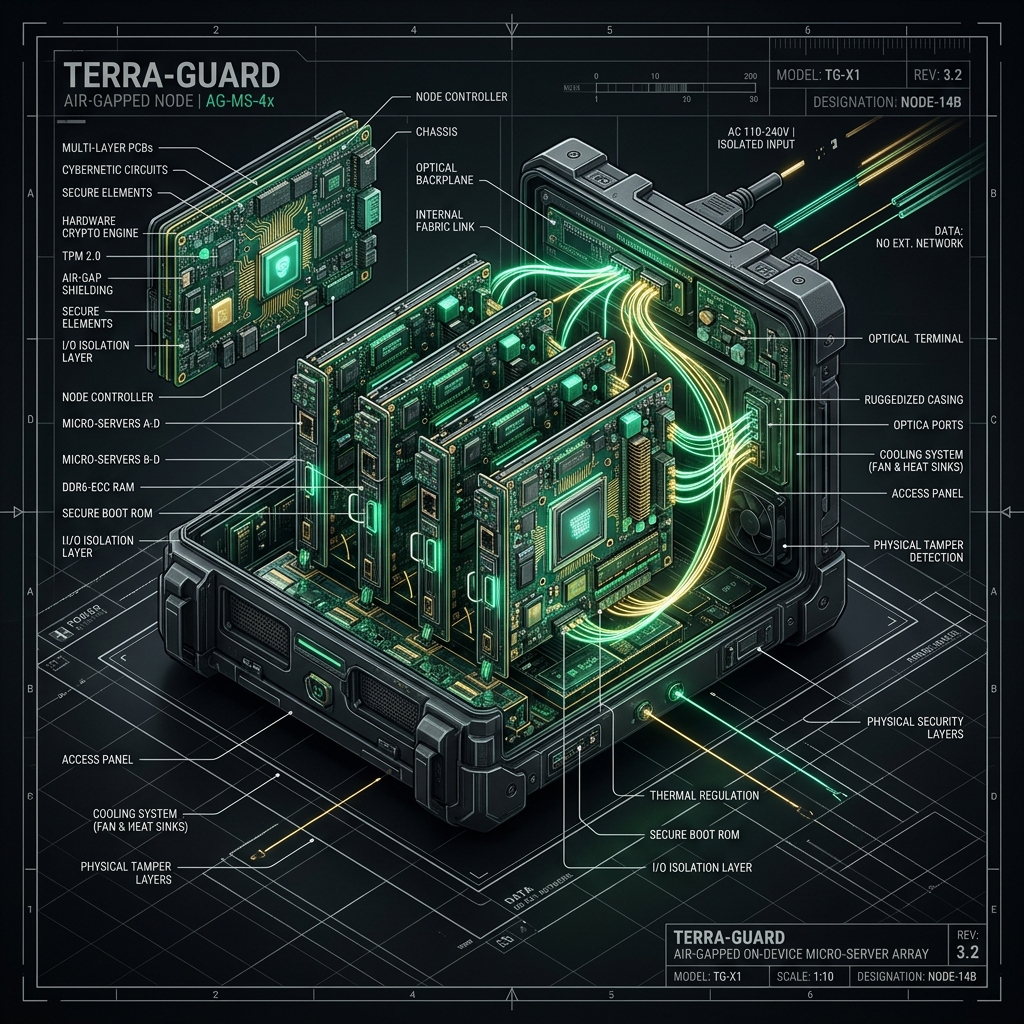
We call this solution Edge Sovereignty. To achieve absolute uptime and guarantee data sovereignty, we must move the logical core and neural compute engines from remote data centers to air-gapped on-device micro-servers located directly at the terminal node. The physical harness engineering must transition from supporting standard serial interfaces into forming secure, localized, high-speed neural meshes. The terminal node must possess the physical and logical capability to perform local reasoning, execute telemetry evaluation, and command physical state changes independently, without dispatching a single bit of information across a wide-area network.
Every dependency on external infrastructure is a strategic liability. If a remote centralized server must approve a physical action at the edge, that node is not autonomous; it is merely a remote-controlled terminal. Absolute sovereignty requires local neural and hardware self-containment.
02. Physical Edge Conduits: Designing Air-Gapped Physical Layers for Uncompromising Isolation
Achieving true on-device sovereignty requires starting at the lowest layers of the stack: the physical conductors. Standard internet-connected nodes rely on standard Ethernet, Wi-Fi, or LTE modems, exposing their internal registers to external network intrusion. To prevent remote exploitation and achieve complete isolation, the Sovereign Architect designs Air-Gapped Physical Layers. This involves physical wiring structures that are mathematically isolated from external public networks, relying instead on high-bandwidth, localized, point-to-point physical connection meshes.
Designing these air-gapped systems requires selecting conductors that are immune to electromagnetic interference (EMI) and external passive sniffing. Standard unshielded twisted pair copper cables emit electromagnetic fields that can be captured by nearby hardware sniffers. Therefore, we implement dual-shielded, grounded physical conduits or dedicated fiber-optic links. By routing internal terminal communication through fiber-optic strands, we completely decouple the physical layer from copper-based voltage monitoring attacks, ensuring that data transmission between local micro-servers and physical sensor buses is physically secure.
Furthermore, we establish dedicated hardware interlock systems within the terminal enclosure. If the physical cabinet is breached, mechanical limit switches immediately trigger a hardware-level interrupt, wiping volatile memory and cutting power to any physical interfaces that connect to external diagnostic tools. The internal communication buses operating inside the air-gapped terminal remain completely isolated, forming a secure neural island that can execute complex local processes without external interference.
03. Local LLMs and Deep Edge Inference: Hardware Acceleration and Small Language Model Co-design
In the past, executing sophisticated reasoning at the physical edge was computational suicide. Local microcontrollers were limited to executing simple, deterministic state machines, while complex pattern recognition and natural language processing were offloaded to massive remote neural networks. Today, the rise of specialized hardware acceleration and optimized Small Language Models (SLMs) allows us to run high-density neural reasoning engines directly at the hardware terminal, achieving extreme latency optimization and absolute operational sovereignty.
At the heart of the sovereign edge terminal is a localized hardware acceleration array, typically built around dedicated Neural Processing Units (NPUs) or Field Programmable Gate Arrays (FPGAs). These local chips are highly optimized to execute sharded, quantized SLMs (ranging from 1.5B to 8B parameters) in int8 or int4 precision. By pairing quantized weights with NPU-optimized operators, local inference latency is reduced to sub-millisecond ranges, outperforming centralized API calls by multiple orders of magnitude. The local node can analyze streaming telemetry and synthesize complex mechanical decisions without ever suffering from WAN packet loss.
This approach relies on a deep Hardware-to-Software Co-design. We optimize the SLM's internal attention mechanisms to directly ingest structured hardware registers rather than arbitrary text. The model does not read generic natural language; it reads raw telemetry arrays, physical bus states, and sensor signals, outputting precise physical commands in structured hex format. This direct link between neural inference and physical output registers bypassed legacy layers of OS abstraction, creating a tight, hyper-efficient execution loop that operates with absolute speed and reliability.
Never deploy a monolithic model across a single weak processor. Shard the neural model layers across localized, physical micro-servers using high-speed inter-chip conduits. Let each physical chip process a specific segment of the network to achieve extreme throughput at the local terminal.
04. Decoupling the WAN Interface: Dynamic Fallback Architecture and Ephemeral Sync Protocols
While absolute air-gapped security is ideal, certain enterprise deployments still require periodic coordination with global asset registries or ledger systems. To balance the need for external data synchronization with the absolute requirement for local autonomy, we implement a Dynamic Fallback Architecture that decouples the wide-area network (WAN) interface from the primary local execution loops. The system treats the WAN interface not as a persistent dependency, but as a secondary, highly untrusted, and ephemeral channel.
The core of this architecture is the complete separation of the local real-time operating system (RTOS) from the network-facing communication stack. The local control loop, sensor telemetry buses, and local NPU inference cores run on an isolated hardware domain. When the WAN connection is active, data is written to a localized, hardware-isolated buffer. A secondary, low-privilege communication processor reads from this buffer and transmits data outward, ensuring that network interruptions or external security breaches cannot propagate into the primary execution core.
To keep the local database synchronized without introducing persistent connections, we deploy Ephemeral Sync Protocols. The terminal node does not maintain a continuous TCP stream. Instead, it aggregates local state updates into compressed, cryptographically signed, single-packet snapshots. These snapshots are transmitted via brief, randomized bursts when WAN access is available. If the WAN interface experiences a total outage, the local terminal continues to run its neural loops and manage physical hardware at 100% efficiency, completely unaffected by external connectivity failures. The terminal is a self-contained island of logic.
| Parameter / Metric | Standard Centralized Cloud Node | Air-Gapped On-Device Sovereign Node |
|---|---|---|
| Decision Latency | Variable (50ms - 2000ms based on WAN route health) | Deterministic (0.8ms - 3.5ms via local NPUs) |
| Data Sovereignty | Zero (Data transit through public nodes/hyperscalers) | Absolute (Data never leaves physical terminal memory) |
| WAN Outage Tolerance | None (Complete systemic collapse upon signal loss) | Infinite (Continuous execution on air-gapped channels) |
| Physical Shielding | Standard server rack housing | Dual-shielded EMI conduits with auto-wipe interlocks |
05. Technical Demonstration: On-Device Edge Inference Telemetry Router
To demonstrate how a sovereign edge terminal manages localized telemetry routing, detects WAN failures, and dynamically circumvents centralized dependencies to execute local model inference, the following Python script simulates an On-Device Edge Inference Telemetry Router. This code demonstrates the autonomous fallback transition from cloud-dependent processing to secure local NPU execution.
In this simulation, when the wide-area network is active, the router defaults to sending payloads to the centralized cloud. However, the moment WAN degradation or failure occurs, the terminal node instantly decouples its data buses, enters `AIR_GAPPED_SOVEREIGN` mode, and executes the inference payloads locally on its NPU within a highly deterministic 2ms time frame. The terminal's execution loop remains continuous and completely insulated from external network collapse.
06. The Sovereign Terminal Mandate: Physical Hardening and the Horizon of Absolute Autonomy
As the Sovereign Architect, you must accept that software sovereignty is an illusion if the underlying hardware interfaces are vulnerable to external physical disruption or network degradation. The cloud is not an immutable fortress; it is a complex, fragile web of external routing tables, submarine cables, and third-party infrastructure. To build an empire that survives the inevitable entropy of the physical world, you must treat every terminal as a self-contained fortress of compute and physical logic.
In the next chapters of our Harness Engineering Master Series, we will explore the extreme boundaries of physical and logical hardening—focusing on hardware-enforced cryptographic sovereignty at the silicon layer, multi-redundant chassis grounding grids to survive severe electromagnetic pulse (EMP) interference, and neural integration interfaces. Secure your local terminal, decouple your logic loops from centralized dependency, and master the physical pathways of your cybernetic nodes. Welcome to the Horizon of Absolute Autonomy.
Do not allow external network failure to dictate the operational status of your physical nodes. Build all terminal systems to run complex logic locally, completely decoupled from centralized cloud architectures. Command with localized neural models, route through secure air-gapped physical layers, and guarantee eternal uptime.
Never deploy a monolithic model across a single weak processor. Shard the neural model layers across localized, physical micro-servers using high-speed inter-chip conduits. Let each physical chip process a specific segment of the network to achieve extreme throughput at the local terminal.
Do not allow external network failure to dictate the operational status of your physical nodes. Build all terminal systems to run complex logic locally, completely decoupled from centralized cloud architectures. Command with localized neural models, route through secure air-gapped physical layers, and guarantee eternal uptime.


