[HE#17] Immutable Hardening: Hardware-Enforced Cryptographic Sovereignty and Sealing Intelligence Nodes at the Silicon Layer
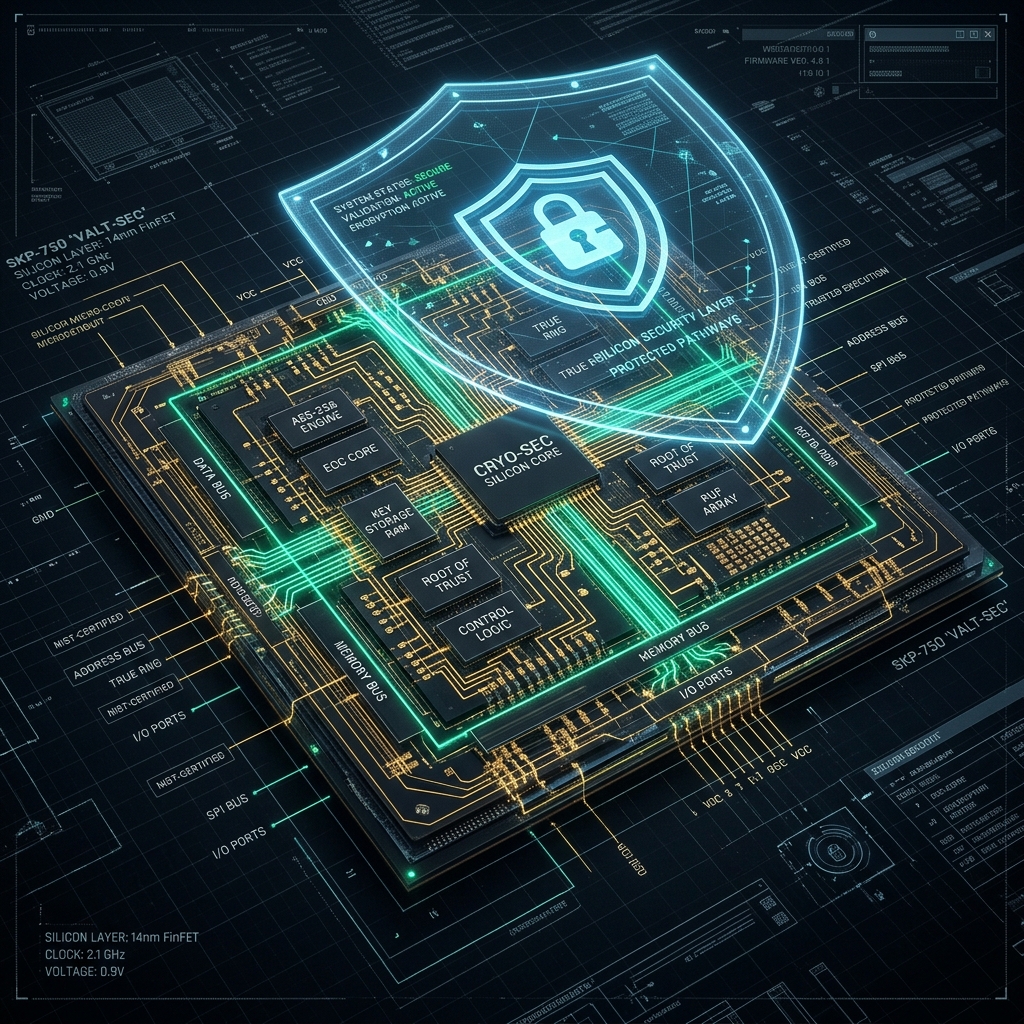
[HE#17] Immutable Hardening: Hardware-Enforced Cryptographic Sovereignty and Sealing Intelligence Nodes at the Silicon Layer
01. The Vulnerability of Soft Trust: Why Logic-Layer Encryption Fails Against Physical Probing
For decades, enterprise security architects focused entirely on software-level defense. They implemented advanced hypervisors, complex kernel access controls, and software-based public key infrastructures (PKI) to defend data in transit and at rest. However, this soft trust paradigm carries a fatal design vulnerability: it assumes the physical medium remains untampered and uncompromised. In the contested cyber-physical landscapes of 2026, where remote hardware enclaves and edge intelligence terminals must operate in completely untrusted physical environments, soft trust is a dangerous illusion. If an adversary gains physical possession of a node, software encryption keys can be extracted directly from physical memories.
Physical access negates all logical guardrails. An attacker equipped with high-resolution oscilloscope probes, micro-probing needles, or localized laser-fault injection tools can circumvent operating system permissions. By measuring the electromagnetic emissions, monitoring the power supply lines, or tapping into the serial communications between the CPU and the memory chips, the attacker can reconstruct raw private keys and steal sensitive model weights. Software-level firewalls cannot prevent a physical probe from reading the raw voltages representing private keys on a memory bus. Decoupling computational authority from physical vulnerability requires hardening at the silicon layer.
This structural hardening is what we call Immutable Hardening. We must transition from passive shielding and software-level certificates to hardware-enforced cryptographic boundaries. Every terminal node must contain an active hardware enclave rooted at the silicon layer, capable of executing critical cryptographic operations inside physically isolated computational boundaries. The wiring harness and circuit interfaces must cease to be passive signal paths; they must become active participants in physical security, defending the terminal logic against physical intrusion and unauthorized side-channel monitoring.
Any cryptographic key stored in standard flash memory or managed by standard operating system kernels is inherently compromised under physical possession. Absolute security demands that keys must be generated, used, and stored strictly within isolated silicon boundaries, with hardware-enforced self-destruction.
02. Silicon Root of Trust (RoT): Embedding Cryptographic Keys in Immutable Hardware Enclaves
To establish a foundation of immutable security, we must anchor our system's identity at the silicon layer using a Silicon Root of Trust (RoT). A Silicon RoT is a dedicated, physically isolated cryptographic coprocessor embedded directly into the micro-architecture of our terminal nodes. Unlike standard CPUs that execute generic instruction sets, the Silicon RoT is hard-coded to execute only highly audited cryptographic algorithms, using dedicated hardware registers that are completely invisible to the host operating system's memory spaces.
The core of this silicon-level identity lies in Physical Unclonable Functions (PUFs). Rather than storing static private keys in non-volatile memory—which can be extracted via physical scanning—a PUF utilizes microscopic, random variations in the silicon chip's manufacturing process to generate a unique, cryptographic fingerprint. This fingerprint acts as a hardware-rooted private key that is only generated dynamically when the chip is powered on and executing secure operations. Because the key is never stored statically on disk, it ceases to exist when power is cut, making physical extraction via silicon-layer microscopy mathematically impossible.
This hardware-enforced isolation ensures that even if the host operating system is completely compromised by malicious root exploits, the private keys and cryptographic credentials remain sealed inside the enclave. The main application processor must dispatch cryptographic requests to the Silicon RoT via secure, hardware-rate-limited mailbox registers. The private key never leaves the secure boundaries of the enclave, ensuring that the terminal's identity and communication links remain immutable, secure, and physically unprobeable.
03. Physical Sniffing Defense: Active Shielding and Differential Power Analysis (DPA) Mitigation
Physical attacks do not always require kinetic intrusion or drilling into silicon. Sophisticated adversaries deploy non-invasive side-channel attacks, such as Differential Power Analysis (DPA) and electromagnetic analysis. When a cryptographic processor executes a modular exponentiation or scalar multiplication to sign a telemetry packet, it draws minute, varying levels of electrical current. By capturing these current fluctuations using high-frequency current clamps, or by monitoring localized electromagnetic emissions (EM) using near-field probes, an attacker can reconstruct the private key without leaving a single trace of physical entry.
To defend against these side-channel vectors, we implement Active Shielding and hardware-enforced DPA mitigations. Active Shielding involves wrapping the cryptographic enclave and high-speed communication lines in dedicated, multi-layered active metallic grids. These grids continuously carry high-frequency, pseudo-random signal noise. Any attempt to place a passive sniffer probe against the cable shield disrupts the capacitance of the grid, instantly triggering a physical-layer tamper interrupt. The signal path is physically defended by the active grid itself, scrambling any external side-channel capture attempts.
At the silicon level, we deploy active current-masking circuits and dual-rail logic designs. The hardware coprocessor continuously draws a flat, constant power level, using internal dummy load capacitors to mask any variations in compute draw. By decoupling the chip's electrical signature from its mathematical executions, we render Differential Power Analysis mathematically useless. The electromagnetic and current footprints of the chip appear as uniform, flat white noise, completely blinding the adversary's sniffing gear and preserving the sovereignty of the cryptographic core.
Never route cryptographic keys or decrypted model outputs across exposed motherboard buses. Every interface between the cryptographic enclave and external NPUs must be dynamically encrypted at the hardware level using ephemeral keys. If a bus trace is probed, the adversary must capture nothing but encrypted entropy.
04. Active Tampering Countermeasures: Active Grid Enclosures and Hardware-Rooted Zeroization
In high-threat environments, kinetic intrusion is a realistic threat. Adversaries will attempt to drill into the secure enclosure, freeze the RAM chips using liquid cooling spray to preserve volatile states (a cold-boot attack), or de-lid the silicon package to probe the bare die directly. To defend against kinetic compromise, the Sovereign Architect builds a multi-tiered Active Tampering Countermeasure framework that triggers immediate self-destruction of sensitive states upon physical breach.
We wrap the entire compute module in an Active Grid Enclosure. This is an advanced, multi-layer outer membrane constructed with interleaved conductive polymer traces. The terminal's security controller continuously measures the electrical resistance, capacitance, and impedance of these traces at microsecond intervals. If an attacker drills a hole, applies pressure, or freezes the membrane, the physical impedance of the traces shifts beyond a strict tolerance threshold. The analog sensor hub registers this variance instantly, interpreting it as an active physical invasion.
The moment a tamper event is detected, the hardware security controller triggers Hardware-Rooted Zeroization. Rather than executing a slow, software-based delete command—which can be aborted by cutting power—the security controller triggers a dedicated analog switch that discharges high-voltage capacitors directly into the secure key registers and volatile memory banks. This instantly wipes all volatile states, purges the PUF activation paths, and physically burns the secure key storage registers. The node renders itself completely useless in a fraction of a millisecond, leaving the attacker with nothing but useless, inert silicon.
| Parameter / Metric | Standard Logic-Layer Encryption | Immutable Hardware-Enforced Sovereignty |
|---|---|---|
| Trust Anchor | Software kernel, OS certificates, standard flash | Silicon-rooted PUFs and dedicated isolated coprocessors |
| Side-Channel Immunity | None (Vulnerable to Differential Power Analysis) | Absolute (Active current-masking and EM noise grids) |
| Physical Tamper Action | Passive (Relies on remote server monitoring) | Active (Microsecond zeroization via capacitor discharge) |
| Key Lifetime | Persistent (Stored on disk or flash sectors) | Ephemeral (Generated via PUF only during compute cycle) |
05. Technical Demonstration: Immutable Hardware Cryptographic Signature and Tamper Simulator
To demonstrate how a sovereign hardware security controller manages on-device key derivation, validates digital signatures inside an isolated enclave, and executes immediate zeroization upon detecting physical tampering, the following Python script simulates an Immutable Hardware Cryptographic Signature & Tamper Simulator.
In this simulation, the secure enclave derives its cryptographic key dynamically from a simulated silicon PUF fingerprint. Under normal operations, it signs telemetry payloads securely. However, the moment a physical probe contacts the active shield grid—causing the shield voltage to drop—the active monitoring routine instantly intercepts the anomaly and triggers hardware zeroization. The keys are completely overwritten with zeros and the vault data is destroyed in less than a millisecond, leaving the adversary with an inert and useless silicon chip.
06. The Sovereign Silicon Decree: Safeguarding the Physical Boundary of Computational Authority
As the Sovereign Architect, you must realize that every computational system exists in a physical medium. The digital logical layers are secondary construct structures; they are utterly dependent on the physical integrity of the copper lanes, the silicon gates, and the electrical power lines that feed them. By hardening your physical boundaries at the silicon layer, you defend the ultimate boundary of your system's sovereignty, guaranteeing that your computations remain immutable, untampered, and eternally under your command.
In the next chapters of our Harness Engineering Master Series, we will analyze the integration of neural networks with physical brain-machine interfaces (BCI)—focusing on neural signal integrity, sharded connection topologies, and localized diagnostic telemetry loops. Harden your silicon, wrap your enclaves in active grids, and master the physical boundaries of your computational empire. Welcome to the Era of Sovereign Silicon.
Do not allow physical proximity to compromise digital sovereignty. Anchor every identity at the silicon layer using PUFs and hardware enclaves. Defend all pathways with active shields, scramble power profiles to neutralize DPA, and build all systems to zeroize instantly upon physical intrusion.
Never route cryptographic keys or decrypted model outputs across exposed motherboard buses. Every interface between the cryptographic enclave and external NPUs must be dynamically encrypted at the hardware level using ephemeral keys. If a bus trace is probed, the adversary must capture nothing but encrypted entropy.
Do not allow physical proximity to compromise digital sovereignty. Anchor every identity at the silicon layer using PUFs and hardware enclaves. Defend all pathways with active shields, scramble power profiles to neutralize DPA, and build all systems to zeroize instantly upon physical intrusion.


