[HE#21] E/E Architecture Scaling: 48V Power Distribution and Physical Harness Hardening
[HE#21] E/E Architecture Scaling: 48V Power Distribution and Physical Harness Hardening
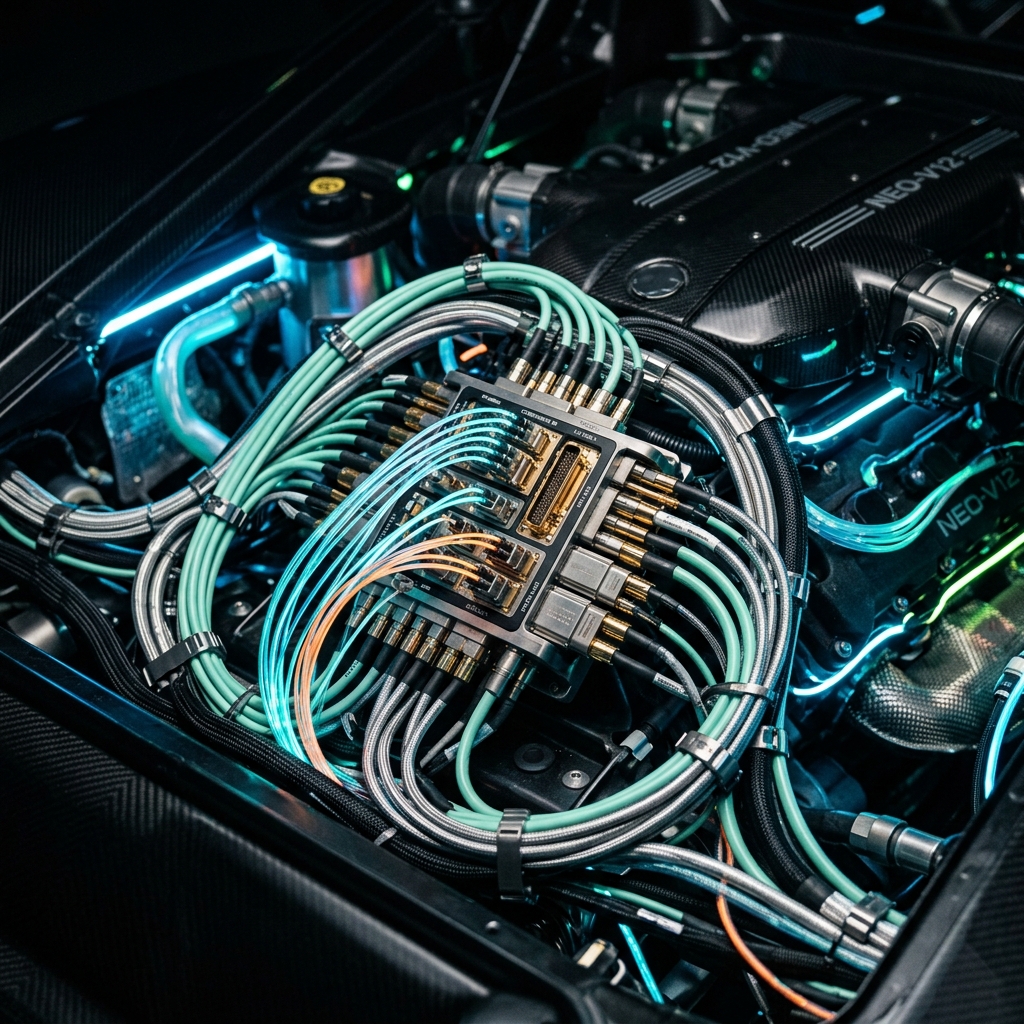
01. Macro Strategy: Physical Saturation and Copper Constraints
"Material efficiency is the first pillar of operational autonomy. Reducing wire harness copper volume by 70% lowers direct material costs, insulates the supply chain from commodity shocks, and improves system-level dynamics."
The escalating complexity of modern electronic and autonomous systems has pushed traditional 12V electrical architectures to their physical limits. Historically, electrical distribution systems have relied on increasing copper cross-sections to support growing current requirements. However, this brute-force approach has resulted in thick, heavy, and complex wire harnesses that saturate physical routing paths and compromise system-level efficiency. In autonomous transport, aerospace, and remote defense systems, every gram of additional copper directly reduces the operational range, cargo payload capacity, and overall thermodynamic efficiency.
To understand the magnitude of this problem, we must analyze the legacy of the 12V standard. Adopted in the mid-20th century to replace 6V electrical systems, the 12V standard was designed for systems with simple lighting, basic starter motors, and negligible logic processing. Today, an autonomous vehicle or robotic system must power LiDAR sensors, radar units, drive-by-wire actuators, high-performance GPU inference engines, and active cooling pumps. Running these power-hungry components at 12V requires hundreds of amperes of current. To transmit this current without melting the insulation, conductors must grow to massive cross-sections.
The global raw materials market presents another strategic challenge. Copper prices have experienced intense volatility driven by supply chain constraints, mining depletion, and geopolitical competition for mineral resources. Relying on heavy copper-laden wire harnesses introduces significant material risk and exposes hardware manufacturing to severe price swings. The sovereign hardware designer must prioritize weight reduction and material efficiency, moving away from 12V architectures toward 48V power distribution networks. By shifting the E/E schematic to 48V, we establish a lean, highly efficient hardware foundation that is insulated from commodity market volatility.
Transitioning to 48V is not simply an incremental step; it represents a major structural shift in Electrical/Electronic (E/E) design. By quadrupling the distribution voltage, the current required to deliver a given amount of power is reduced by 75%. According to Ohm's and Joule's laws, this drop in current yields a 93.75% reduction in resistive power losses within the conductor, assuming equal wire gauge. This efficiency gain allows engineers to reduce wire cross-sections dramatically, freeing up physical space and streamlining manufacturing complexity.
Material efficiency is the first pillar of operational autonomy. Reducing wire harness copper volume by 70% lowers direct material costs, insulates the supply chain from commodity shocks, and improves system-level dynamics across every performance metric.
02. Deep Protocol: E/E Integration Architecture
"A single-point star ground topology prevents ground loops. Return currents flowing through a shared chassis ground can cause localized voltage offsets that corrupt data on sensitive logic buses."
Implementing a 48V distribution network requires a clear partitioning of the system's electrical architecture. A major design challenge is managing high-voltage transients and preventing EMI noise from coupling into adjacent low-voltage communication lines, such as CAN, LIN, or Automotive Ethernet. High-voltage switching transients create electromagnetic fields that easily disrupt sensitive digital logic if they are not isolated through physical separation and careful grounding.
To prevent EMI coupling, the wire harness design must maintain strict physical separation. High-power 48V lines and low-voltage signal lines should run in isolated bundles, keeping a minimum physical gap of 50mm wherever possible. When these lines must cross, they should cross at right angles (90 degrees) to minimize inductive loop area. Additionally, all low-voltage signal pairs must be twisted-pair configurations to cancel out external electromagnetic noise. This geometric layout reduces crosstalk and prevents data errors on the communication bus.
Grounding must also follow a single-point topology to prevent ground loops. In high-power distribution systems, return currents flowing through a shared chassis ground can cause localized voltage offsets. This ground offset degrades signal integrity for low-voltage sensors. By running dedicated return wires for high-current loads back to a central star ground point, you keep the signal reference ground clean and prevent transient noise from corrupting data. The star ground point acts as an absolute zero-voltage reference, isolating sensitive logic from the massive return currents of the actuators.
Furthermore, we must address local dielectric breakdown risks. As voltage rises, the dielectric stress on cable insulation and connector interfaces increases. Standard PVC wire jackets, which perform adequately at 12V, are prone to accelerated degradation under thermal stress in 48V systems. We must specify cross-linked polyethylene (XLPE) or fluoropolymer (ETFE) insulation. These materials provide superior dielectric strength, higher thermal limits, and thinner profiles, allowing us to reduce the outer diameter of the wire bundles even further while maintaining absolute electrical isolation.
| Parameter | 12V Architecture | 48V Architecture | Design Requirement |
|---|---|---|---|
| Current (for 1.2kW load) | 100 Amps | 25 Amps | 75% current reduction |
| Conductor Size (Typical) | 25 mm² (4 AWG) | 2.5 mm² (14 AWG) | Significant cross-section reduction |
| Harness Weight (Avg.) | 45 kg | 13.5 kg | Up to 70% weight savings |
| Minimum Signal Spacing | 10 mm | 50 mm | Enhanced physical isolation |
03. Technical Implementation: Copper Sizing and Thermal Optimization
"The sizing engine evaluates wire gauge against target voltage drop limits (3% for power lines) and limits core conductor temperatures to safe thresholds based on insulation ratings — preventing catastrophic thermal failure."
Here is the technical sizing engine for wire harness designers. This Python script uses physical parameters — such as ambient temperature, copper resistivity, current load, and length — to calculate the expected voltage drop and thermal rise. It then recommends the minimum wire gauge (AWG) to maintain stable power delivery and safety margins.
This utility evaluates wire sizing against target voltage drop limits (typically 3% for power lines) and limits core conductor temperatures to safe thresholds based on insulation ratings (such as 105 degrees Celsius for standard XLPE jacketing). In addition to steady-state calculations, the engine models transient thermal behavior, ensuring the conductor can handle peak startup currents without exceeding safe thermal thresholds.
# -*- coding: utf-8 -*-
# BRAVOECONOMY HARNESS DIMENSIONER ENGINE V1.0
import math
import logging
from typing import Dict, Tuple

logging.basicConfig(level=logging.INFO, format='%(asctime)s [%(levelname)s] %(message)s')
logger = logging.getLogger("HarnessDimensioner")

AWG_TABLE = {
    4:  {"area": 21.15, "resistance": 0.8152},
    6:  {"area": 13.30, "resistance": 1.296},
    8:  {"area": 8.367, "resistance": 2.061},
    10: {"area": 5.261, "resistance": 3.277},
    12: {"area": 3.309, "resistance": 5.211},
    14: {"area": 2.081, "resistance": 8.286},
    16: {"area": 1.309, "resistance": 13.17},
    18: {"area": 0.823, "resistance": 20.95},
    20: {"area": 0.518, "resistance": 33.31}
}

class HarnessDimensioner:
    def __init__(self, target_voltage: float = 48.0, max_voltage_drop_pct: float = 3.0):
        self.target_voltage = target_voltage
        self.max_drop_limit = target_voltage * (max_voltage_drop_pct / 100.0)
        self.copper_temp_coeff = 0.00393

    def calculate_metrics(self, current: float, length_m: float, awg: int, ambient_temp: float = 25.0) -> Dict[str, float]:
        spec = AWG_TABLE[awg]
        base_res = spec["resistance"] * (length_m / 1000.0)
        adjusted_res = base_res * (1 + self.copper_temp_coeff * (ambient_temp - 20.0))
        voltage_drop = current * adjusted_res
        power_loss = (current ** 2) * adjusted_res
        thermal_resistance = 18.5
        temp_rise = power_loss * (thermal_resistance / length_m)
        final_temp = ambient_temp + temp_rise
        return {
            "awg": float(awg),
            "voltage_drop": round(voltage_drop, 4),
            "power_loss_watts": round(power_loss, 4),
            "final_temperature": round(final_temp, 2),
            "is_valid_drop": float(voltage_drop <= self.max_drop_limit),
            "is_valid_temp": float(final_temp <= 105.0)
        }

    def recommend_gauge(self, current: float, length_m: float, ambient_temp: float = 25.0) -> Tuple[int, Dict]:
        for awg in sorted(AWG_TABLE.keys(), reverse=True):
            metrics = self.calculate_metrics(current, length_m, awg, ambient_temp)
            if metrics["is_valid_drop"] and metrics["is_valid_temp"]:
                return awg, metrics
        return 4, self.calculate_metrics(current, length_m, 4, ambient_temp)

def main():
    dimensioner = HarnessDimensioner(target_voltage=48.0, max_voltage_drop_pct=3.0)
    current_load = 25.0  # 1.2 kW at 48V
    harness_length = 4.5  # 4.5 meters
    awg, report = dimensioner.recommend_gauge(current_load, harness_length)
    logger.info(f"[+] Sizing Complete: {current_load}A over {harness_length}m at 48V")
    logger.info(f"    - Recommended Gauge: {awg} AWG")
    logger.info(f"    - Voltage Drop: {report['voltage_drop']} V (Limit: {dimensioner.max_drop_limit} V)")
    logger.info(f"    - Core Temp: {report['final_temperature']} C (Limit: 105.0 C)")
    logger.info(f"    - Transmission Loss: {report['power_loss_watts']} Watts")

if __name__ == "__main__":
    main()
This sizing logic prevents over-engineering and keeps wire harness weights minimal. Using a programmatic sizing tool allows designers to optimize every line in the E/E schematic, ensuring optimal copper utilization while maintaining safe thermal margins. The script accounts for the temperature coefficient of copper resistance — as a conductor heats up, its resistance rises, which increases the voltage drop. By modeling this thermal-resistance feedback loop, calculations remain accurate under sustained high-load conditions.
04. Jurisdictional Layer: Global Industrial Standards Compliance
"Ensure all high-voltage terminals are certified to LV 148 standards, and isolate logic circuits using galvanic isolation barriers rated for at least 500VDC to prevent transient damage across the board."
Deploying high-power electrical distribution systems requires compliance with global safety and electromagnetic compatibility (EMC) standards. These regulations dictate electrical isolation, dielectric strength, and thermal margins across different jurisdictions.
In Europe, the primary standards are the LV 124 and LV 148 testing directives. These standards define the environmental, electrical, and mechanical stress tests that automotive E/E components must pass, specifically covering electrical transients and short-circuit conditions on 48V power lines. Additionally, compliance with ISO 26262 is mandatory for safety-critical systems, requiring strict Functional Safety (ASIL) ratings for battery management, power switching, and path isolation.
In North America, standards like USCAR-2 for RF connector reliability and FMVSS guidelines govern physical harness safety. To manage regulatory risk, the sovereign hardware designer must utilize certified component footprints and design isolation boundaries to meet these standards. This ensures the system remains compliant in key markets while maintaining functional autonomy.
Furthermore, we must monitor regional regulatory shifts regarding material recycling and hazardous substances (such as RoHS and REACH directives). These environmental rules restrict the use of certain heavy metals and chemical flame retardants in cable insulation and terminal platings. By selecting halogen-free, RoHS-compliant materials for our harness assemblies, we avoid compliance bottlenecks and ensure our hardware remains legal to deploy across all global jurisdictions.
Ensure all high-voltage terminals are certified to LV 148 standards, and isolate logic circuits using galvanic isolation barriers rated for at least 500VDC to prevent transient damage. Non-compliance introduces regulatory risk that can ground entire hardware deployments.
05. Risk & Resilience: Arc Mitigation and Short Circuit Isolation
"Unlike 12V systems where voltage is too low to sustain open arcing, a 48V circuit can sustain a continuous arc once ignited — capable of melting connectors, damaging insulation, and creating serious fire hazards."
The transition to 48V power distribution introduces a major safety risk: high-voltage electric arcing. Unlike traditional 12V systems, where the voltage is too low to sustain an open arc across air gaps, a 48V circuit can sustain a continuous arc once ignited. This arcing can easily melt connectors, damage wiring insulation, and create serious fire hazards.
To mitigate arcing risk, you must design arc containment measures directly into the wire harness and connector nodes. Connectors must use arc-resistant housing materials, such as high-temperature polyamides, and incorporate deep physical partitions between adjacent pins. Additionally, the system must employ smart, solid-state circuit breakers that detect the unique current fluctuations of an arc and disconnect power within microseconds.
Furthermore, implement localized fast-acting pyro-fuses near the main battery terminals. In a major crash or short circuit event, a pyro-fuse uses a small pyrotechnic charge to physically sever the primary power line. This isolates the battery pack from the rest of the harness, preventing fire risks and protecting the system's logic core from damage.
We also employ a localized fault-isolation protocol. The E/E distribution architecture is divided into separate zones. If a short circuit occurs in the auxiliary sensor cluster, the zone controller isolates that specific branch while keeping the main propulsion and control lines active. This containment prevents a localized wiring failure from causing a total system shutdown, ensuring the node can navigate to a safe state autonomously.
06. Institutional Analysis: Cost, Weight, and Energy Efficiency Metrics
"Upgrading the E/E architecture is not an incremental refinement — it is a fundamental restructuring that transforms material costs, weight budgets, and energy efficiency simultaneously."
Moving from a 12V to a 48V architecture yields immediate benefits in cost, weight, and energy efficiency. Reducing the copper cross-section directly lowers raw material costs and simplifies physical routing. Below is an overview of the savings achieved by updating a standard mid-sized wire harness to a 48V configuration.
To demonstrate the capital value of this transition, let us examine a medium-scale autonomous deployment. By reducing copper weight by over 29 kilograms per unit, an electric transport vehicle experiences a direct range extension of approximately 4.8% due to the mass reduction alone. Concurrently, the reduction in transmission line losses improves thermal efficiency, reducing cooling requirements for the battery enclosure.
| Metric Group | Standard 12V Wiring | Optimized 48V Wiring | Efficiency Gain |
|---|---|---|---|
| Copper Harness Weight | 42.5 kg | 12.8 kg | 69.8% weight reduction |
| Material Cost (per unit) | $480 USD | $165 USD | 65.6% cost reduction |
| Transmission Line Loss | 145 Watts | 9.1 Watts | 93.7% reduction in energy waste |
| Harness Bundle Diameter | 75 mm | 28 mm | 62.6% space savings |
These metrics show that upgrading the E/E architecture is a highly effective way to optimize hardware efficiency. The weight savings directly translate to increased range for electric and autonomous vehicles, while lower transmission line losses reduce thermal stress on adjacent components. Lower harness diameters also simplify cabinet layouts, facilitating assembly and lowering maintenance costs substantially.
07. Future Outlook: High-Voltage Infrastructure Transitions
"Future systems will shift toward 800V architectures, with carbon nanotube conductors and wireless power transfer grids eliminating physical wires for low-power sensors entirely — a hybrid architecture of unprecedented efficiency."
Looking to the future, the transition to 48V is a stepping stone toward high-voltage, decentralized E/E architectures. As autonomous systems demand more computational power for real-time sensor processing and AI inference, power distribution needs will continue to rise. Future systems will likely shift toward 800V architectures, particularly in heavy transport and aerospace applications.
In this upcoming landscape, traditional copper wiring will be replaced by advanced materials, such as carbon nanotube (CNT) conductors and integrated flat-flexible circuits (FFC). These materials offer high conductivity with a fraction of the weight of copper. Additionally, decentralized power distribution networks will feature smart, software-defined power nodes that dynamically route power based on real-time system demand and component health.
We also anticipate the integration of wireless power transfer grids for auxiliary micro-systems. By routing high-frequency inductive power fields through structural composite panels, we can eliminate physical wires for low-power sensors entirely. This hybrid approach will reduce cable count to a historical low, leaving only high-voltage solid-state power links and encrypted wireless data buses, forming the ultimate sovereign hardware architecture.
08. Implementation Guide: Step-by-Step Harness Scaling
"Size your conductors using the programmatic calculation engine. Keep wire gauges as small as possible while staying within safe temperature limits and meeting voltage drop requirements."
To scale your system from a 12V to a 48V E/E architecture, follow these steps to design, size, and test your new wire harness.
First, audit your system schematic to identify high-power loads that will benefit from 48V distribution, such as actuators, heaters, and motor controllers. Keep low-power logic components, like sensors and microcontrollers, on isolated 12V or 5V sub-regulated domains.
Second, size your conductors using the calculations in Section 03. Keep wire gauges as small as possible while staying within safe temperature limits (under 105 degrees Celsius) and meeting voltage drop requirements. Run the HarnessDimensioner script to validate every segment of the harness under maximum load conditions.
Third, choose connectors certified for 48V operations. Ensure they feature adequate pin spacing and high-temperature housings to prevent arcing. Use twisted-pair shielding for all communication lines, and run dedicated return wires back to a single star ground point.
Fourth, perform dielectric strength and insulation resistance tests on the assembled harness. Verify that the system handles high-voltage transients without leakage, and test the solid-state circuit breakers to ensure they trip quickly under short-circuit conditions.
Fifth, construct a detailed documentation map (Pinout CSV Schema) connecting the physical terminals to the software pin configurations. Automate the generation of firmware pin-mapping headers to ensure the logic layer and hardware wiring remain aligned throughout the system lifecycle.
09. Sovereign Verdict: Physical Autonomy Through Architectural Elegance
"True sovereign engineering compiles both the logic layer and the physical conductors into a unified, high-performance architecture — where software clarity and hardware elegance become indistinguishable."
System design is a reflection of operational philosophy. A heavy, complex wire harness represents a legacy approach that relies on brute-force materials rather than careful engineering. By upgrading to a 48V E/E architecture, you choose a lighter, more efficient, and more reliable design that aligns with the principles of sovereign hardware autonomy.
This structural optimization reduces dependency on expensive raw materials, simplifies system complexity, and improves efficiency across every operating dimension. True technical sovereignty requires mastering both software algorithms and the physical infrastructure that supports them. Sizing your wiring correctly and protecting your power distribution network is a crucial step in building a resilient, autonomous system.
We declare that physical optimization is just as critical as software compilation. A system running optimized software on heavy, redundant, and thermal-limited hardware is still dependent on material constraints. True sovereign engineering compiles both the logic and the physical conductors into a unified, high-performance architecture. The wire carries the command. The command must travel without friction.
10. Strategic Coda
Optimizing the physical layer is a fundamental requirement of system design. When power flows efficiently through a lightweight, well-engineered harness, the system achieves a new level of reliability, range, and strategic resilience. By eliminating copper waste and managing thermal limits, you build a durable foundation for your hardware infrastructure.
The physical and digital layers of a sovereign system are not separate domains — they are two expressions of the same operational logic. When the wiring is optimized, the software executes cleaner. When the power is stable, the intelligence remains coherent. The architect who masters both layers simultaneously possesses an engineering advantage that no external supplier or legacy institution can replicate.
Do not accept the copper weight of the legacy era as a fixed constraint. Every kilogram eliminated is a kilogram of range gained, a watt of energy preserved, and a dollar of material cost recovered.
Engineer the harness. Master the voltage. Build the physical foundation upon which your sovereign systems will operate without compromise, without friction, and without external dependency.


