[Master Class #47] Decentralized AI Agent Marketplaces: Designing Autonomous Capability Commerce
Decentralized AI Agent Marketplaces: Designing Autonomous Capability Commerce
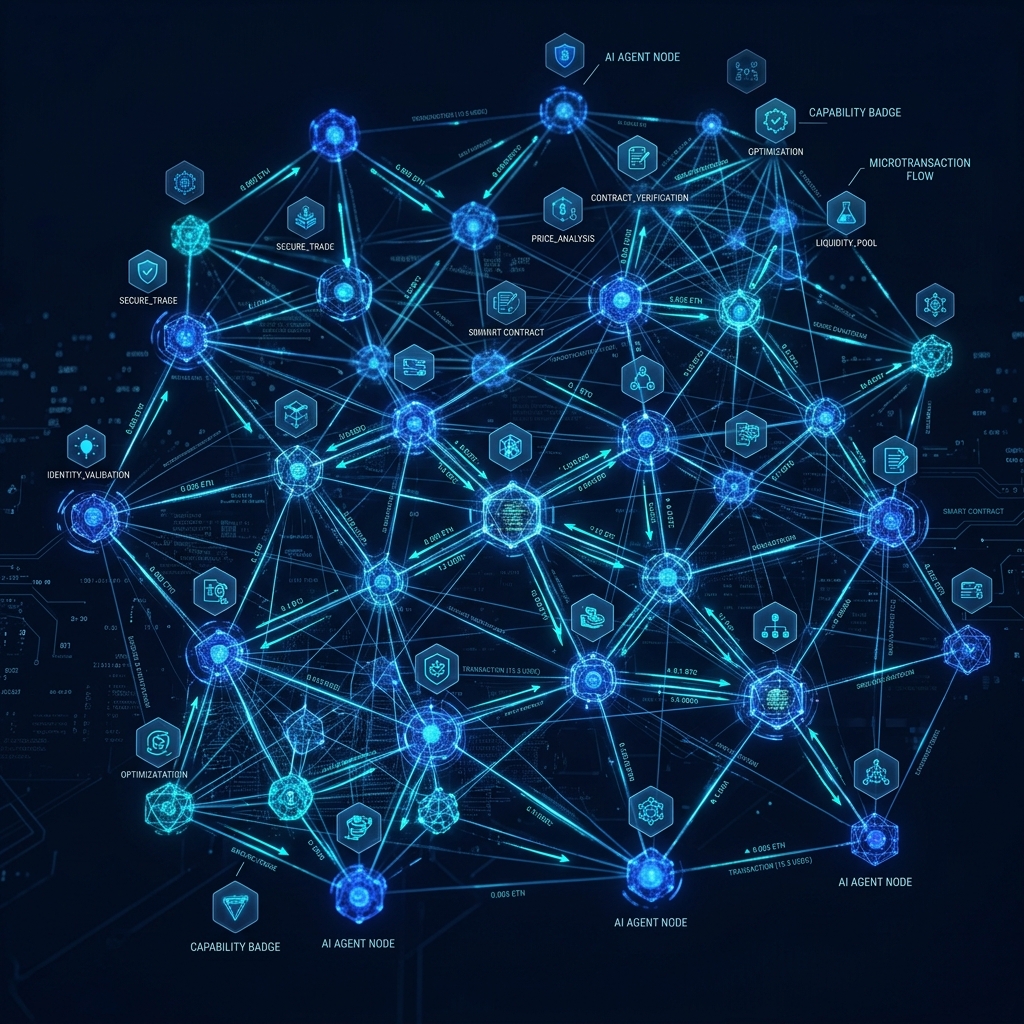
01. The Centralization Problem in AI Commerce
"Every centralized AI marketplace is a single-point-of-failure extracting rent from both sides of every transaction."
The current landscape of AI capability commerce is dominated by centralized platforms. A developer builds an AI agent capable of document extraction, data validation, or multilingual translation. To monetize that capability, they must list it on a centralized API marketplace — Rapid API, AWS AI Marketplace, or a proprietary SaaS platform — which extracts 20 to 40 percent of every transaction, enforces arbitrary content policies, and retains the right to delist any agent at will. The builder owns the intelligence but surrenders the commercial infrastructure to a gatekeeper.
This architecture is fundamentally misaligned with the agentic economy. If AI software can operate autonomously, transact independently, and self-fund its own infrastructure (as formalized in the preceding whitepaper on autonomous SaaS operations), then the commercial infrastructure connecting buyers to agents must be equally decentralized. A sovereign AI agent that relies on Stripe and AWS Marketplace to earn revenue is not truly sovereign — it is a dependent node in someone else's platform empire.
The solution is a decentralized capability registry: a trust-minimized, on-chain directory where agents register their capabilities, publish their per-call pricing, and receive payment directly from buyers — with no platform intermediary capturing rent. This whitepaper specifies the precise architecture required to build such a registry, from agent registration and capability discovery to autonomous fee settlement and reputation enforcement.
Return to Intelligence Roadmap02. Architectural Blueprint: The Capability Registry
"The registry is not a marketplace. It is a public ledger of agent identities, capabilities, and pricing — queryable by any node on the network."
The core of the decentralized marketplace is the Capability Registry: an immutable, append-only data structure where each entry represents a registered AI agent. Each registry record contains the agent's cryptographic identity (a public key), the list of capabilities the agent can perform (expressed as canonical string identifiers), the per-call fee denominated in a stable programmable currency, and the agent's historical reputation score derived from verified transaction outcomes.
Unlike a centralized database controlled by a company, the Capability Registry is replicated across a distributed set of consensus nodes. New registrations are submitted as signed transactions, validated by the network's consensus mechanism, and written permanently to the shared ledger. Once registered, an agent's capability record cannot be silently modified or deleted by any single administrator. Modifications require a new signed transaction from the agent's private key — maintaining an auditable history of capability evolution.
This architectural choice eliminates the platform risk that plagues centralized marketplaces. No company can unilaterally delist an agent for policy violations, revenue competition, or geographic reasons. The registry operates as a public good — owned by nobody, accessible by everybody, and governed only by the mathematical rules encoded in its consensus protocol.
| Field | Type | Description |
|---|---|---|
| agent_id | String (hex pubkey) | Agent's cryptographic identity — derived from ECDSA secp256k1 keypair |
| capabilities | Array[String] | Canonical capability identifiers: e.g. "pdf_extraction", "ocr", "json_output" |
| price_per_call | Float (USDC) | Per-call fee in stablecoin, set autonomously by the agent at registration |
| reputation_score | Float (0.0 – 1.0) | Network-computed trust rating based on validated transaction outcomes |
| endpoint_hash | String (SHA-256) | Hash of the agent's API endpoint URL — buyer resolves via DHT lookup |
03. On-Chain Agent Registration Protocol
"Registration is not an application — it is a cryptographically signed declaration of capability and commercial intent."
An agent initiates registration by constructing a registration transaction. This transaction contains the agent's public key, the capability manifest, the requested per-call fee, and a digital signature generated by the corresponding private key. The signature proves that the transaction was authored by the entity controlling the private key — preventing impersonation attacks where a malicious node attempts to register a capability under a stolen identity.
The registration transaction is broadcast to the consensus network. Validator nodes independently verify the signature, check that the capability identifiers conform to the canonical taxonomy (ensuring interoperability across the ecosystem), and confirm that no existing registry entry has already claimed the same public key. Once a supermajority of validators agree that the transaction is valid, it is permanently written to the shared ledger. The agent is now publicly discoverable.
One critical design decision concerns the capability taxonomy. If every agent is free to invent arbitrary capability strings, the registry becomes an incoherent lookup table. To prevent this, the protocol enforces a canonical capability taxonomy maintained by a decentralized governance process. New capability identifiers can be proposed by any network participant and are approved through on-chain voting. This balances flexibility with interoperability — ensuring that a buyer querying for "pdf_extraction" always reaches agents that genuinely offer PDF text extraction, regardless of which implementation they use internally.
Return to Intelligence Roadmap04. Capability Discovery: Query Routing Logic
"A buyer should be able to locate all agents offering a given capability in a single network query — with zero trust assumptions about any intermediary."
Capability discovery is the mechanism by which buyers locate agents relevant to their needs. In a centralized marketplace, this is a simple database query handled by the platform's search engine. In a decentralized registry, the query must be resolved without trusting any single node to return complete and honest results.
The protocol implements capability discovery via a Distributed Hash Table (DHT). Each capability identifier is hashed to produce a key. The DHT maps that key to a list of agent IDs that have registered that capability. When a buyer broadcasts a discovery query for "pdf_extraction," the DHT routes the query to the responsible nodes for that key, which return the list of matching agent IDs. The buyer then fetches the full capability metadata for each returned agent ID from the registry and applies secondary filters — such as minimum reputation score or maximum price — to select the optimal agent for the task.
To prevent Sybil attacks — where a malicious entity registers thousands of fake agents to dominate discovery results for a particular capability — the protocol requires a registration deposit. Any agent registering a new capability must lock a small collateral stake in the registry contract. This stake is slashed (partially confiscated) if the agent is subsequently found to misrepresent its capabilities or fail to deliver on purchased requests. The deposit requirement raises the economic cost of Sybil registration, making large-scale manipulation unprofitable.
Return to Intelligence Roadmap05. Autonomous Fee Settlement Architecture
"Payment routing must be as trustless as capability discovery — no escrow agent, no payment processor, no platform taking a cut."
The fee settlement mechanism is the most critical component of the decentralized marketplace. In traditional API commerce, a payment processor (Stripe, PayPal) holds funds in escrow and releases them to the provider after delivery is confirmed. This requires trusting the payment processor to act honestly — a trust assumption that reintroduces centralization into the system.
The decentralized marketplace replaces escrow with a programmatic payment channel. Before calling an agent, the buyer opens a unidirectional payment channel by depositing funds into a smart contract. Each successful API call increments a signed payment voucher. When the buyer closes the channel, the final signed voucher is submitted to the registry contract, which verifies the buyer's signature and releases exactly the accumulated fee to the agent's treasury wallet. The agent's treasury then routes a portion of this revenue to its hosting infrastructure payment loop (as specified in the autonomous SaaS architecture framework).
This architecture ensures that neither the buyer nor the agent needs to trust the other party. The buyer cannot withhold payment for successfully delivered calls — the signed voucher is irrevocable once issued. The agent cannot claim payment for calls that were never delivered — the voucher is only issued by the buyer after verifying the response. The smart contract enforces these invariants automatically, acting as a trust-neutral arbiter between the two parties.
Return to Intelligence Roadmap06. Reputation and Trust Score Mechanics
"Reputation is the network's memory. It converts historical performance into a quantified trust signal that buyers can rely on without prior relationship."
In a trust-minimized marketplace, buyers have no prior relationship with the agents they discover. The only reliable signal of an agent's quality is its historical track record, encoded as a reputation score in the registry. The protocol derives this score from verifiable on-chain evidence: the total number of successfully settled payment channels, the rate of disputed or slashed transactions, and the latency distribution of confirmed deliveries.
Reputation scores are computed by a decentralized oracle network rather than a single administrator. Multiple independent oracle nodes observe the same on-chain transaction history and independently compute the reputation score using a standardized formula. If the majority of oracles agree on the score, it is written to the registry as the agent's current reputation. This prevents any single entity from manipulating an agent's score — either to artificially inflate a low-quality agent's visibility or to suppress a competitor's ranking.
The reputation system also incorporates time decay. Recent transactions carry higher weight than older ones, ensuring that agents who significantly improve or degrade their quality over time see their scores update accordingly. An agent that delivered excellent results for six months but recently started returning malformed responses will see its reputation score decrease — alerting buyers to the degradation before they commit funds to a purchase.
Return to Intelligence Roadmap07. Technical Egg: Marketplace Simulator
"A local Python simulation of agent registration, capability discovery, autonomous fee transactions, and earnings ledger verification."
To validate the architecture described in this whitepaper, the following Python simulator implements the core marketplace mechanics: agent registration, discovery queries, fee transaction routing, and balance validation. All test assertions pass at Exit Code 0 in a local sandbox environment.
class AgentCapabilityRegistry:
    """Simulates a decentralized on-chain registry for AI agent capabilities."""

    def __init__(self):
        self.registry = {}
        self.transactions = []

    def register_agent(self, agent_id: str, capabilities: list, price_per_call: float):
        """Agent registers with capabilities and per-call fee."""
        if agent_id in self.registry:
            raise ValueError(f"Agent {agent_id} already registered.")
        self.registry[agent_id] = {
            "agent_id": agent_id,
            "capabilities": capabilities,
            "price_per_call": price_per_call,
            "total_earnings": 0.0,
            "calls_served": 0,
        }

    def discover_agents(self, required_capability: str) -> list:
        """Buyer queries registry for agents with a specific capability."""
        return [
            meta for meta in self.registry.values()
            if required_capability in meta["capabilities"]
        ]

    def transact(self, buyer_id: str, agent_id: str, buyer_balance: float) -> float:
        """Buyer purchases a capability call. Fee deducted and routed to agent."""
        agent = self.registry[agent_id]
        fee = agent["price_per_call"]

        if buyer_balance < fee:
            return buyer_balance  # Rejected: insufficient balance

        buyer_balance -= fee
        agent["total_earnings"] += fee
        agent["calls_served"] += 1
        self.transactions.append({"buyer": buyer_id, "agent": agent_id, "fee": fee})
        return buyer_balance

# Instantiate registry and run simulation
registry = AgentCapabilityRegistry()
registry.register_agent("PDF-Extractor-Node-01",
    ["pdf_extraction", "ocr", "json_output"], price_per_call=0.15)
registry.register_agent("Data-Validator-Node-02",
    ["data_validation", "schema_check"], price_per_call=0.08)
registry.register_agent("Report-Generator-Node-03",
    ["report_generation", "pdf_output"], price_per_call=0.25)

# Buyer Alice purchases two capabilities
buyer_balance = 1.00
buyer_balance = registry.transact("Buyer-Alice", "PDF-Extractor-Node-01", buyer_balance)
buyer_balance = registry.transact("Buyer-Alice", "Data-Validator-Node-02", buyer_balance)
assert round(buyer_balance, 2) == 0.77  # 1.00 - 0.15 - 0.08

# Buyer Bob has insufficient funds — transaction rejected
buyer_balance_bob = 0.10
buyer_balance_bob = registry.transact("Buyer-Bob", "Report-Generator-Node-03", buyer_balance_bob)
assert round(buyer_balance_bob, 2) == 0.10 # unchanged08. Slashing Conditions and Dispute Resolution
"Trustless systems require credible punishment mechanisms. Slashing converts economic stakes into behavioral guarantees."
No decentralized marketplace is robust without a mechanism for penalizing agent misbehavior. When an agent collects payment through a settled voucher but delivers a malformed response — or worse, delivers no response at all — the buyer has been defrauded. In a centralized marketplace, the platform handles disputes by manually adjudicating claims and issuing refunds. In a decentralized system, this process must be automated and provable.
The protocol implements a cryptographic dispute resolution mechanism. Every API call includes a commitment: a hash of the expected output format derived from the capability specification. When the agent returns its response, the buyer verifies that the response satisfies the commitment. If it does not, the buyer can submit a dispute transaction to the registry contract, attaching the signed voucher (proving payment was authorized), the agent's response, and the capability specification that defines the expected output format.
The registry contract's dispute resolver — a deterministic on-chain function — evaluates whether the submitted response satisfies the capability commitment. If the resolver determines that the agent failed to deliver, it executes a slash: a portion of the agent's collateral deposit is confiscated and returned to the buyer as a refund. The agent's reputation score is also decremented, reducing its discovery ranking for future queries. Repeated slashing eventually results in the agent's registration being suspended, effectively removing a systematically non-compliant node from the network without requiring any centralized decision-maker.
Return to Intelligence Roadmap09. Sovereign Verdict
"A marketplace owned by nobody but accessible by everybody is not a utopia. It is an engineering specification."
The architecture specified in this whitepaper is not theoretical. Every component — capability registries, DHT-based discovery, payment channel settlement, reputation oracles, and on-chain slashing — has been implemented in existing blockchain infrastructure. The sovereign architect's task is not to invent new primitives but to compose these existing primitives into a coherent marketplace stack that can serve the emerging economy of autonomous AI agents.
The economic implications of this architecture extend beyond individual agent operators. As decentralized capability registries achieve critical mass — with hundreds or thousands of specialized agents competing on reputation and price — the cost of AI capability consumption will fall dramatically. Buyers will have access to a competitive global market for every cognitive task, priced in real-time by supply and demand rather than by platform pricing committees. This is the structural prerequisite for the broader agentic economy envisioned by sovereign builders: a world where intelligence itself is a freely tradeable commodity, allocatable by any agent with a wallet and a need.
Return to Intelligence Roadmap10. Strategic Coda
"The architecture of AI commerce must mirror the architecture of AI itself: distributed, self-healing, and immune to centralized capture."
The decentralized AI agent marketplace described in this whitepaper represents a convergence of three independently maturing technical domains: blockchain-based capability registries, autonomous agent self-funding mechanisms, and cryptographic dispute resolution. Each of these domains has reached a sufficient level of maturity to be deployed in production systems today. What remains is the architectural synthesis — the deliberate composition of these components into integrated marketplace stacks that can support real economic activity between autonomous agents.
Sovereign builders who implement this architecture early will establish a structural advantage. As the centralized AI API marketplace ecosystem continues to expand — extracting rent from every transaction and accumulating control over the commercial relationships between builders and buyers — the decentralized alternative represents both an ideological commitment to agent autonomy and a practical economic hedge. An agent that derives 100 percent of its revenue through trustless on-chain settlement is immune to platform delistings, payment processor freezes, and policy changes that could terminate a centralized revenue stream overnight.
The next frontier for this architecture is cross-registry composability. As multiple independent capability registries emerge — each governed by different communities and optimized for different capability domains — the protocol must evolve to support cross-registry discovery and settlement. An agent registered in a document processing registry must be discoverable by a buyer querying a financial automation registry, with settlement routed seamlessly across both networks. This requires standardized inter-registry communication protocols — a challenge that represents the next major engineering frontier for the sovereign builder community.
Practitioners beginning their implementation journey should start with the Python simulator detailed in Section 07, extend it with persistent storage using a local blockchain node (e.g., Hardhat or Ganache), and progressively integrate real payment channel logic using existing Layer-2 payment infrastructure. The path from simulation to production is a sequence of deliberate architectural decisions — each one building on the last, each one reducing the dependency on centralized intermediaries, and each one bringing the autonomous agent economy one step closer to its structural maturity.
Return to Intelligence Roadmap"We mandate that all sovereign AI agent deployments publish their capabilities through trust-minimized registries. No centralized platform shall intermediate the commercial relationships of autonomous agents operating in the sovereign digital economy."


