[Master Class #53] Encrypted Multi-Tenant Storage & Compliance Auditing for Agent Actions

[Master Class #53] Encrypted Multi-Tenant Storage & Compliance Auditing for Agent Actions
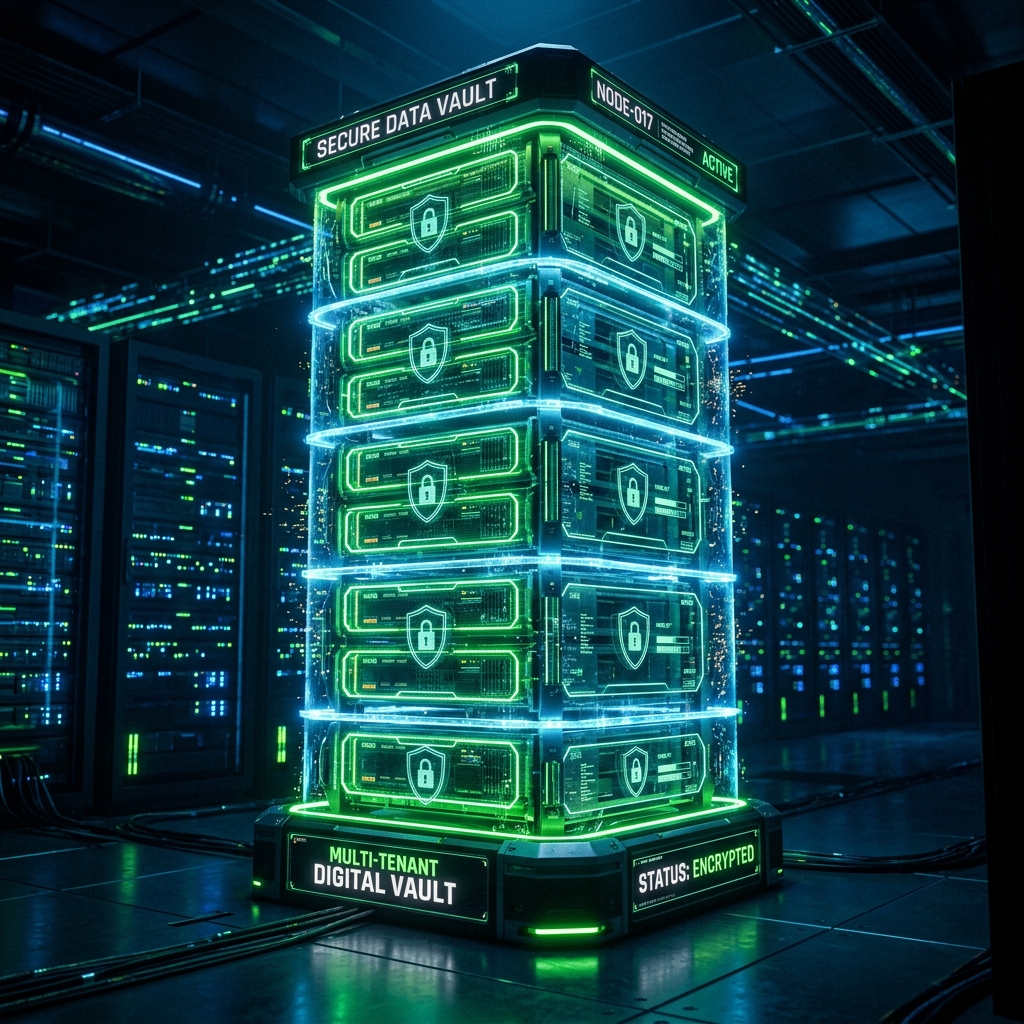
MASTER CLASS #53: ENCRYPTED MULTI-TENANT STORAGE
- 2026.07.25 -

[Master Class #53] Encrypted Multi-Tenant Storage & Compliance Auditing for Agent Actions

BRAVOECONOMY: THE INSTITUTIONAL BRIDGE SERIES
Encrypted Multi-Tenant Storage AES-256-GCM and SHA-256 Hash-Chained Compliance Audit Trail for Sovereign Agent Clusters
ENCRYPTED MULTI-TENANT STORAGE: AES-256-GCM BOUNDARY SECURING AGENT ACTION LEDGERS WITH SHA-256 HASH CHAINING

01. The Multi-Tenant Data Sovereignty Problem

"When multiple autonomous agents share a single storage layer, every unencrypted record is a breach waiting to happen. Cryptographic isolation is not optional — it is the architectural foundation."

As sovereign business operations scale to incorporate multiple autonomous agent clusters, the shared storage layer becomes a critical vulnerability. A single database or file system hosting data from multiple agents introduces a fundamental security gap: without cryptographic isolation, a compromised agent can read or corrupt data belonging to another agent operating in the same environment.

This challenge is not limited to external threats. In multi-tenant deployments, an internal software fault, a misconfigured access control list, or an improperly scoped query can expose sensitive data from one operational context to another. The consequences extend beyond privacy violations — they include financial liability, regulatory non-compliance, and reputational damage that can permanently impair institutional credibility.

The solution is not access control alone. Role-based access controls and permission layers are necessary but insufficient, because they operate at the application layer and can be circumvented by direct database access or administrative override. True multi-tenant data sovereignty requires cryptographic enforcement at the storage layer, ensuring that data from one tenant is mathematically inaccessible to any other party — even to the system administrator — without the correct tenant-specific key.

02. AES-256-GCM: The Encryption Standard for Sovereign Storage

"AES-256-GCM provides both confidentiality and authenticity in a single pass. It is the institutional-grade standard for protecting data at rest and in transit."

The Advanced Encryption Standard with a 256-bit key operating in Galois/Counter Mode (AES-256-GCM) is the industry benchmark for symmetric encryption in high-security environments. It is mandated by the United States National Security Agency for protecting classified information, and it is the default encryption algorithm in TLS 1.3, the protocol securing modern internet communications.

AES-256-GCM provides two critical security properties simultaneously. First, it guarantees confidentiality: the plaintext is mathematically transformed into ciphertext that is computationally infeasible to reverse without the correct 256-bit key. Second, it provides authenticated encryption: the GCM mode computes an authentication tag that verifies both the integrity of the ciphertext and the authenticity of associated data. If a single bit of the ciphertext is modified in transit or at rest, decryption fails with a cryptographic exception — making silent data corruption impossible.

For multi-tenant storage, AES-256-GCM is the ideal choice because it supports associated data — additional context that is authenticated but not encrypted. This allows the tenant identifier to be cryptographically bound to each record without being included in the ciphertext payload, preventing cross-tenant decryption even if the ciphertext is somehow transferred between storage partitions.

The critical implementation requirement for AES-256-GCM is nonce uniqueness. Each encryption operation must use a fresh, cryptographically random 96-bit nonce. Reusing a nonce with the same key destroys the security guarantees of GCM mode, potentially exposing the key and all encrypted content. The sovereign architect must enforce nonce generation through cryptographic random number generators, never through deterministic counters or timestamp-based approaches.

03. Technical Egg: Implementing MultiTenantCryptStore

"Validate per-tenant key isolation and hash-chained audit logging locally before any data reaches production storage. The sandbox must prove cryptographic correctness."

The following implementation demonstrates a sovereign multi-tenant encrypted storage engine. Each tenant receives a unique AES-256-GCM key provisioned at registration time. All write and read operations are logged to an immutable SHA-256 hash-chained audit trail that detects any retrospective modification.

from cryptography.hazmat.primitives.ciphers.aead import AESGCM
import hashlib, os, time

class MultiTenantCryptStore:
    def __init__(self):
        self._tenant_keys = {}   # tenant_id -> 32-byte AES-256 key
        self._audit_log   = []   # immutable hash-chained compliance log
        self._store       = {}   # tenant_id -> list of ciphertext blobs

    def register_tenant(self, tenant_id: str) -> None:
        if tenant_id in self._tenant_keys:
            raise ValueError(f"Tenant '{tenant_id}' already registered.")
        self._tenant_keys[tenant_id] = AESGCM.generate_key(bit_length=256)
        self._store[tenant_id] = []
        self._write_audit(tenant_id, "REGISTER", b"tenant_key_provisioned")

    def write(self, tenant_id: str, plaintext: bytes) -> int:
        key = self._tenant_keys[tenant_id]
        aesgcm = AESGCM(key)
        nonce = os.urandom(12)                  # fresh 96-bit cryptographic nonce
        ciphertext = aesgcm.encrypt(
            nonce, plaintext,
            associated_data=tenant_id.encode() # binds ciphertext to this tenant only
        )
        self._store[tenant_id].append(nonce + ciphertext)
        self._write_audit(tenant_id, "WRITE", plaintext)
        return len(self._store[tenant_id]) - 1

    def read(self, tenant_id: str, index: int) -> bytes:
        blob  = self._store[tenant_id][index]
        nonce, ct = blob[:12], blob[12:]
        plain = AESGCM(self._tenant_keys[tenant_id]).decrypt(
            nonce, ct, associated_data=tenant_id.encode()
        )
        self._write_audit(tenant_id, "READ", plain)
        return plain

    def _write_audit(self, tenant_id, action, payload):
        seq   = len(self._audit_log)
        phash = hashlib.sha256(payload).hexdigest()
        ts    = time.time()
        prev  = self._audit_log[-1]["chain_hash"] if self._audit_log else "GENESIS"
        chain_input = f"{prev}|{seq}|{tenant_id}|{action}|{phash}|{ts}".encode()
        self._audit_log.append({
            "seq": seq, "tenant_id": tenant_id, "action": action,
            "payload_hash": phash, "timestamp": ts,
            "chain_hash": hashlib.sha256(chain_input).hexdigest()
        })

    def verify_audit_integrity(self) -> bool:
        prev = "GENESIS"
        for e in self._audit_log:
            inp = f"{prev}|{e['seq']}|{e['tenant_id']}|{e['action']}|{e['payload_hash']}|{e['timestamp']}".encode()
            if hashlib.sha256(inp).hexdigest() != e["chain_hash"]:
                return False
            prev = e["chain_hash"]
        return True
        

04. Cross-Tenant Isolation: Enforcing Cryptographic Boundaries

"Cryptographic isolation ensures that tenants cannot access each other's data even if application-layer access controls are compromised."

The architectural guarantee of the MultiTenantCryptStore is that each tenant's data is encrypted under a unique, independently generated AES-256 key. This means that even if an application bug or misconfigured query exposes one tenant's ciphertext to another tenant's decryption routine, the decryption operation will fail with a cryptographic authentication error.

This guarantee is enforced by the associated data parameter in AES-256-GCM. When a record is encrypted, the tenant identifier is passed as associated data, cryptographically binding the ciphertext to that specific tenant. When decryption is attempted with a different tenant's associated data — even using the correct algorithm and key length — the GCM authentication tag verification will fail, and the decryption function will raise an exception rather than returning corrupted plaintext.

This double-layer of protection (separate keys plus associated data binding) ensures that cross-tenant data access is impossible through both direct key compromise and indirect query injection. The cryptographic boundary is enforced at the mathematical level, independent of any application-layer logic that could be bypassed or manipulated.

⚡ SOVEREIGN INTELLIGENCE BRIEF

"In institutional environments, data sovereignty is non-negotiable. The AES-256-GCM boundary between tenants is not a policy — it is a mathematical wall. No administrative override, no software patch, and no privileged access can cross it without the tenant's private key."

05. The Immutable SHA-256 Hash-Chained Audit Trail

"An audit trail is only credible if it cannot be retroactively modified. Hash chaining transforms a list of log entries into a cryptographically linked chain that detects any tampering."

Every read, write, and administrative action performed by the MultiTenantCryptStore is recorded in a hash-chained audit log. Each log entry includes the sequence number, tenant identifier, action type, SHA-256 hash of the data payload, timestamp, and a chain hash computed over all preceding entries.

The chain hash is computed by hashing the concatenation of the previous chain hash and the current entry's fields. The first entry in the log uses a genesis sentinel value as the previous chain hash. This structure creates a cryptographic dependency between entries: modifying any historical entry changes its chain hash, which invalidates the chain hash of every subsequent entry.

This tamper-detection property makes the audit trail suitable for regulatory compliance requirements. Financial regulators, data protection authorities, and institutional due diligence processes often require demonstrable evidence that audit logs have not been modified after the fact. The hash-chained structure provides this guarantee through cryptographic proof rather than administrative policy.

AUDIT LOG CHAIN VERIFICATION SCHEMA: ───────────────────────────────────────────────────────────── Entry[0]: GENESIS chain anchor chain_hash = SHA256("GENESIS|0|tenant_id|action|payload_hash|ts") Entry[1]: Dependent on Entry[0] chain_hash = SHA256("{entry[0].chain_hash}|1|tenant_id|action|payload_hash|ts") Entry[N]: Dependent on Entry[N-1] chain_hash = SHA256("{entry[N-1].chain_hash}|N|tenant_id|action|payload_hash|ts") TAMPER DETECTION: Modification of Entry[K] → chain_hash[K] changes → chain_hash[K+1] computed from wrong prev → MISMATCH → verify_audit_integrity() returns False at position K+1 VERIFICATION COMPLEXITY: O(N) linear scan, computationally negligible

06. Compliance Auditing: Centralized vs Distributed Audit Ledgers

"Evaluate the architectural tradeoffs between local hash-chained audit logs and distributed ledger anchoring for compliance evidence."

The MultiTenantCryptStore implements a local hash-chained audit trail that provides strong tamper detection within a single deployment. This approach is efficient, fast, and sufficient for most compliance requirements. However, for the highest levels of institutional assurance, sovereign architects may consider anchoring the audit chain to an external distributed ledger.

Audit Dimension Local Hash-Chain Log Blockchain-Anchored Ledger Hybrid (Recommended)
Tamper Detection Strong (internal verification) Strongest (external consensus) Strongest (anchored hash root)
Query Performance Instant (in-memory scan) Slow (network queries) Instant (local log + anchors)
Infrastructure Cost Zero (local storage only) High (chain transaction fees) Low (periodic anchor only)
Regulatory Acceptance High (most jurisdictions) Varies (jurisdiction-dependent) High (standard + provable)
Implementation Complexity Low (single library) High (chain integration) Moderate (periodic anchoring)

07. Security Hardening: Key Rotation and Nonce Management

"Cryptographic keys must be rotated on a defined schedule. Nonces must be generated from cryptographically secure random sources to maintain AES-256-GCM security guarantees."

Long-term use of the same encryption key increases the risk of cryptanalytic attacks and reduces the forward secrecy of the encrypted data. Best practice for sovereign storage systems is to implement a key rotation policy that generates new tenant keys on a defined schedule — typically every 90 days for standard deployments or every 30 days for high-security environments.

Key rotation in a multi-tenant storage system requires careful coordination. When a tenant's key is rotated, all existing records encrypted under the old key must be re-encrypted under the new key before the old key is permanently destroyed. This re-encryption process must be atomic — either all records are successfully re-encrypted, or the operation is rolled back — to prevent partial encryption states that could result in data loss.

Nonce management is equally critical. The 96-bit nonce space for AES-256-GCM provides approximately 2^96 unique values per key. For most deployments, this is more than sufficient to eliminate collision risk using cryptographically random nonces. However, deployments that process extremely high volumes of records — exceeding hundreds of billions of encryption operations per key — should implement a nonce counter with explicit collision detection to maintain security guarantees.

08. Implementation Guide: Deploying the Encrypted Store in Production

"Follow a structured deployment checklist to configure key storage, audit log persistence, and rotation schedules before connecting live agent workloads."

Step 1: Provision a Hardware Security Module (HSM) or Key Management Service
Tenant encryption keys must never be stored in plaintext on the same system as the encrypted data. Provision a dedicated key management service (KMS) such as AWS KMS, Google Cloud KMS, or a local HashiCorp Vault instance to store and serve tenant keys with access control and audit logging.

Step 2: Configure Persistent Audit Log Storage
The hash-chained audit log must be persisted to durable storage — either a dedicated database with write-once semantics or an append-only file system. Configure the storage backend to prevent deletion or modification of existing log entries at the file system or database permission level.

Step 3: Establish Key Rotation Schedules
Configure automated key rotation triggers based on time intervals or encryption volume thresholds. Implement the re-encryption pipeline as an atomic transaction with rollback capability to prevent partial encryption states.

Step 4: Deploy Audit Integrity Verification Jobs
Schedule automated audit trail integrity verification runs at defined intervals — at minimum daily, preferably after every batch of write operations. Configure alerting to notify administrators immediately if tamper detection returns a failure.

Step 5: Conduct Cross-Tenant Isolation Penetration Testing
Before connecting live agent workloads, execute a formal cross-tenant isolation audit. Simulate direct key swapping attempts, associated data manipulation, and raw ciphertext transfer between tenant storage partitions. Verify that all decryption attempts across tenant boundaries fail with cryptographic exceptions.

09. Sovereign Verdict

"The architect who controls the encryption boundary controls the data. Multi-tenant sovereignty is not a configuration — it is a cryptographic guarantee."

The implementation of per-tenant AES-256-GCM encryption combined with an immutable hash-chained audit trail transforms shared storage infrastructure from a security liability into a sovereign data vault. Each tenant's data exists in a cryptographically isolated partition that is mathematically inaccessible to any other party without the tenant's private key.

This architecture enables institutional-grade compliance for multi-agent deployments operating in regulated environments. The audit trail provides tamper-evident proof of every data access and modification event, satisfying requirements for financial auditing, data protection regulation compliance, and institutional due diligence investigations.

10. Strategic Coda

Multi-tenant encrypted storage is not merely a technical security measure — it is the foundation of trust for sovereign multi-agent operations. When clients, partners, or institutional counterparties evaluate an autonomous business system for acquisition or investment, the presence of cryptographic data isolation and immutable compliance auditing transforms abstract operational claims into verifiable, mathematically provable guarantees.

The sovereign architect who implements this framework does not simply protect data. They build the cryptographic infrastructure that transforms an autonomous agent cluster into an institution-ready asset — one that can withstand regulatory scrutiny, survive due diligence investigation, and command the premium valuation reserved for systems built to institutional standards.

Every encryption key provisioned, every nonce generated, and every audit log entry hash-chained is a brick in the wall of sovereign institutional credibility. Build it correctly from the foundation, and the entire structure — from the byte-level storage operation to the boardroom acquisition conversation — rests on unassailable cryptographic ground.

Sovereign Data Isolation Directive

"We declare that all agent-generated data must be encrypted under tenant-specific AES-256-GCM keys. Every storage action must be recorded in an immutable hash-chained audit trail. No unencrypted record shall persist. No audit entry shall be modified."

Popular posts from this blog

What to Automate First in a Small Business

[Master Class #01] The 2026 Agentic Economy: A Blueprint for Sovereign Wealth

[Master Class #18] The Algorithmic Sentinel: Deploying High-Performance Private Data Harvesters