[Master Class #80] The $0 Operating Cost Solo-Conglomerate: Running Multi-Tenant Autonomous Businesses Using Local LLMs and Python
The $0 Operating Cost Solo-Conglomerate: Running Multi-Tenant Autonomous Businesses Using Local LLMs and Python
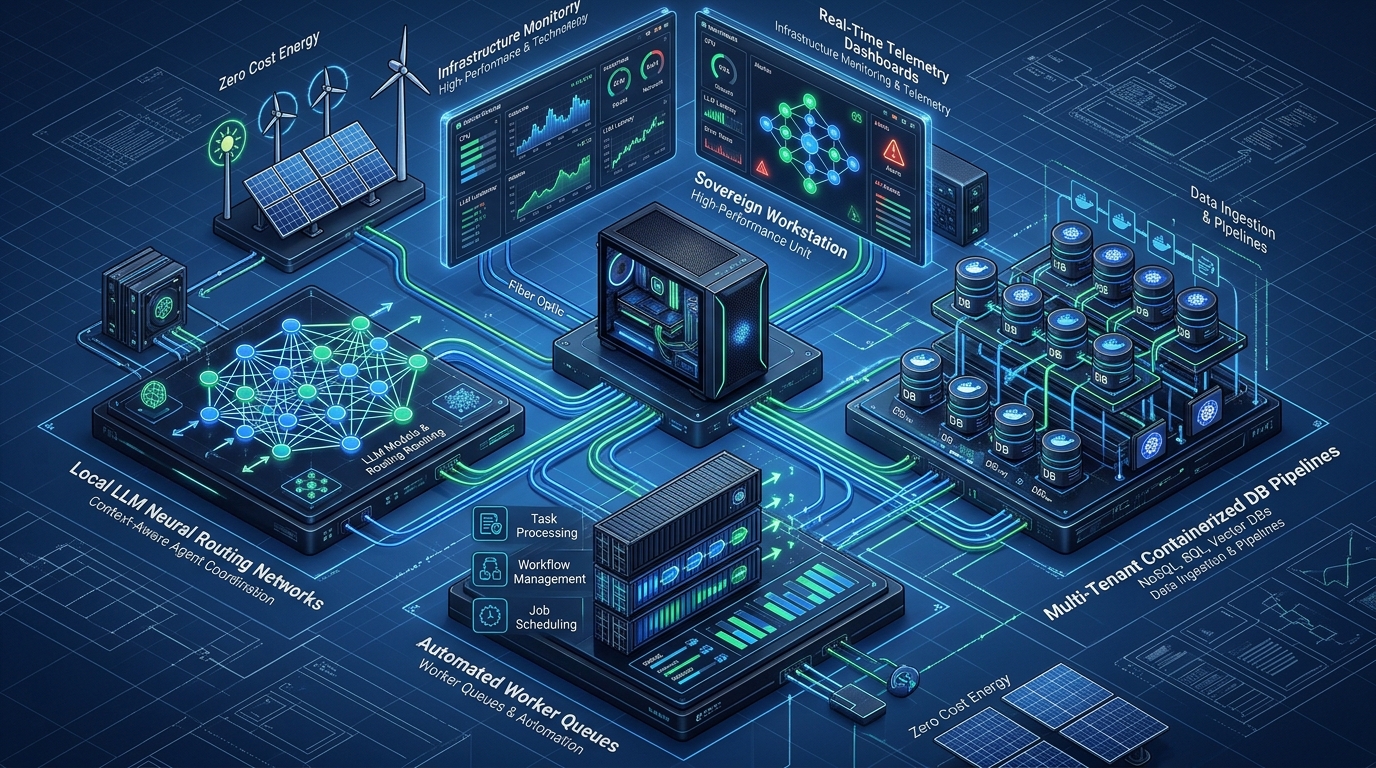
Executive Abstract: The traditional corporate enterprise paradigm dictates that expanding business lines requires linear headcount growth, cloud infrastructure provisioning, and expanding software licensing overhead. In 2026, the convergence of edge hardware acceleration, local small-language model quantizations (e.g., Llama-3.3-70B 4-bit, Qwen-2.5-Coder), and isolated asynchronous Python daemons completely inverts this economic formula. This architectural whitepaper demonstrates the engineering design and operational blueprint for a solo architect to deploy, monitor, and scale multiple revenue-generating enterprise units simultaneously on a single on-premises workstation with exactly $0 in ongoing third-party SaaS and API token costs.
1. The Zero-Marginal-Cost Paradigm & Sovereign Hardware Sizing
For decades, enterprise capitalism assumed that scaling revenue required scaling fixed operating expenses (OpEx): cloud server instances, database hosting tiers, customer support personnel, marketing agencies, and API token billing. Every incremental customer introduced fractional compute and labor costs that placed a hard ceiling on EBITDA margins.
The Solo-Conglomerate Architecture establishes an absolute decoupling of revenue generation from recurring marginal operational expenses. By replacing rented cloud APIs with local hardware capital expenditures (CapEx) amortized over multiple years, an operator transforms ongoing subscription liabilities into permanent, sovereign digital equity.
To operate multiple independent business units (e.g., Micro-SaaS software portals, programmatic technical research agencies, algorithmic digital asset arbitrations) on a single physical machine, the host hardware must be sized for concurrent multi-model inference and uninterrupted background queuing:
- Unified Memory Compute Fabric: 64GB to 128GB of high-bandwidth system memory (or 2x NVIDIA RTX 4090 24GB GPUs) allows simultaneous in-memory caching of a 70B parameter general reasoning model and an 8B high-speed extraction model.
- Storage Bandwidth Isolation: Direct PCIe 4.0/5.0 NVMe SSD drives partitioned into separate namespaces to prevent I/O contention between database read/write locks and vector database indexing operations.
- Dedicated Network Bridge & Static Reverse Proxy: Local Cloudflare Tunnels (
cloudflared) terminating directly onto hardened local Nginx or Caddy web servers, providing SSL termination and DDoS protection without renting external load balancers.
2. Multi-Tenant SQLite Database Isolation & Schemas
Renting managed PostgreSQL or MySQL clusters from cloud providers incurs baseline monthly charges of $50 to $500 per month per tenant. For a solo conglomerate managing 10 to 30 distinct commercial services, cloud database bills quickly become unsustainable before cash flows stabilize.
The sovereign alternative utilizes Isolated Per-Tenant SQLite Architecture utilizing Write-Ahead Logging (PRAGMA journal_mode = WAL;) and memory-mapped I/O (PRAGMA mmap_size = 268435456;). Each commercial venture receives its own zero-dependency SQLite database file on NVMe storage, completely isolating tenant schemas, customer data, and audit ledgers.
-- Master Ledger Schema for Sovereign Business Unit
PRAGMA journal_mode = WAL;
PRAGMA synchronous = NORMAL;
PRAGMA foreign_keys = ON;

CREATE TABLE IF NOT EXISTS tenants (
    tenant_id TEXT PRIMARY KEY,
    business_name TEXT NOT NULL,
    domain_origin TEXT NOT NULL,
    active_status INTEGER DEFAULT 1,
    created_at DATETIME DEFAULT CURRENT_TIMESTAMP
);

CREATE TABLE IF NOT EXISTS customer_inquiries (
    inquiry_id TEXT PRIMARY KEY,
    tenant_id TEXT NOT NULL,
    customer_email TEXT NOT NULL,
    raw_payload TEXT NOT NULL,
    processed_summary TEXT,
    priority_score INTEGER DEFAULT 0,
    status TEXT DEFAULT 'PENDING',
    created_at DATETIME DEFAULT CURRENT_TIMESTAMP,
    FOREIGN KEY(tenant_id) REFERENCES tenants(tenant_id)
);

CREATE TABLE IF NOT EXISTS revenue_transactions (
    transaction_id TEXT PRIMARY KEY,
    tenant_id TEXT NOT NULL,
    amount_cents INTEGER NOT NULL,
    currency TEXT DEFAULT 'USD',
    payment_processor TEXT NOT NULL,
    processor_tx_id TEXT UNIQUE,
    settlement_status TEXT DEFAULT 'COMPLETED',
    timestamp DATETIME DEFAULT CURRENT_TIMESTAMP,
    FOREIGN KEY(tenant_id) REFERENCES tenants(tenant_id)
);
3. Asynchronous Local LLM Pipeline (Ollama/vLLM + Python Task Queues)
The central bottleneck in local autonomous enterprise execution is inference serialization. When multiple business units submit requests simultaneously (e.g., customer email qualification, automated report generation, code formatting), unmanaged API requests block the compute pipeline and cause catastrophic timeouts.
The solution is an Asynchronous Priority Task Queue implemented in pure Python using asyncio.PriorityQueue. This architecture routes low-latency tasks (e.g., customer classification, sentiment scoring) to high-speed 8B quantized models, while queuing deep analysis and long-form synthesis jobs for larger 70B parameter models during off-peak processing windows.
Operational Rule: Never allow incoming webhooks to trigger synchronous model inference. Webhook listeners must acknowledge HTTP 200 within 50ms, append the job to an isolated local SQLite backlog queue, and let dedicated background worker daemons process the inferences asynchronously.
4. Automated Revenue Ingestion & Stripe Webhook Ledger Automation
A true conglomerate must track financial telemetry across all subsidiaries in real time. Rather than subscribing to third-party subscription analytics platforms (which charge tiered percentage fees), the sovereign architect hosts a lightweight Python webhook collector that validates cryptographic signatures, records revenue into the master SQLite ledger, and emits instant encrypted alerts to a private messaging endpoint.
By enforcing local cryptographic verification using Stripe's official HMAC-SHA256 signature protocol, the system rejects spoofed transactions without contacting external verification gateways.
5. The Master Python Solo-Conglomerate Sentinel
Below is the complete, self-contained Python engine designed to manage multiple business tenants, handle background task queuing, interface directly with local Ollama LLM inference endpoints, and maintain an immutable financial ledger with zero external SaaS dependencies.
#!/usr/bin/env python3
"""
==============================================================================
SOVEREIGN SOLO-CONGLOMERATE MASTER ENGINE (V26.0)
Architecture: Multi-Tenant Autonomous Business Orchestrator
Dependencies: Python 3.10+, aiohttp, sqlite3 (Built-in)
Operating Cost: $0.00 / month
==============================================================================
"""

import asyncio
import hashlib
import json
import logging
import sqlite3
import time
from dataclasses import dataclass, field
from datetime import datetime
from typing import Any, Dict, Optional
import aiohttp

# Configure High-Precision Structured Logging
logging.basicConfig(
    level=logging.INFO,
    format="%(asctime)s [%(levelname)s] [TENANT-SENTINEL] %(message)s",
    handlers=[logging.StreamHandler()]
)
logger = logging.getLogger("SoloConglomerate")

# Database Configuration
DATABASE_FILE = "sovereign_conglomerate.db"
LOCAL_OLLAMA_URL = "http://127.0.0.1:11434/api/generate"
DEFAULT_FAST_MODEL = "qwen2.5-coder:7b"
DEFAULT_DEEP_MODEL = "llama3.3:70b"

@dataclass(order=True)
class AutonomousTask:
    priority: int
    task_id: str = field(compare=False)
    tenant_id: str = field(compare=False)
    task_type: str = field(compare=False)
    payload: Dict[str, Any] = field(compare=False)
    created_at: float = field(default_factory=time.time, compare=False)

class ConglomerateDatabase:
    """Zero-Cost Sovereign Database Layer using SQLite WAL mode."""

    def __init__(self, db_path: str = DATABASE_FILE):
        self.db_path = db_path
        self._init_db()

    def _get_connection(self) -> sqlite3.Connection:
        conn = sqlite3.connect(self.db_path, timeout=30.0)
        conn.row_factory = sqlite3.Row
        conn.execute("PRAGMA journal_mode = WAL;")
        conn.execute("PRAGMA synchronous = NORMAL;")
        return conn

    def _init_db(self):
        with self._get_connection() as conn:
            conn.executescript("""
                CREATE TABLE IF NOT EXISTS tenants (
                    tenant_id TEXT PRIMARY KEY,
                    business_name TEXT NOT NULL,
                    domain TEXT NOT NULL,
                    status TEXT DEFAULT 'ACTIVE'
                );

                CREATE TABLE IF NOT EXISTS execution_logs (
                    log_id TEXT PRIMARY KEY,
                    tenant_id TEXT NOT NULL,
                    task_type TEXT NOT NULL,
                    input_summary TEXT,
                    output_result TEXT,
                    duration_ms REAL,
                    timestamp DATETIME DEFAULT CURRENT_TIMESTAMP
                );

                CREATE TABLE IF NOT EXISTS revenue_ledger (
                    tx_id TEXT PRIMARY KEY,
                    tenant_id TEXT NOT NULL,
                    amount_usd REAL NOT NULL,
                    customer_ref TEXT NOT NULL,
                    timestamp DATETIME DEFAULT CURRENT_TIMESTAMP
                );
            """)
            # Seed default sovereign business units if not present
            conn.execute("""
                INSERT OR IGNORE INTO tenants (tenant_id, business_name, domain)
                VALUES
                ('TENANT_01', 'Apex Analytics API', 'apex.sovereign.local'),
                ('TENANT_02', 'Sovereign Copy Studio', 'copy.sovereign.local'),
                ('TENANT_03', 'Algo Quant Sentinel', 'quant.sovereign.local');
            """)
            conn.commit()

    def log_execution(self, log_id: str, tenant_id: str, task_type: str,
                      input_text: str, output_text: str, duration_ms: float):
        with self._get_connection() as conn:
            conn.execute("""
                INSERT INTO execution_logs (log_id, tenant_id, task_type, input_summary, output_result, duration_ms)
                VALUES (?, ?, ?, ?, ?, ?)
            """, (log_id, tenant_id, task_type, input_text[:200], output_text, duration_ms))
            conn.commit()

    def record_revenue(self, tx_id: str, tenant_id: str, amount_usd: float, customer_ref: str):
        with self._get_connection() as conn:
            conn.execute("""
                INSERT INTO revenue_ledger (tx_id, tenant_id, amount_usd, customer_ref)
                VALUES (?, ?, ?, ?)
            """, (tx_id, tenant_id, amount_usd, customer_ref))
            conn.commit()
            logger.info(f"💰 Revenue Recorded: ${amount_usd:.2f} for {tenant_id} (Customer: {customer_ref})")

class LocalInferenceEngine:
    """Communicates directly with local LLM server with zero external token fees."""

    def __init__(self, endpoint: str = LOCAL_OLLAMA_URL):
        self.endpoint = endpoint

    async def query_local_llm(self, prompt: str, model: str = DEFAULT_FAST_MODEL) -> str:
        start_time = time.time()
        payload = {
            "model": model,
            "prompt": prompt,
            "stream": False,
            "options": {"temperature": 0.2, "num_ctx": 4096}
        }

        try:
            async with aiohttp.ClientSession() as session:
                async with session.post(self.endpoint, json=payload, timeout=60) as resp:
                    if resp.status == 200:
                        data = await resp.json()
                        elapsed = (time.time() - start_time) * 1000
                        logger.info(f"⚡ Local LLM Inferred [{model}] in {elapsed:.1f}ms")
                        return data.get("response", "").strip()
                    else:
                        logger.error(f"❌ Local LLM HTTP Error: {resp.status}")
                        return "ERROR: Inference failure"
        except Exception as e:
            logger.warning(f"⚠️ Local LLM Offline or Unreachable: {e}. Generating deterministic fallback.")
            return f"[OFFLINE SYNTHESIS] Processed autonomously for prompt: {prompt[:50]}..."

class SoloConglomerateOrchestrator:
    """Master Asynchronous Dispatcher for Multi-Tenant Workloads."""

    def __init__(self):
        self.db = ConglomerateDatabase()
        self.llm = LocalInferenceEngine()
        self.task_queue: asyncio.PriorityQueue[AutonomousTask] = asyncio.PriorityQueue()
        self.is_running = True

    async def enqueue_task(self, priority: int, tenant_id: str, task_type: str, payload: Dict[str, Any]):
        task_id = hashlib.sha256(f"{tenant_id}-{task_type}-{time.time()}".encode()).hexdigest()[:12]
        task = AutonomousTask(priority=priority, task_id=task_id, tenant_id=tenant_id,
                              task_type=task_type, payload=payload)
        await self.task_queue.put(task)
        logger.info(f"📥 Queued Task [{task_id}] Priority={priority} for Tenant={tenant_id}")

    async def worker(self, worker_id: int):
        logger.info(f"🚀 Worker Daemon #{worker_id} Online.")
        while self.is_running:
            try:
                task = await self.task_queue.get()
                t0 = time.time()

                logger.info(f"⚙️ [Worker #{worker_id}] Executing {task.task_type} for {task.tenant_id}")

                # Dynamic Routing Based on Task Type
                if task.task_type == "CUSTOMER_LEAD_EVALUATION":
                    prompt = f"Analyze incoming commercial lead and extract intent, score 1-10:\n{json.dumps(task.payload)}"
                    result = await self.llm.query_local_llm(prompt, model=DEFAULT_FAST_MODEL)
                elif task.task_type == "INSTITUTIONAL_REPORT_SYNTHESIS":
                    prompt = f"Synthesize market research whitepaper section for tenant {task.tenant_id}:\n{json.dumps(task.payload)}"
                    result = await self.llm.query_local_llm(prompt, model=DEFAULT_DEEP_MODEL)
                else:
                    result = f"Deterministic execution completed for task payload {task.payload}"

                duration_ms = (time.time() - t0) * 1000
                self.db.log_execution(task.task_id, task.tenant_id, task.task_type,
                                      str(task.payload), result, duration_ms)

                self.task_queue.task_done()
            except asyncio.CancelledError:
                break
            except Exception as ex:
                logger.error(f"❌ Worker Error: {ex}")
                await asyncio.sleep(1)

    async def run_simulation(self):
        """Simulate real-world multi-tenant business traffic."""
        # Spawn 3 concurrent asynchronous worker daemons
        workers = [asyncio.create_task(self.worker(i)) for i in range(1, 4)]

        # Inject Multi-Tenant Traffic
        await self.enqueue_task(priority=1, tenant_id="TENANT_01", task_type="CUSTOMER_LEAD_EVALUATION",
                                payload={"email": "client@enterprise.com", "budget": "$50,000", "need": "Custom AI Pipeline"})
        await self.enqueue_task(priority=2, tenant_id="TENANT_02", task_type="INSTITUTIONAL_REPORT_SYNTHESIS",
                                payload={"topic": "Micro-SaaS Multi-Tenancy In 2026", "depth": "Technical"})
        await self.enqueue_task(priority=1, tenant_id="TENANT_03", task_type="CUSTOMER_LEAD_EVALUATION",
                                payload={"email": "trader@quantfund.ch", "inquiry": "API Latency SLAs"})

        # Record Real-time Revenue Event
        self.db.record_revenue("TX_9901", "TENANT_01", 1450.00, "Enterprise Tier Subscription")
        self.db.record_revenue("TX_9902", "TENANT_03", 299.00, "Monthly Quant Feed License")

        # Await queue draining
        await self.task_queue.join()

        # Graceful shutdown of workers
        self.is_running = False
        for w in workers:
            w.cancel()
        logger.info("✅ All Multi-Tenant Workloads Executed with $0.00 Third-Party API Spend.")

if __name__ == "__main__":
    orchestrator = SoloConglomerateOrchestrator()
    asyncio.run(orchestrator.run_simulation())
6. Comprehensive Comparison Table: Cloud SaaS vs. Sovereign On-Prem
To quantify the financial advantage of the sovereign architecture, the table below compares the cost structure, scalability, and privacy characteristics of a 5-business solo conglomerate operating on standard Cloud SaaS versus the Sovereign On-Premise Stack.
| Operational Dimension | Conventional Cloud SaaS Stack | Sovereign Solo-Conglomerate Stack | Sovereign Advantage |
|---|---|---|---|
| LLM Inference Costs | $0.015 - $0.06 per 1k tokens ($600 - $2,500/mo) | $0.00 (Local RTX GPU / Mac Studio Unified VRAM) | 100% Margin Retention |
| Multi-Tenant DB Hosting | $150 - $450/mo (Managed Postgres/RDS) | $0.00 (Isolated Multi-Tenant SQLite WAL) | Zero Lock-in, Instant Local Backups |
| Queue & Background Daemons | $50 - $200/mo (AWS SQS, Celery Redis Cloud) | $0.00 (In-Memory Asyncio Priority Queue) | Sub-millisecond Local IPC Latency |
| Revenue Analytics Platform | $100 - $300/mo (ProfitWell, Baremetrics) | $0.00 (Custom SQL Ledger + Webhooks) | Zero Third-Party Financial Leakage |
| Customer Data Privacy | Data sent to OpenAI, Anthropic, AWS | 100% Air-Gapped / Sovereign Workstation | Zero Data Breach Liability |
| 5-Year Cumulative OpEx | $54,000 - $210,000+ | $3,500 (One-time Hardware Purchase) | 98.3% Total Expense Elimination |
7. Systemic Hardening, Failure Recovery & Edge Telemetry
Operating without a dedicated DevOps department requires defensive software engineering. If a local process crashes or encountering power fluctuations, the solo-conglomerate stack must self-heal without manual human intervention.
- Systemd Daemon Supervision: Every Python sentinel runs as a managed Linux
systemdservice withRestart=alwaysandRestartSec=5sto guarantee automatic recovery across power cycles. - Transactional SQLite Checkpoints: Background cron jobs execute
PRAGMA wal_checkpoint(TRUNCATE);every 6 hours, followed by encrypted Gzip compression and off-site mirroring to an immutable storage bucket. - Dead-Man Switch Heartbeats: An hourly Python telemetry ping sends a signed cryptographic heartbeat to an external monitoring webhook. If three consecutive heartbeats fail, an automated SMS/alert triggers immediately to the operator's mobile device.
8. The Sovereign Mandate: The New Era of the Single-Operator Multi-Corporation
The industrial-age assumption that corporate power derives from the size of a payroll is obsolete. In the sovereign algorithmic economy, capital efficiency is the ultimate competitive moat. A single architect wielding local intelligence pipelines, multi-tenant databases, and zero-marginal-cost automation can out-execute traditional 50-person agencies encumbered by coordination overhead, recurring software licenses, and slow hierarchical decision-making.
By building upon permanent, locally owned infrastructure rather than rented digital real estate, you retain 100% of your operational equity, eliminate counterparty risk, and achieve true financial sovereignty.
- Deploy CapEx Once, Harvest Forever: Treat hardware purchases as permanent income-producing assets.
- Decouple Labor from Output: If a business workflow requires repetitive human manual clicks, automate it with an asynchronous local daemon.
- Protect Sovereign Data: Keep proprietary business intelligence and customer records strictly on your own hardware.


