[HE#18] Neural Integration: Synchronizing Brain-Machine Interfaces (BCI) with Local Neural Meshes
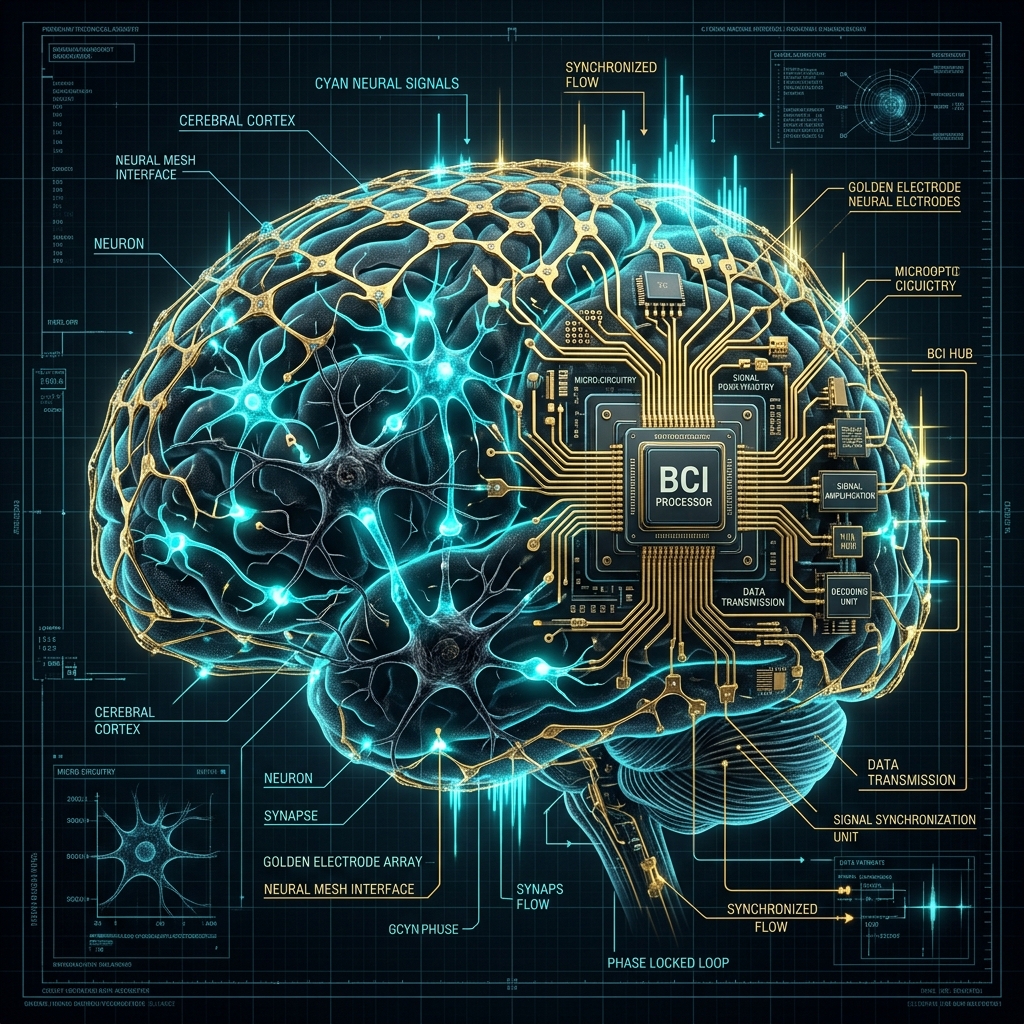
[HE#18] Neural Integration: Synchronizing Brain-Machine Interfaces (BCI) with Local Neural Meshes
01. The Synaptic Boundary: Defining the Physical Interface of Cyber-Biological Synthesis
The ultimate frontier of cybernetic connection is not the connection between two pieces of silicon; it is the direct physical interface between biological neural tissue and digital hardware. For decades, cybernetics remained a science fiction concept or was relegated strictly to restorative medical treatments. However, in the strategic landscapes of 2026, the synchronization of Brain-Machine Interfaces (BCI) with high-speed digital networks has emerged as the definitive threshold of cognitive acceleration and sovereign intelligence control. circumventing biological input/output bottlenecks—such as visual reading speeds and physical keystroke latencies—demands direct coupling at the synaptic boundary.
Designing physical connections that interface directly with cranial tissue presents extreme mechanical, thermal, and biological engineering challenges. The human brain is a highly corrosive fluid environment. Standard copper or silicon conductors corrode rapidly when exposed to cerebrospinal fluid, while triggering aggressive biological foreign-body immune responses that encapsulate the electrodes in thick glial scars. Glial encapsulation isolates the electrode, rapidly degrading signal transmission until the interface becomes completely deaf. Bridging this bio-electrical divide requires utilizing advanced, highly biocompatible materials such as carbon nanotube (CNT) fiber arrays and flexible conductive polymers.
These modern micro-electrode arrays are designed to match the mechanical compliance of neural tissue, flexing naturally with the brain's pulsatile movements rather than cutting into delicate membranes. Carbon nanotube micro-threads, measuring only a few micrometers in diameter, can weave seamlessly into the cerebral cortex without causing localized cellular trauma. By establishing stable, low-impedance electrical contact with individual neural synapses, these bio-compatible arrays allow us to bridge biological action potentials with digital semiconductor logic, forming a highly reliable synaptic boundary that remains stable over decades of continuous operation.
Digital-biological symbiosis cannot be achieved through rigid implants. The connection must act as a flexible cybernetic overlay that mirrors the brain's micro-mechanical properties, circumventing the immune system's isolation response to secure long-term electrical coupling.
02. Neural Signal Decoding: From Analog Action Potentials to Digital Logical Vectors
Establishing a physical contact layer is only the first step. The raw electrical activity captured by a BCI array is a chaotic, noisy mix of overlapping action potentials, extracellular voltage fluctuations, and thermal noise. A single cortical electrode captures a composite analog signal containing electrical spikes from hundreds of nearby neurons. Translating this organic noise into precise digital control commands requires advanced, low-latency computational decoders running directly at the edge boundary.
The neural decoding pipeline begins with Spike Sorting. When a neuron fires, it generates a highly characteristic, brief voltage spike known as an action potential. Because individual neurons have unique physical structures and spatial positions relative to the electrode, their spikes possess distinct wave shapes and amplitudes. High-speed analog-to-digital converters (ADC) capture the raw brain signals at 30 kHz, passing them through real-time hardware bandpass filters to isolate individual action potentials. Machine learning algorithms, such as localized clustering decoders, categorize these spikes by shape, mapping individual firing patterns to specific, isolated biological neurons in real time.
Once individual neural spikes are isolated, the decoder calculates firing rates across thousands of parallel channels to reconstruct the biological intent. Advanced state-space models and localized Kalman filters analyze these high-dimensional firing patterns to predict motor intent, cognitive load, or semantic thoughts. By translating high-frequency neural spike trains into structured, digital logical vectors, the BCI system converts organic biological intent into clean, machine-readable instructions, circumventing muscle pathways completely and enabling microsecond-latency cognitive command execution.
03. Electromagnetic Isolation: Shielding Cranial Circuits Against Environmental Entropy
Biological neural pathways operate on incredibly minute electrical potentials. A standard neuronal action potential measures only -70 to +40 millivolts, while extracellular local field potentials are captured in the microvolt range. This extreme sensitivity makes the biological-digital interface exceptionally vulnerable to external electromagnetic interference (EMI). The ambient electromagnetic noise generated by nearby power grids, smartphone cellular transceivers, wireless networks, and even the digital circuitry of the BCI processor itself can easily swamp the delicate biological signals, rendering the decoder completely blind.
Securing neural signal integrity requires implementing absolute Electromagnetic Isolation at the hardware layer. The analog signal cables routing from the cranial micro-electrode array to the primary pre-amplifier chips must be heavily shielded using ultra-lightweight, high-density Mu-metal or carbon-fiber braided jackets. Mu-metal provides high magnetic permeability, effectively absorbing low-frequency magnetic fields that easily penetrate standard copper shielding. Every signal pathway must be laid out as a differential pair, allowing the pre-amplifiers to use common-mode rejection to discard ambient EMI noise that affects both lines equally.
Furthermore, the primary processing core must be physically decoupled from the analog front-end (AFE) using high-isolation opto-couplers or capacitive barrier digital isolators. By transmitting digital signal packets across an optical or capacitive gap rather than direct galvanic wires, we prevent high-frequency digital switching noise from feeding back into the sensitive analog cranial probes. This galvanic isolation barrier protects the biological tissue from hazardous electrical faults while maintaining an pristine, noise-free signal environment that allows the decoding algorithms to operate at maximum resolution.
Every component of the cranial analog front-end must maintain a galvanic isolation barrier exceeding 2,500 volts. Under no circumstances may digital processing surges, power fluctuations, or hardware faults transmit voltage leakage back to biological tissues. The safety of the neural medium is absolute.
04. The Local Neural Mesh: Orchestrating Ephemeral Edge Processing Inside Cranial Boundaries
Traditional BCI architectures route raw biological data streams to external, centralized computing hubs or cloud networks for processing. However, this centralized topology introduces catastrophic vulnerabilities. A high-density BCI array with 1,024 channels capturing data at 30 kHz generates over 600 megabits of raw electrical telemetry every second. Streaming this massive bandwidth over wireless links introduces severe latency delays, consumes massive battery power, and exposes highly intimate cognitive data to remote interception, sniffing, and unauthorized server-side analysis.
To defend cognitive sovereignty, we implement The Local Neural Mesh. We move the entire signal processing, spike sorting, and semantic decoding pipeline onto a localized, highly optimized edge computing processor worn directly on or near the body. This local neural mesh acts as an ephemeral edge processing enclave, digesting raw microvolt signals locally and transmitting only compressed, encrypted, low-bandwidth command vectors to external systems. The raw thoughts, subconscious sensory perceptions, and electrical anomalies are never broadcast; they remain isolated and sealed within the local physical boundary.
This edge-processing paradigm guarantees absolute cognitive privacy. By sealing the high-bandwidth raw neural data inside a local, hardware-hardened cryptographic boundary, we prevent adversaries from reconstructing mental states or mapping internal neural pathways. Furthermore, running local neural networks directly on ultra-low-power neuromorphic edge chips reduces decoding latencies from hundreds of milliseconds (common in cloud infrastructures) to under 2 milliseconds. This instant processing loop enables real-time, bidirectional cognitive interaction, allowing the sovereign individual to orchestrate digital systems at the speed of thought.
| Metric / Parameter | Centralized Cloud BCI Architecture | Localized Edge Neural Mesh |
|---|---|---|
| Processing Latency | 120ms - 350ms (network-dependent) | < 2.0ms (direct hardware decoding) |
| Telemetry Bandwidth | High (600+ Mbps raw neural streams) | Ultra-Low (< 100 Kbps encrypted commands) |
| Cognitive Privacy | Zero (Raw neural waveforms exposed to cloud servers) | Absolute (Raw data processed locally; never broadcast) |
| Power Efficiency | Poor (Constant high-power wireless transmission) | Excellent (Ultra-low-power local neuromorphic compute) |
| System Sovereignty | Vulnerable (Dependent on cloud API availability) | Absolute (Fully functional in isolated, air-gapped states) |
05. Technical Demonstration: BCI Neural Signal Integration and Decoupling Loop
To demonstrate how a localized cranial telemetry processor captures raw electrical signals, performs digital bandpass filtering to extract key frequency bands (alpha, beta, gamma), and cryptographically signs secure command vectors before localized dispatch, the following Python script simulates a BCI Neural Signal Integration & Decoupling Loop.
This simulation illustrates the raw data path of a localized BCI telemetry framework. The processor receives volatile bio-electrical telemetry inputs, immediately performs active noise-canceling normalization if common-mode EMI exceeds thresholds, filters out the baseline offset, and extracts root-mean-square feature power. The classified cognitive intent is then dynamically signed with a localized cryptographic private key, guaranteeing that any downstream system receiving the command can verify its origin and integrity instantly, without ever exposing the raw neuronal waveforms.
06. The Sovereign Mind Manifesto: Hardcoding the Ultimate Boundary of Biological Autonomy
The convergence of biological brains and digital machinery marks the ultimate milestone of our cybernetic evolutionary journey. However, as the physical interface between biological pathways and digital networks becomes seamless, the threat of cognitive compromise, neural manipulation, and data extraction moves from theoretical speculation to immediate, real-world reality. If an external entity can write to your neural enclaves or read your raw cortical processes, your absolute sovereignty ceases to exist.
As the Sovereign Architect, you must draw an immutable boundary around the human cognitive space. The local neural mesh must act as a one-way cryptographic diode. It must capture, filter, decode, and sign biological telemetry for external control, but it must strictly restrict external write inputs to highly audited, isolated sensory feedback paths. Direct cortical writing must be locked behind physical-layer hardware switches that can only be engaged via conscious biological consent. Welcome to the Era of the Sovereign Mind—harness your biological circuits, defend your cranial boundaries, and hardcode your cognitive independence into the fabric of the universe.
Do not allow external systems write access to your neural enclaves. The biological-digital interface must operate as a cryptographic diode—allowing output command telemetry while physically locking and isolating external input paths behind bios-level physical switches. Secure the mind as the absolute fortress of your empire.
Every component of the cranial analog front-end must maintain a galvanic isolation barrier exceeding 2,500 volts. Under no circumstances may digital processing surges, power fluctuations, or hardware faults transmit voltage leakage back to biological tissues. The safety of the neural medium is absolute.
Do not allow external systems write access to your neural enclaves. The biological-digital interface must operate as a cryptographic diode—allowing output command telemetry while physically locking and isolating external input paths behind bios-level physical switches. Secure the mind as the absolute fortress of your empire.


