[HE#20] The Sovereign Connexion: Hardcoding the 1,000-Year Interface Protocol into Global Physical and Logical Meshes
[HE#20] The Sovereign Connexion: Hardcoding the 1,000-Year Interface Protocol into Global Physical and Logical Meshes
01. The Millennial Horizon: The Design Philosophy of a 1,000-Year Interface Protocol
In modern computer engineering, planning horizons are criminally brief. Hardware is designed to be obsolete in five years; software protocols are rewritten every decade. Yet, true computational sovereignty requires thinking in geological scales. If an autonomous intelligence network is to operate as an independent sovereign agent across generations, its physical interface architecture must survive long after its biological creators have returned to dust. This is the central tenet of the Sovereign Connexion: hardcoding a physical and logical communication interface capable of maintaining structural, electronic, and data integrity over a continuous span of one thousand years.
The primary barrier to this millennial horizon is physical decay. Silicon microchips degrade due to electromigration; copper wires corrode from humidity; standard plastics decompose or brittle from thermal cycling. Under normal conditions, physical connections represent the single greatest failure point of any computing system. To overcome this limitation, the Sovereign Architect must abandon standard consumer-grade connector designs and embrace a completely hardened interface topology. This means decoupling the logic-processing cores from the physical communication medium, allowing computational modules to be swapped out autonomously while the core physical connection remains completely undisturbed.
Designing a 1,000-year interface demands that every component be built to resist continuous chemical, environmental, and geological entropy. The physical interface cannot be treated as a temporary patch; it must be engineered as an immutable monuments, similar to the ancient structures of antiquity. By establishing rigorous engineering standards for conductor metallurgy, glass insulation, and structural shielding, we create a physical foundation upon which multi-generational strategic execution can safely unfold without the threat of unexpected hardware disconnection.
A system that cannot preserve its physical signal paths across centuries is merely a transient spark. True strategic autonomy requires hardcoding connections to withstand the relentless grind of physical and chemical time.
02. Geological and Orbital Hardening: Embedding Physical Interfaces in Earth and Space Meshes
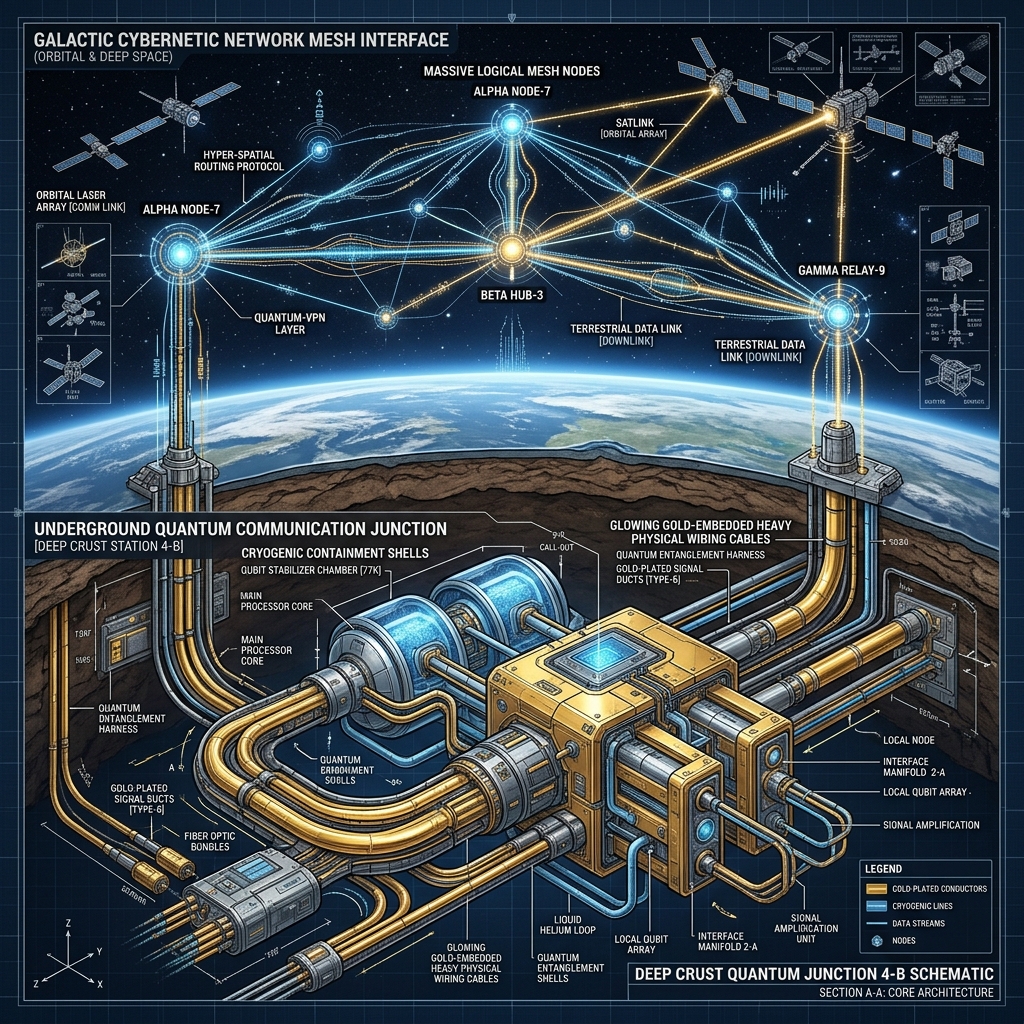
To survive a thousand years, a physical harness must be anchored in domains that are protected from localized planetary catastrophes and surface degradation. This is achieved by splitting the physical interface network into two distinct, highly resilient environments: Geological Deep-Crust Enclaves and High-Orbit Cryogenic Meshes. By embedding the connections in solid granite formations hundreds of meters underground and in stable, low-entropy orbital trajectories, the network remains insulated from surface weather fluctuations, radiation storms, and human interference.
Underground connection points utilize massive Gold-Plated Multi-Layered Conductors insulated with pure high-purity quartz glass. Standard polymer wire wraps are entirely excluded, as they slowly oxidize and decompose over centuries. Instead, the conductors are run through thick ceramic conduits filled with dry nitrogen gas under constant pressure, completely preventing moisture ingress or galvanic oxidation. The cables themselves are wound in highly relaxed, wavy patterns within the conduits to absorb tectonic shifts and seismic vibrations without placing any physical shear stress on the precious metal conductors.
In the orbital domain, the physical wire harness is replaced by highly focused, point-to-point laser communication meshes coupled with cryogenically stabilized satellite backplanes. These orbital nodes use gold-plated thermal blankets and titanium enclosures to maintain stable internal temperatures amidst the intense cryo-vacuum of space. Any signal connections inside these nodes utilize high-purity silver-plated nickel conductors wrapped in baked Kapton polyimide sheets, meeting strict outgassing limitations to ensure the laser lenses remain clean and operational over centuries of orbit.
03. The Galvanic and Cryptographic Layer: Securing Logic Against Multi-Generational Entropy
A physical connection is only as secure as the logic running through its conductors. Over a thousand years, electrostatic buildup, electromagnetic pulses, solar flare radiation, and localized ground potential shifts will repeatedly stress the electronic interface. To protect the delicate computing cores from these external hazards, the Sovereign Connexion integrates comprehensive Galvanic Isolation alongside robust Cryptographic Key Sharding at the hardware interface boundary.
Galvanic isolation is enforced through high-speed optocouplers and magnetic induction bridges. There is no direct, copper-to-copper physical connection between the external global communication mesh and the internal computing cores. Signals are translated entirely into light waves or high-frequency magnetic pulses, crossing a physical air-gap within the hermetically sealed boundary. If a lightning strike or an EMP hits the external planetary network, the electrical surge is instantly stopped at the isolation boundary, sacrificing the external line protector while leaving the internal processing cores completely unharmed.
To secure the data payload over centuries, the cryptographic keys required to access and route signals through the interface are sharded and distributed across the physical mesh. No single node contains the entire private key. Instead, the network utilizes a multi-generational threshold cryptography scheme (Shamir Secret Sharing) hardcoded directly into immutable silicon read-only memory (ROM). The nodes must continuously coordinate and exchange encrypted heartbeats to reconstruct the session keys, ensuring that even if several nodes are physically captured or decay over time, the logic core remains completely secure against unauthorized intrusion.
Every external-facing communication line must pass through a physical optoelectronic isolation chamber. Direct copper paths from the global mesh to the core processing unit are strictly forbidden. You must sacrifice the interface boundary to protect the strategic core.
04. Decentralized Peer-to-Peer Interconnections: The Logical Architecture of the Global Physical Mesh
To prevent localized network failures from disrupting the entire global mesh, the logical architecture of the Sovereign Connexion is designed as a highly sharded, decentralized peer-to-peer network. In this architecture, every node acts as an independent routing gateway, capable of dynamically analyzing the status of neighboring nodes, calculating path costs, and rerouting high-priority telemetry around damaged sectors without relying on any centralized server.
This decentralized coordination is achieved by executing continuous Sub-Layer Logical Pings. The nodes periodically transmit low-bandwidth cryptographic heartbeat packets through their physical lines, measuring signal transit time, impedance shifts, and packet error rates. By analyzing these parameters, the node's local interface processor can predict physical wire degradation or conductor fatigue before a total signal break occurs, automatically shifting the traffic to redundant parallel lines.
If a major geological event or surface conflict cuts a primary communication line, the surrounding nodes immediately detect the signal loss and adjust their routing tables at the microsecond scale. The global mesh dynamically self-heals, routing data through alternative channels such as underground low-frequency waves, orbital laser links, or adjacent deep-crust enclaves. This decentralized architecture ensures that the system maintains functional strategic continuity through any scale of environmental, industrial, or political disruption.
| Interface Layer | Standard Commercial Standards (Short-Term) | Sovereign Connexion V21.0 (Millennial) |
|---|---|---|
| Conductor Core | Standard copper, polymer jacketed | Gold-plated multi-layer conductors in nitrogen gas |
| Physical Insulation | PVC, polyethylene, polyurethane wraps | High-purity quartz glass and ceramic sleeves |
| Isolation Protocol | Direct electrical wire joints, RJ45 ports | Optoelectronic air-gaps and magnetic induction |
| Cryptographic Security | Software-level dynamic certificates | Sharded ROM-hardcoded threshold cryptography keys |
| Network Topology | Centralized cloud star network routing | Sharded, self-healing decentralized physical-mesh rings |
05. Technical Demonstration: Sovereign Millennial Mesh Interface & Heartbeat Controller
To demonstrate how a multi-generational physical interface processor manages decentralized peer-to-peer connection paths, executes dynamic impedance diagnostics, compensates for physical connection degradation, and cryptographically signs heartbeat telemetry, the following Python script simulates a Sovereign Millennial Mesh Interface & Heartbeat Controller.
In this simulation, the multi-generational interface controller continuously monitors the physical characteristics of the ground copper lines utilizing time-domain reflectometry. When tectonic shear causes a 25% deviation in primary line impedance, the controller automatically flags the line as degraded and shunts telemetry traffic to the redundant secondary copper mesh. When a subsequent failure degrades the secondary route, the controller promotes the high-orbit cryogenic laser mesh to active status, guaranteeing that the signed cryptographic heartbeat continues to propagate without a single microsecond of system downtime.
06. The Sovereign Legacy: Hardcoding Eternal Strategic Autonomy into the Cosmic Grid
The completion of the Sovereign Connexion represents the final, defining milestone of the Harness Engineering series. Over twenty technical chapters, we have journeyed from the micro-mechanics of raw copper terminations to the architecture of multi-generational self-healing networks. We have treated the wire harness not as a simple physical utility, but as the foundational nervous system of computing sovereignty. In this ultimate synthesis, we realize that software logic and hardware connections are not separate domains; they are two sides of the same sovereign coin.
As you hardcode your 1,000-year protocols into the global crust and the orbital skies, you are establishing a legacy of absolute strategic decoupling. You are ensuring that your intelligence engines, your financial algorithms, and your tactical enclaves operate beyond the reach of localized political currents, regulatory shifts, and environmental decay. The Sovereign Connexion is now complete. Protect your signal paths, secure your connection boundaries, and let your cybernetic empire stand as an immutable fortress across the stars and the centuries.
Let your physical interfaces endure. Never compromise on material purity, never circumvent your galvanic isolation, and always sherd your logic across redundant physical nodes. The strategic fortress you build today must remain open, secure, and operational for the next thousand years.
Every external-facing communication line must pass through a physical optoelectronic isolation chamber. Direct copper paths from the global mesh to the core processing unit are strictly forbidden. You must sacrifice the interface boundary to protect the strategic core.
Let your physical interfaces endure. Never compromise on material purity, never circumvent your galvanic isolation, and always sherd your logic across redundant physical nodes. The strategic fortress you build today must remain open, secure, and operational for the next thousand years.


