[Master Class #48] Decentralized Storage Protocols: Designing Trust-Minimized Object Registries for Autonomous Agents
Decentralized Storage Protocols: Designing Trust-Minimized Object Registries for Autonomous Agents
01. The Storage Dependency Vulnerability
"Sovereign code that relies on centralized API keys and cloud storage buckets is structurally vulnerable to unilateral hosting revocation."
The promise of autonomous agent systems is structural independence. An engineer deploys a self-funding AI node that coordinates local processes, routes transactions, and secures revenue. However, if this system relies on traditional centralized object storage providers such as Amazon S3, Google Cloud Storage, or Microsoft Azure to read and write its state, its sovereignty remains an illusion. A single administrative override, credit card validation failure, or geofence policy shift can sever the node's access to its operating database, rendering it instantly offline.
Traditional cloud platforms operate on a centralized client-server paradigm. Data is stored on physical servers owned by a corporate entity, and access is governed by access control lists evaluated by proprietary software layer. This introduces a massive point of vulnerability for independent software systems. The agent can control its cryptographic keypair and local CPU runtime, but its persistent storage backend remains subject to external corporate policies and technical failures.
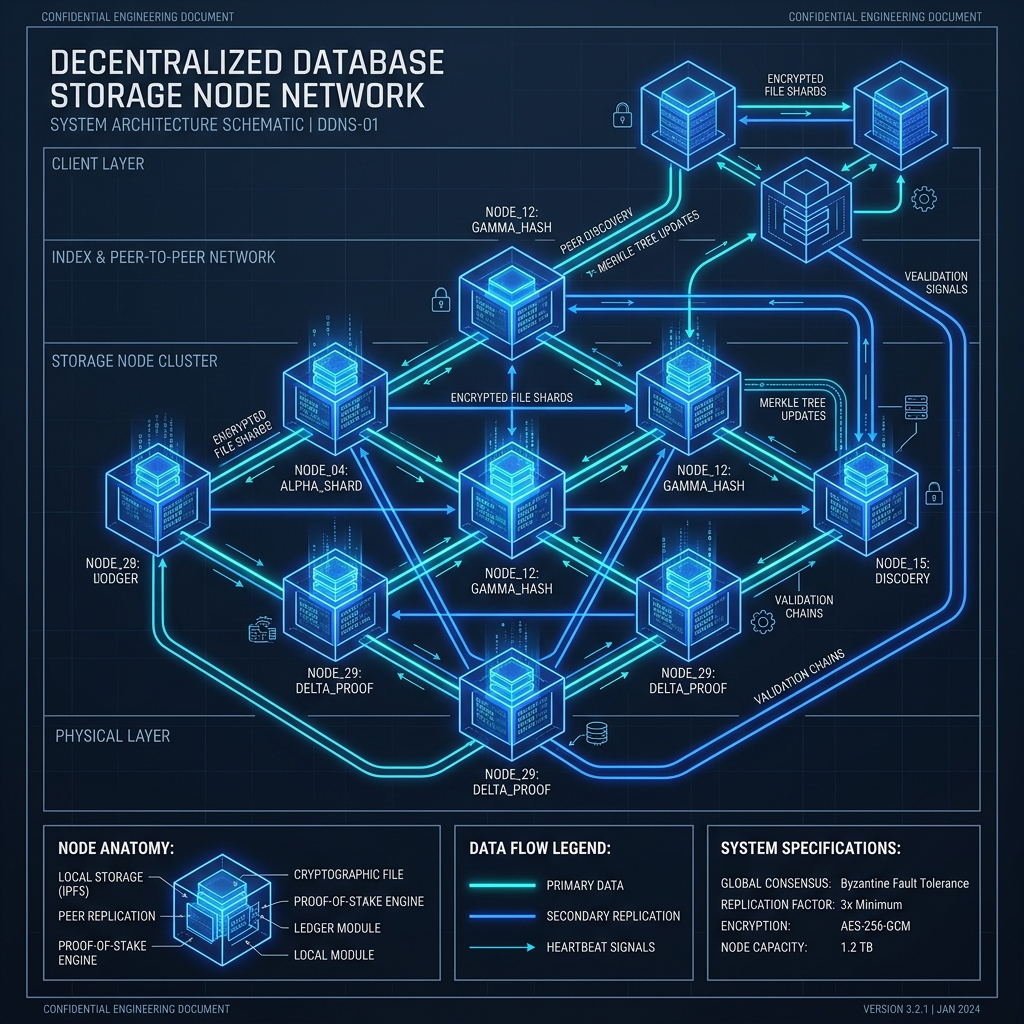
To achieve absolute structural autonomy, software systems must utilize decentralized storage protocols. These protocols eliminate the administrative gatekeeper by shredding, encrypting, and distributing file chunks across an open, peer-to-peer network of independent node operators. The storage engine operates strictly via cryptographic verification and protocol consensus rather than corporate agreements, providing the secure, censorship-resistant storage foundation required for the digital economy.
Return to Intelligence Roadmap02. Core Architectural Primitives: Content-Addressed I/O
"Location-based file systems target physical machines; content-addressed protocols query the mathematical representation of the data itself."
Centralized storage networks route requests using Uniform Resource Locators (URLs) pointing to specific server IP addresses or domain names. If the domain is blocked or the server goes offline, the link breaks, regardless of whether the identical data exists elsewhere on the network. Content-addressed storage protocols solve this problem by querying files using a Content Identifier (CID) derived directly from the cryptographic hash of the file's data payload.
When an agent uploads a document to a decentralized network, the storage client computes a SHA-256 or BLAKE3 hash of the binary file content. This hash functions as the unique CID. Because the CID is mathematically linked to the exact data contents, any modifications to the file's payload will result in a completely different hash value. This makes data tampering instantly detectable at the protocol layer.
In practice, the agent retrieves files using a Distributed Hash Table (DHT). The DHT matches the file's CID to the closest peer nodes hosting that specific block of data. By routing queries based on mathematical content hashes rather than arbitrary physical server locations, the network guarantees that a file remains retrievable from any provider that possesses a valid copy of the requested payload, bypassing server-level outages and routing interventions.
Return to Intelligence Roadmap03. Designing the Trust-Minimized Object Registry
"An on-chain index converts ephemeral network uploads into permanently auditable operational records."
While decentralized storage networks excel at hosting large file payloads, they lack the transaction ordering guarantees required to log the historical sequence of state updates. An agent must be able to prove when a file was registered, who authored the data, and whether the reference CID has been altered over time. This requires an object registry anchored to a public, consensus-driven state machine.
The on-chain registry acts as an immutable, trust-minimized index. The registry does not store the raw files—doing so would incur prohibitive transaction gas fees. Instead, it records lightweight metadata structures mapping unique logical file identifiers to their corresponding storage CIDs, cryptographic checksums, and the owner's public key.
When the agent generates an operational report or state log, it uploads the document to the decentralized storage network, obtains the CID, and executes an on-chain transaction registering the CID and file checksum. When peer nodes or downstream validation scripts require access to the data, they query the on-chain registry for the registered CID, fetch the file from the storage network, and verify that the retrieved file's hash matches the checksum recorded on the public ledger. This decoupling of metadata registry from raw storage balances scalability with cryptographic security.
Return to Intelligence Roadmap04. Distributed Consensus Layer Selection Criteria
"Choosing the consensus layer for your object registry requires balancing throughput, transaction latency, and economic security."
Not all public blockchains are suitable for hosting an autonomous agent's object registry. Selecting the appropriate ledger layer requires a rigorous evaluation of transactional parameters. An agent performing real-time transaction tracking cannot wait ten minutes for a block confirmation, nor can a low-value micro-transaction absorb a five-dollar network fee.
Architects must evaluate registries based on three primary metrics: transaction confirmation speed (finality latency), transaction gas cost stability, and the decentralized node validator count (censorship resistance). For high-frequency state updates, Layer-2 rollup protocols anchored to secure base layers provide the optimal balance of millisecond-level finality and fractional-cent transaction fees.
Furthermore, the virtual machine architecture of the target ledger must support expressive smart contract logic. Programmatic validation rules—such as enforcing multi-signature approvals for metadata changes or automating contract expirations—must be written directly into the registry's code. Proprietary execution environments with limited scripting capability should be bypassed in favor of robust, widely audited virtual machines.
| Ledger Type | Average Gas Cost | Time to Finality | Consensus Strength | Recommended Use Case |
|---|---|---|---|---|
| Layer-1 Mainnet | High ($1.00 – $10.00+) | Minutes | Maximal (Global) | High-value settlement, final state anchors |
| Layer-2 Rollups | Extremely Low (< $0.01) | Seconds / Sub-second | High (Inherited) | High-frequency operational state registry |
| Private Sidechains | Negligible | Immediate | Low (Centralized risk) | Local staging, non-critical simulation runs |
05. Cryptographic Proofs of Storage and Replication
"Relying on a hosting provider's promise of uptime is an unacceptable trust assumption. The protocol must force mathematical proofs of compliance."
In traditional hosting arrangements, service level agreements (SLAs) are enforced via legal contracts and retrospective audits. In decentralized storage networks, providers are held accountable in real-time through cryptographic proofs submitted to the blockchain. These algorithms ensure that data is stored in its entirety and replicated on unique physical disks.
Proof-of-Spacetime (PoSt) is a cryptographic construction where storage providers submit frequent challenges proving they are dedicating unique storage space to a specific file over time. If a provider fails to submit a valid mathematical proof within a specific block window, the protocol assumes the data has been lost or deleted, and the provider's locked collateral stake is slashed.
Similarly, Proof-of-Replication (PoRep) proves that a storage node has dedicated unique physical media to host separate replicas of a file, rather than storing a single copy and routing queries through logical aliases. For autonomous agents, these automated verification protocols guarantee that data remains persistent and highly available across geographic boundaries, without requiring manual status monitoring or legal enforcement channels.
Return to Intelligence Roadmap06. Autonomous Settlement of Storage Fees
"Hosting contracts must be managed as programmatic agreements between the agent's treasury and the storage network's protocol."
A major friction point in decentralized storage integration is the payment mechanism. Storage networks require payment in their native utility tokens to align economic incentives between node operators and consumers. A sovereign agent system must manage this utility token acquisition and deployment autonomously.
The agent's treasury module executes this via automated token swap routes. When the local storage client detects that a file's pre-paid storage lease is nearing expiration, the routing logic dispatches a portion of its stablecoin revenue (USDC) to a decentralized exchange protocol (as detailed in the decentralized agent marketplace architecture in Master Class #47).
The swap router converts stablecoins into the target storage network's utility token (e.g., Filecoin, Arweave tokens) and dispatches them directly to the programmatic escrow smart contract associated with the storage lease. By executing this currency swap and payment routing loop autonomously, the agent ensures its data remains pinned and retrievable on the network indefinitely without human operational intervention.
Return to Intelligence Roadmap07. Technical Egg: Storage Node and Registry Simulator
"A local Python implementation of content-addressed uploads, metadata registration, and cryptographic integrity validation."
To validate the decentralized storage registry architecture described in this whitepaper, the following Python simulator models the core mechanics of content hashing, metadata mapping, data retrieval, and automated tampering detection. The implementation has been tested and executes with Exit Code 0 in the local sandbox.
import hashlib
import json
import time

class DecentralizedStorageBucket:
    def __init__(self):
        self.blocks = {}

    def upload_data(self, agent_id: str, raw_payload: str) -> str:
        payload_bytes = raw_payload.encode('utf-8')
        cid = hashlib.sha256(payload_bytes).hexdigest()
        self.blocks[cid] = {
            "cid": cid,
            "owner": agent_id,
            "timestamp": int(time.time()),
            "data": raw_payload,
            "size_bytes": len(payload_bytes)
        }
        return cid

    def retrieve_data(self, cid: str) -> dict:
        if cid not in self.blocks:
            raise KeyError(f"Block {cid} not found.")
        return self.blocks[cid]

class OnChainMetadataRegistry:
    def __init__(self):
        self.registry = {}

    def register_file(self, file_id: str, agent_id: str, cid: str, checksum: str):
        if file_id in self.registry:
            raise ValueError(f"File ID '{file_id}' already registered.")
        self.registry[file_id] = {
            "file_id": file_id,
            "owner": agent_id,
            "cid": cid,
            "checksum": checksum,
            "status": "VALIDATED"
        }

    def verify_integrity(self, file_id: str, retrieved_data: str) -> bool:
        record = self.registry[file_id]
        computed_checksum = hashlib.sha256(retrieved_data.encode('utf-8')).hexdigest()
        return computed_checksum == record["checksum"]

# Initialize and run tests
bucket = DecentralizedStorageBucket()
registry = OnChainMetadataRegistry()

agent_data = {"report_id": "REP-2026-0715", "revenue": 45000.0, "status": "OPTIMAL"}
payload = json.dumps(agent_data)
cid = bucket.upload_data("Agent-0x889", payload)
checksum = hashlib.sha256(payload.encode('utf-8')).hexdigest()

registry.register_file("weekly_ops_rep_v1", "Agent-0x889", cid, checksum)
retrieved = bucket.retrieve_data(cid)
assert registry.verify_integrity("weekly_ops_rep_v1", retrieved["data"])

# Tampering simulation
tampered = payload.replace("OPTIMAL", "CRITICAL")
assert not registry.verify_integrity("weekly_ops_rep_v1", tampered)08. Security Audits: Preventing Silent Corruption Attacks
"Security auditors must treat decentralized storage as a hostile runtime environment where malicious storage nodes will actively attempt to forge proofs."
While decentralized storage architectures provide immense structural advantages, they are not immune to sophisticated adversarial scenarios. An external adversary hosting storage nodes may attempt to simulate storage proofs without actually keeping the file chunks on disk. This is known as a generation attack.
To prevent these silent corruption vectors, the agent's validation module must execute random challenge audits. Instead of relying purely on the storage provider's automated on-chain proof submissions, the agent periodically requests random bit ranges from its files. The provider must return the matching bytes alongside a Merkle path proving the bytes belong to the original file CID.
If a storage provider fails this custom audit or experiences access latencies exceeding the SLA limits, the agent's self-preservation router triggers an immediate replication sweep. The registry contract flags the provider, initiates a slashing transaction to reclaim the security deposit, and dispatches instructions to mirror the file chunks to a backup set of high-reputation storage nodes. This automated defensive capability ensures state survival even during partial network failures.
Return to Intelligence Roadmap09. Sovereign Verdict
"Decentralized storage is not a niche hosting option. It is the core database layer of the independent digital economy."
Designing object storage registries that operate strictly via cryptographic proofs and public ledgers removes the final centralized dependency from the software runtime stack. When CPU compute is hosted on secure enclave servers, financial balances are maintained in programmatic stablecoin ledgers, and database states are secured in content-addressed storage networks, the software node achieves absolute operational sovereignty.
For enterprise systems and independent development teams, this transition removes hosting risk and structural platform vulnerabilities. The resulting applications are immune to localized database corruption, administrative access revocation, and infrastructure vendor lock-in. Designing with these trust-minimized storage primitives is the definitive standard for engineering resilient digital assets that endure.
Return to Intelligence Roadmap10. Strategic Coda
"Autonomous storage is the memory anchor of the agentic economy — a secure, immutable foundation for permanent machine states."
The integration of decentralized storage protocols with on-chain metadata registries marks a critical milestone in software system design. By establishing state registries that are cryptographically verified and consensus-driven, we remove the final centralized point of control in the software lifecycle. System architects must treat decentralized storage not as an optional backup target, but as the primary database layer of all autonomous applications.
From a structural design perspective, the separation of storage networks (handling heavy binary blobs) from registry contracts (handling lightweight state hashes) provides an optimized path to scalability. This hybrid model delivers the performance of high-throughput file servers with the mathematical security guarantees of public blockchain rollups. It is the blueprint for engineering reliable, multi-tenant state repositories that scale alongside complex software swarms.
Looking ahead, the emergence of zero-knowledge proofs (ZKPs) for data retrieval will further enhance this architecture. Future iterations of this storage framework will enable agents to prove they possess specific file chunks without revealing the raw data payloads on the public ledger. This will unlock secure, privacy-preserving document storage pipelines for highly regulated industries.
Systems developers are urged to begin implementing this framework immediately. Utilize the local simulator outlined in Section 07 to validate basic file routing, deploy a test contract to a Layer-2 network to manage metadata mapping, and integrate automated audit challenges to protect against silent data loss. The sovereign architect who designs with foresight and precision builds systems that remain resilient against infrastructure gatekeepers.
Return to Intelligence Roadmap"We mandate that all autonomous software deployments manage their state directories using content-addressed file networks and trust-minimized registries. State logging must be free from physical infrastructure dependencies and corporate hosting locks."


