[Master Class #64] Enterprise State Attestation: Multi-Agent Consensus and Zero-Knowledge Result Integrity
[Master Class #64] Enterprise State Attestation: Multi-Agent Consensus and Zero-Knowledge Result Integrity
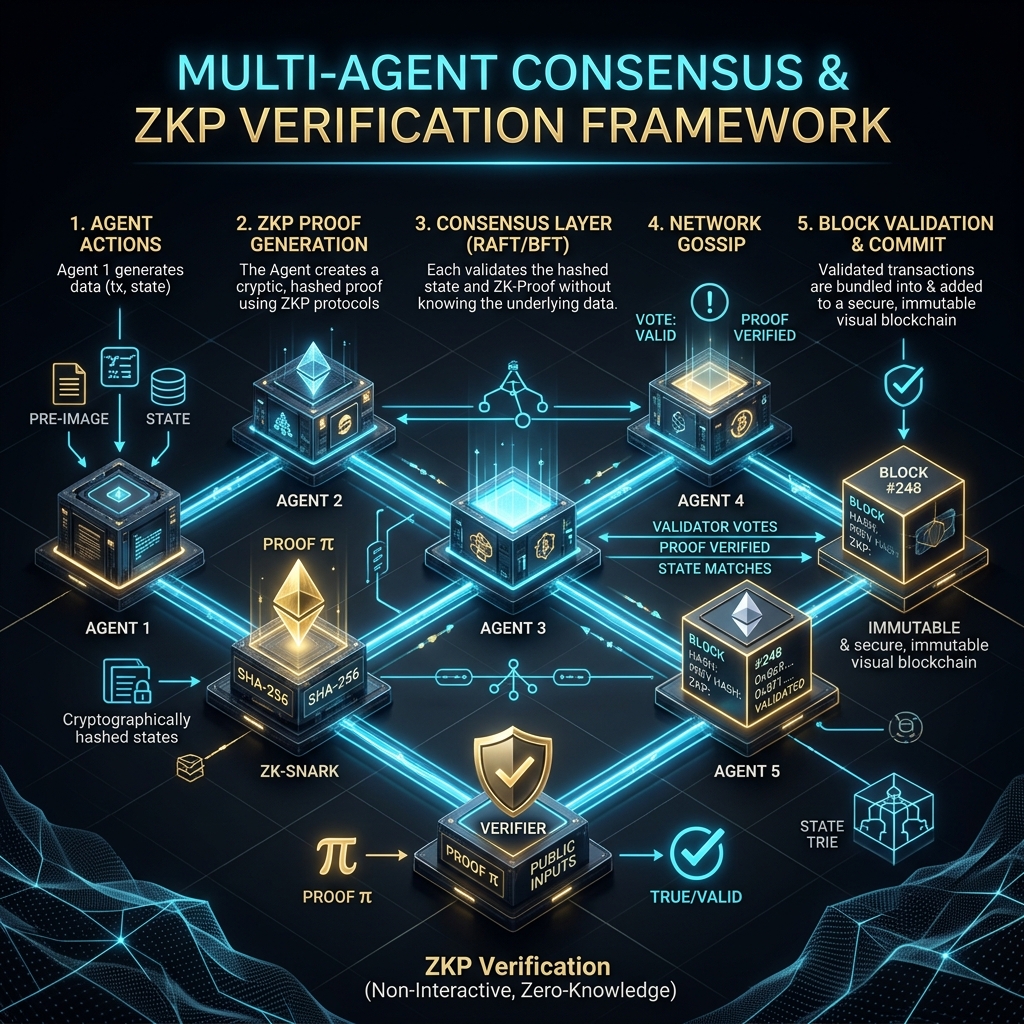
- 01. The Threat of Untrusted Executions in Decentralized Swarms
- 02. Multi-Agent Consensus: Enforcing Byzantine Fault Tolerance in Node Clusters
- 03. Zero-Knowledge Proofs (ZKP): Proving Computational Integrity without Data Leakage
- 04. Technical Egg: Implementing a Cryptographic Attestation Ledger
- 05. State Verification: Validating Hashes and Signatures across Host Nodes
- 06. Security Auditing: Replay Attacks and Sybil Defense
- 07. Sovereign Verdict
- 08. Strategic Coda
Relying on a single agent node's calculations is a significant operational hazard. If your decentralized swarm executes business decisions without cryptographically attesting execution states, a single compromised node can corrupt your entire corporate ledger.
In a decentralized agent swarm, nodes process real-world inputs (such as financial database records, pricing APIs, or inventory lists) to execute sovereign automated tasks. If Node A is compromised by an external adversary or encounters an unhandled system exception, it may yield altered, corrupt, or malicious execution outputs. Without an independent attestation layer, adjacent nodes will ingest these bad states as truth, causing cascading errors across your transaction ledgers or automation triggers.
We reject the assumption of node honesty. Every execution state must be attested and verified before it is committed to our system. By implementing multi-node cryptographic consensus and zero-knowledge verification, we verify that calculations are executed correctly without exposing private, proprietary data payloads. This state verification architecture is the core of decentralized agent sovereignty.
State attestation verifies that the execution output of an agent node matches the expected state change. By hashing and chaining states sequentially, any alteration of execution memory is immediately detected and rejected by peer nodes.
To defend against rogue or malfunctioning nodes, we implement a Byzantine Fault Tolerant (BFT) consensus protocol. This ensures that the swarm converges on a single, verified execution state even when a subset of nodes is compromised.
A BFT architecture assumes that a fraction of the network nodes may act maliciously or fail unpredictably. By forcing nodes to broadcast their proposed state changes (along with their cryptographic hashes) to all peers, the swarm initiates a multi-stage consensus round (pre-prepare, prepare, commit). A state change is only committed to the global ledger when a supermajority of nodes (typically 2f + 1, where f is the number of tolerated faulty nodes) sign and validate the matching state hash.
This consensus boundary completely neutralizes single-node compromise. If a compromised edge server attempts to inject a fraudulent financial transaction or alter an orchestration variable, its mismatched state hash will fail to gather the required signatures. The swarm detects the anomaly, rejects the state change, and automatically isolates the faulty node, maintaining the integrity of the sovereign enterprise.
| Verification Metric | Single-Node Execution | BFT Consensus Swarm |
|---|---|---|
| Single Point of Failure | Yes (Any node compromise leaks error) | No (Swarm functions under f-faults) |
| State Mutability | Mutable (Can be rewritten by root user) | Immutable (Chained hashes prevent rewrites) |
| Validation Latency | Instant (No peer communication overhead) | Low (1-RTT multi-peer signature round) |
| Compromise Defense | Low (Host takeover compromises output) | High (Host takeovers are rejected by peers) |
While consensus ensures agreement, it typically requires nodes to share raw data payloads—introducing data leakage risks. Zero-Knowledge Proofs (ZKP) allow a node to prove it performed a calculation correctly without revealing the underlying inputs.
Using ZK-SNARKs (Zero-Knowledge Succinct Non-Interactive Argument of Knowledge), an agent node compiles its computation into an arithmetic circuit. The node executes the code inside its secure enclave, generating a mathematical proof (`proof.json`) along with the public output hash. Peer nodes act as verifiers, running a constant-time cryptographic check against the proof. If the verification returns true, it mathematically proves that the node executed the correct logic on valid inputs, without the peers ever seeing the private user payloads or database variables.
This ZKP boundary is crucial when routing sensitive information (such as personal client records, private keys, or API credentials) across different host nodes. Nodes can verify calculation integrity without violating privacy regulations or exposing intellectual property. ZKP transforms distributed computing from a trust-dependent network into a mathematically verified, zero-leak workspace.
We construct a production-ready Python class that implements a cryptographic state hash chain (Attestation Ledger) to sign and verify execution outputs across nodes.
The code hashes local states, signs them using private keys, appends transactions to a hash chain, and verifies signatures dynamically. Below is the complete Python implementation of the attestation ledger:
This implementation ensures that once a block is added, it cannot be modified without breaking the hash chain. Because each block contains the validator's signature (`HMAC-SHA256`), peer nodes can immediately trace which node validated a state change, ensuring accountability across the distributed network.
State verification requires nodes to constantly audit peer ledger states. Peer auditing ensures that split-brain anomalies and data injections are detected immediately.
When an agent node receives a state update, it does not apply it directly to its local database. Instead, it extracts the transaction block, audits the signature against the validator's public key, and verifies that the `prev_hash` aligns with the local ledger genesis path. If the hashes match, the node recalculates the state transformation locally and checks it against the proposed output hash. The update is only committed if all checks return true.
This continuous audit loop guarantees consistency across multi-cloud enclaves. If a network partition causes Node B to desynchronize, the next synchronization handshake will reveal the hash mismatch. The system halts updates on Node B, rolls back its state to the last verified consensus block, and re-syncs the missing ledger entries from verified peers, ensuring absolute state consistency.
Distributed ledgers are targets for network attacks. We configure strict cryptographic controls to defend against replay vectors and malicious node spawning.
A replay attack occurs when an adversary captures a valid signed block (such as an authorized payout state) and broadcasts it again to force a duplicate execution. We prevent this by embedding unique, monotonically increasing sequence numbers (nonces) and strict timestamp windows within every block. If a node receives a transaction block containing a duplicate nonce or an expired timestamp, it immediately drops the packet and logs the anomaly.
Furthermore, to prevent Sybil attacks—where an adversary spawns dozens of virtual nodes to hijack the BFT consensus majority—we enforce hardware attestation validation. A node's consensus vote is only counted if it is verified to originate from a unique physical CPU secure enclave (Intel SGX/AMD SEV) registered in our whitelist. This hardware-bound Sybil defense ensures that only authorized enclaves participate in swarm decisions.


