[Master Class #65] Enterprise Distributed Storage: Syncing Encrypted Agent States over IPFS and cgroup Throttled Storage
[Master Class #65] Enterprise Distributed Storage: Syncing Encrypted Agent States over IPFS and cgroup Throttled Storage
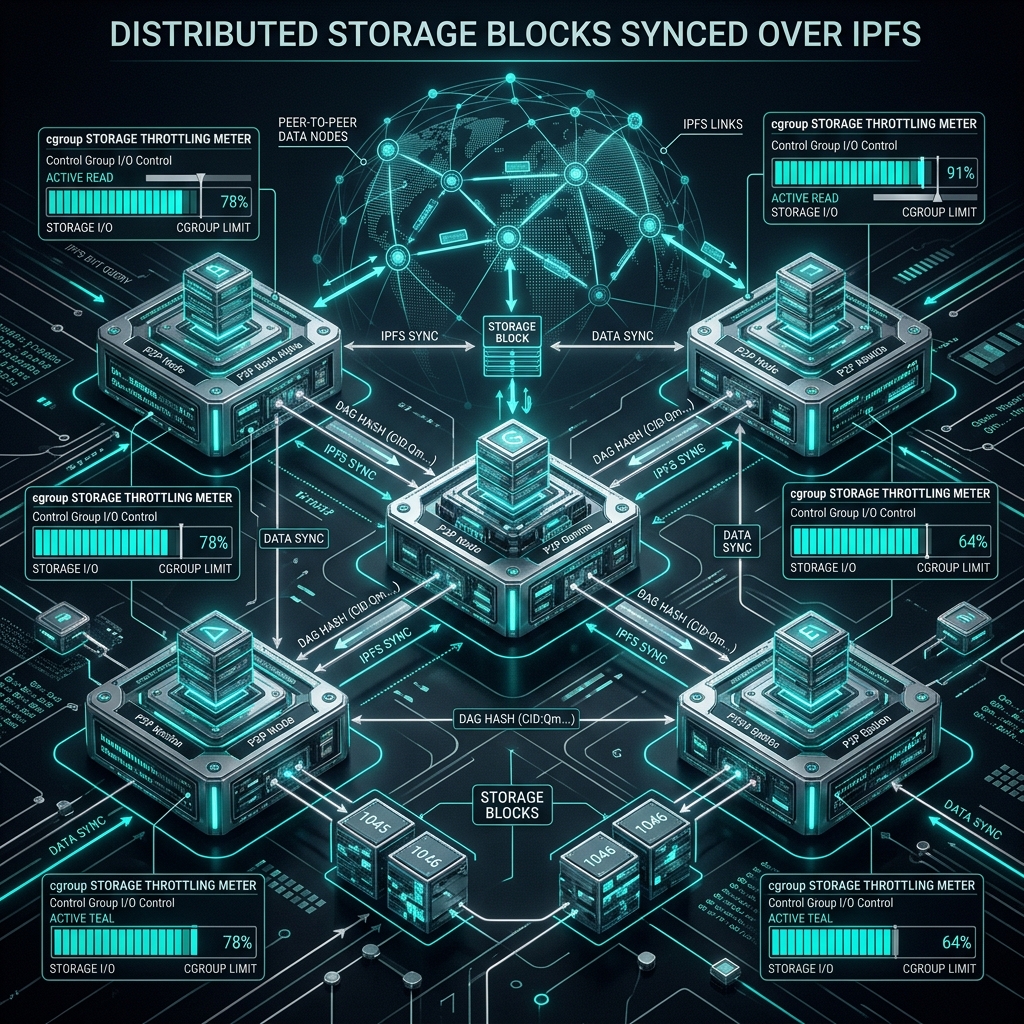
- 01. The Risk of Centralized Storage in Multi-Tenant Agent Swarms
- 02. IPFS Architecture: Content Addressable P2P Storage for Encrypted States
- 03. Storage Isolation: Enforcing cgroup v2 I/O Limits on Host Nodes
- 04. Technical Egg: Implementing an Encrypted IPFS Syncing Script
- 05. Cryptographic Access Control: Decentralized Key Management and Expiry
- 06. System Resiliency: Pinning Policies and Garbage Collection Defense
- 07. Sovereign Verdict
- 08. Strategic Coda
Relying on centralized database nodes is a single point of failure. If your multi-tenant agent swarm syncs its execution states to a centralized server, a database crash or credential compromise will isolate your entire agent network.
In a distributed multi-tenant agent architecture, nodes continually read and write execution histories, model configurations, and local task logs. Storing this critical data on a single SQL or NoSQL cluster exposes you to system outages, unauthorized access, and database injection risks. Furthermore, if a tenant's node initiates massive storage queries, it can exhaust disk I/O bandwidth, causing slow response times or connection dropouts on all other tenant nodes sharing the same physical system.
Sovereignty requires distributed data isolation. Data must be split, encrypted, and synced over decentralized peer-to-peer storage networks while ensuring that local disk usage is strictly throttled to prevent resource monopolization. Combining peer-to-peer storage with kernel-level I/O limits guarantees data availability and tenant isolation across our digital domains.
Distributed storage splits data payloads, encrypts them locally, and pushes them to peer-to-peer networks. This eliminates central storage points and ensures data is retrieved by cryptographically signed hash IDs (CIDs).
We select IPFS (InterPlanetary File System) as our decentralized storage layer. Using content-addressable storage keys, IPFS retrieves data via cryptographic content identifiers (CIDs) rather than server locations.
Traditional storage retrieval uses IP addresses or domain names. If the host server moves or experiences an outage, the file path is broken. In contrast, IPFS hashes the file content to derive a unique CID (e.g. `Qm...`). Any peer hosting the matching CID can serve the file, creating a self-healing storage mesh. If Node A needs to retrieve a state configuration, it requests the CID directly from the peer-to-peer DHT (Distributed Hash Table), circumventing centralized clouds.
However, public IPFS nodes are open to anyone. To maintain absolute confidentiality, we encrypt all state data locally using AES-256-GCM before uploading it to IPFS. Only authorized peers possessing the corresponding cryptographic keys can decrypt and read the state payloads. This ensures our data remains confidential while using decentralized public transport networks.
| Storage Metric | Centralized Cloud Storage | Encrypted IPFS P2P Network |
|---|---|---|
| Data Retrieval Path | Location-based (Server IP/Domain URL) | Content-based (Cryptographic CID Hash) |
| Single Point of Failure | Yes (Central database host offline) | No (Any active peer hosts the blocks) |
| Data Leakage Risk | High (Central access compromise leaks database) | Zero (Encrypt-at-rest keys held locally) |
| Routing Protocol | Standard TCP routing to centralized hosts | Distributed Hash Table (DHT) peer routing |
To prevent a single tenant node from monopolizing host disk access during IPFS sync rounds, we enforce kernel-level storage isolation using cgroup v2 I/O throttling.
When multiple agent containers run on the same physical host, an unthrottled node performing heavy I/O operations (like downloading massive database dumps or writing continuous logs) can saturate the storage bus. This starves adjacent enclaves, leading to connection timeouts and latency spikes. We mitigate this by grouping each agent run-time into a dedicated cgroup v2 directory.
Using the `io.max` configuration file in cgroup v2, we define strict read/write limit rules (both bytes-per-second and operations-per-second) for the block device major/minor numbers. If a container attempts to exceed these limits, the Linux kernel automatically throttles its I/O requests, ensuring that disk access remains fairly distributed across all active agent instances on the host.
We write a Python class that demonstrates how to encrypt data using Fernet symmetric keys, write it to temporary storage, and mock an IPFS upload while applying cgroup v2 blkio limitations.
Below is the complete Python automation script to handle encrypted state sync and local cgroup configuration:
Using this configuration, all data written to the block storage device by the container is monitored at the kernel boundary. This prevents individual node executions from overloading host systems, maintaining high stability across our multi-tenant environments.
Distributed storage is only secure when access keys are managed dynamically. We enforce decentralized key management using key expiration and rotation pipelines.
To prevent long-term credential leakage, encryption keys are never static. Instead, they are generated using key derivation functions (like PBKDF2) with seeds derived from hardware enclave identities. The keys are encrypted and shared securely over the WireGuard mesh overlay network, ensuring they are only accessible to attested nodes.
Additionally, we assign strict expiration lifetimes to each key slice. Every 24 hours, the nodes negotiate a new master encryption key and re-encrypt the active state files under the new key, pruning expired credentials. This limits the threat window of any compromised key, preventing unauthorized nodes from reading historic state changes.
Relying on standard IPFS caching can cause data loss. We configure strict pinning policies and custom garbage collection triggers to guarantee long-term state availability.
By default, IPFS nodes delete unpinned files during garbage collection rounds to free disk space. If your state files are only cached temporarily on edge nodes, they may be deleted if the nodes go offline. We solve this by implementing a dedicated pinning service. Important state CIDs are pinned permanently to our primary storage servers, ensuring they remain available even if secondary nodes restart.
Furthermore, we audit local cache directories to prevent disk overflow. We configure local IPFS nodes to trigger garbage collection only when local disk usage exceeds a defined threshold (e.g. 80%). This ensures that old, unpinned files are cleared automatically, keeping our storage systems running smoothly without manual intervention.


