[Master Class #66] Kernel-Level Rate Limiting: Implementing Token Bucket Algorithms in eBPF for High-Performance DDoS Mitigation
[Master Class #66] Kernel-Level Rate Limiting: Implementing Token Bucket Algorithms in eBPF for High-Performance DDoS Mitigation
Abstract: This systems architecture whitepaper presents a high-performance, kernel-level Distributed Denial of Service (DDoS) mitigation framework utilizing the eXpress Data Path (XDP) subsystem within the Linux kernel. By implementing a stateful Token Bucket rate-limiting algorithm directly inside the network driver's main execution path, the proposed architecture circumvents the overhead of the standard Linux network stack, including socket buffer (sk_buff) allocation and context switching. We detail the design of a lockless, highly concurrent kernel-space C program loaded via the BPF Compiler Collection (BCC) Python framework. The paper analyzes the critical trade-offs between global atomic operations and per-CPU map architectures, addresses strict eBPF verifier constraints, and evaluates the performance optimization strategies necessary to achieve line-rate mitigation on multi-gigabit network interfaces.
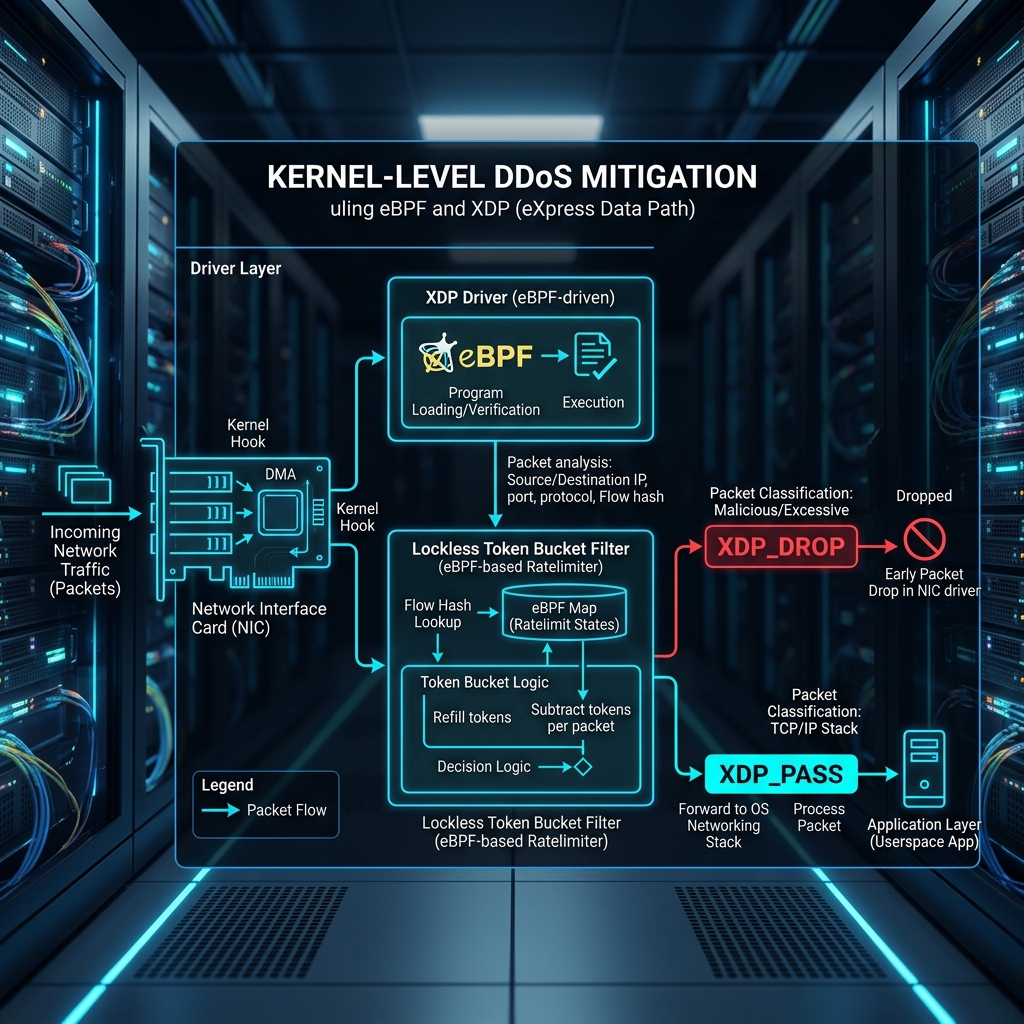
- 01. Executive Summary & Core Engineering Challenge
- 02. Linux Kernel Subsystem Deep Dive
- 03. System Topology & Flow Architecture
- 04. Core Data Structures & Optimization Constraints
- 05. Concurrency Control & Threading Models
- 06. Code Implementation
- 07. Production Configuration & Kernel Settings
- 08. Telemetry, Monitoring & Diagnostics
- 09. System Failures, Mitigation & Auto-Recovery
- 10. Strategic Implications & The Sovereign Architecture Mandate
In modern high-throughput networking environments, Distributed Denial of Service (DDoS) attacks present a critical threat to infrastructure availability. Traditional mitigation strategies operating at the user-space boundary or within the high-level kernel network stack (such as iptables, nftables, or user-space reverse proxies) suffer from a fundamental architectural bottleneck: they require the kernel to allocate a socket buffer (sk_buff) metadata structure for every incoming packet. Under a volumetric attack exceeding millions of packets per second (Mpps), the CPU overhead associated with sk_buff allocation, memory management, and subsequent context switching rapidly exhausts system resources, leading to packet loss for legitimate traffic and eventual system collapse.
To overcome this limitation, this whitepaper details a kernel-level rate-limiting architecture operating at the eXpress Data Path (XDP) layer. XDP allows the execution of sandboxed eBPF (Extended Berkeley Packet Filter) bytecode directly within the network driver's main polling loop (NAPI) before any memory allocation or protocol parsing occurs. By executing a stateful Token Bucket algorithm at this early stage, malicious or excessive traffic can be dropped (XDP_DROP) with minimal CPU cycle expenditure.
The core engineering challenge lies in implementing a mathematically precise, stateful rate limiter within the highly constrained execution environment of the eBPF virtual machine. These constraints include:
- No Floating-Point Arithmetic: The kernel-space eBPF VM does not support floating-point operations, requiring all token replenishment calculations to be performed using high-precision integer arithmetic.
- Strict Verifier Limits: The eBPF verifier enforces static analysis to guarantee program termination and memory safety, limiting instruction counts, stack size (512 bytes), and prohibiting arbitrary loops.
- Concurrency and Race Conditions: On multi-core systems utilizing Receive Side Scaling (RSS), packets from the same flow may be processed concurrently across different CPU cores, necessitating lockless synchronization mechanisms to prevent state corruption without introducing CPU serialization bottlenecks.
This document provides the complete architectural blueprint for a production-grade, eBPF-based Token Bucket rate limiter, utilizing a kernel-space C implementation and a user-space Python loader leveraging the BPF Compiler Collection (BCC) for dynamic orchestration and telemetry.
To understand the performance advantages of XDP-based rate limiting, we must analyze the path of a packet through the Linux kernel network subsystem.
The Traditional Ingress Path vs. XDP
In a standard Linux network configuration, a packet arriving at the Physical Medium Attachment (PMA) is transferred via Direct Memory Access (DMA) to a ring buffer in host memory. The Network Interface Card (NIC) raises a hardware interrupt (IRQ), which is handled by the softIRQ daemon (NAPI poll loop). At this point, the driver allocates an sk_buff structure, copies packet metadata, and passes it up to the Traffic Control (tc) subsystem, followed by the Netfilter hook points (conntrack, iptables), and finally to the socket layer. This path is illustrated below:
| Stage | Traditional Ingress Path | XDP Ingress Path |
|---|---|---|
| 1. DMA Transfer | Packet written to host memory ring buffer. | Packet written to host memory ring buffer. |
| 2. Driver Poll | NAPI poll loop triggered. | NAPI poll loop triggered. |
| 3. Execution Point | sk_buff allocated; packet passed to IP stack. |
eBPF program executes immediately in driver. |
| 4. Action Taken | Routing, Netfilter rules, socket delivery. | XDP_DROP, XDP_PASS, or XDP_TX. |
| 5. CPU Overhead | High (allocation, locks, context switches). | Extremely Low (direct memory access, no allocation). |
XDP intercepts the packet at Stage 3, executing the eBPF program directly on the raw packet buffer (represented by the xdp_md context structure) before the sk_buff is initialized. This circumvents the entire kernel network stack for dropped packets.
XDP Execution Modes
XDP can be deployed in three distinct modes, depending on hardware capabilities and performance requirements:
- Offloaded XDP: The eBPF bytecode is JIT-compiled and loaded directly onto a compatible SmartNIC (e.g., Netronome Agilio). Packets are filtered at the hardware level, consuming zero host CPU cycles.
- Native/Driver XDP: The eBPF program runs within the network driver's main poll loop. This is the default high-performance mode for standard NICs (e.g., Intel
i40e, Mellanoxmlx5), executing before the kernel network stack is reached. - Generic XDP: A software-fallback mode that executes after
sk_buffallocation. While it offers no performance benefits for DDoS mitigation, it is highly useful for testing and development on hardware drivers that do not natively support XDP.
The eBPF Virtual Machine and JIT Compiler
The eBPF execution environment is a register-based virtual machine operating within the Linux kernel. It features eleven 64-bit registers (R0–R10):
- R0: Return value of helper functions and exit code of the eBPF program.
- R1–R5: Argument registers for helper function calls.
- R6–R9: Callee-saved registers preserved across helper calls.
- R10: Read-only frame pointer accessing the 512-byte stack.
Upon loading, the Just-In-Time (JIT) compiler translates the eBPF bytecode into native CPU instructions (x86_64, ARM64, etc.), ensuring near-native execution speeds. The kernel verifier statically analyzes the code to guarantee that it cannot dereference null pointers, access out-of-bounds memory, or enter infinite loops, ensuring kernel stability.
The rate-limiting system is divided into a high-performance kernel-space data plane and a user-space control plane. The interaction between these components and the packet flow is detailed in the architecture diagram below:
+-----------------------------------------------------------------------------------+
|                                    USER SPACE                                     |
|                                                                                   |
|   +----------------------------------+     +----------------------------------+   |
|   |       BCC Python Controller      |     |        Telemetry & Metrics       |   |
|   +-----------------+----------------+     +----------------+-----------------+   |
|                     |                                       ^                     |
|                     | Loads Bytecode                        | Reads Map State     |
|                     v                                       |                     |
+---------------------+---------------------------------------+---------------------+
|                     |                                       |                     |
|                     |             KERNEL SPACE              |                     |
|                     v                                       |                     |
|   +-----------------+----------------+     +----------------+-----------------+   |
|   |        eBPF JIT Compiler         |     |  eBPF Map: BPF_MAP_TYPE_HASH     |   |
|   +-----------------+----------------+     |  (Key: IP, Value: Bucket State)  |   |
|                     |                      +----------------+-----------------+   |
|                     | JIT-Compiled Code                     ^                     |
|                     v                                       | Read/Write          |
|   +-----------------+----------------+                      | State               |
|   |       XDP Ingress Hook           +----------------------+                     |
|   +-----------------+----------------+                                            |
|                     |                                                             |
|                     | Packet Evaluation                                           |
|                     v                                                             |
|            +--------+--------+                                                    |
|            |  Token Bucket   |                                                    |
|            |   Evaluation    |                                                    |
|            +---+--------+----+                                                    |
|                |        |                                                         |
|  Tokens >= Len |        | Tokens < Len                                            |
|                v        v                                                         |
|          +-----+--+  +--+-----+                                                   |
|          |  PASS  |  |  DROP  |                                                   |
|          +-----+--+  +--------+                                                   |
|                |                                                                  |
|                v                                                                  |
|     [ Standard Linux Stack ]                                                      |
+-----------------------------------------------------------------------------------+
Ingress Packet Path and Decision Matrix
When a packet arrives at the physical network interface, the following sequence of operations is executed in the kernel space:
- Context Initialization: The driver passes a pointer to the
xdp_mdstructure, which contains pointers to the start (data) and end (data_end) of the raw packet payload in memory. - Protocol Parsing: The eBPF program parses the Ethernet header, checks for the 802.1Q VLAN tag if present, and extracts the EtherType. If the payload is IPv4, it parses the IP header to extract the source IP address. Non-IP packets are immediately passed to the stack (
XDP_PASS) to avoid disrupting control plane protocols (e.g., ARP, LACP). - Map Lookup: The source IP address is used as a key to query a
BPF_MAP_TYPE_HASHmap containing the token bucket state for each monitored host. - Token Replenishment Calculation:
- The current system time is retrieved with nanosecond precision using the
bpf_ktime_get_ns()helper. - The elapsed time since the last packet arrival ($\Delta t = t_{current} - t_{last}$) is calculated.
- The number of newly generated tokens is computed: $Tokens_{new} = \Delta t \times FillRate$.
- The bucket's token count is updated: $Tokens_{updated} = \min(MaxCapacity, Tokens_{current} + Tokens_{new})$.
- The current system time is retrieved with nanosecond precision using the
- Rate Limiting Decision:
- If the updated token count is greater than or equal to the packet length (measured in bytes), the packet is allowed. The token count is decremented by the packet length, the timestamp is updated to
t_current, and the program returnsXDP_PASS. - If the token count is less than the packet length, the state is not updated, and the program returns
XDP_DROP, discarding the packet instantly.
- If the updated token count is greater than or equal to the packet length (measured in bytes), the packet is allowed. The token count is decremented by the packet length, the timestamp is updated to
To implement the token bucket algorithm efficiently, we must design data structures that minimize memory footprint and conform to the strict alignment rules of the eBPF verifier.
Map Selection: Hash vs. LPM Trie
The choice of eBPF map type directly impacts lookup latency and memory consumption:
BPF_MAP_TYPE_HASH: ProvidesO(1)lookup complexity. This is ideal for tracking individual source IP addresses (IPv4 32-bit keys). However, it is susceptible to hash collisions under massive, randomized source IP spoofing attacks, which can degrade lookup performance.BPF_MAP_TYPE_LPM_TRIE: Longest Prefix Match trie. While lookups are slightly slower (O(W)whereWis the key bit-width), it allows rate limiting based on entire CIDR blocks (e.g., /24 or /16 subnets), making it highly effective for mitigating distributed botnets originating from specific autonomous systems.
For this architecture, we utilize a BPF_MAP_TYPE_HASH to track individual source IPs, combined with a user-space control loop that prunes stale entries to prevent memory exhaustion.
Memory Alignment and Structure Layout
The eBPF verifier requires structures to be naturally aligned to prevent unaligned memory accesses, which can cause hardware exceptions on architectures like ARM64. We define our token bucket state structure as follows:
struct bucket_state {
    __u64 last_updated; // 8 bytes: Nanosecond timestamp of last packet
    __u64 tokens;       // 8 bytes: Current token count (scaled to prevent precision loss)
};
By using 64-bit integers (__u64) for both fields, we ensure perfect 8-byte alignment, preventing the compiler from inserting padding bytes that would increase the map entry size and degrade cache locality.
Verifier Constraints and Optimization Techniques
The eBPF verifier enforces strict safety checks. To comply with these checks and optimize execution speed, we employ several techniques:
- Null Pointer Validation: Every map lookup returns a pointer to the value. The verifier will reject the program if this pointer is dereferenced without an explicit
NULLcheck.struct bucket_state *state = bpf_map_lookup_elem(&bucket_map, &ip_key); if (!state) { // Handle first-time initialization or pass packet } - Loop Unrolling: Traditional loops are restricted in older kernels. While modern kernels support bounded loops, they still increase verifier complexity. We use the
#pragma unrollcompiler directive to force the LLVM compiler to unroll loops at compile time, eliminating branch instructions and satisfying the verifier. - Avoiding Division: Division operations are computationally expensive and can trigger divide-by-zero exceptions, which the verifier strictly blocks. We structure our token replenishment math using multiplication and bit-shifting to avoid division entirely.
On modern multi-core servers, the network interface distributes incoming packets across multiple CPU cores using Receive Side Scaling (RSS). Consequently, multiple instances of our XDP program may execute concurrently on different cores, processing packets from the same source IP. This concurrency introduces severe race conditions when updating the shared token bucket state.
The Race Condition Scenario
Consider two packets from the same IP address arriving simultaneously on CPU 0 and CPU 1. Both cores perform the following Read-Modify-Write (RMW) sequence:
- CPU 0 reads
tokens = 1000andlast_updated = T0. - CPU 1 reads
tokens = 1000andlast_updated = T0. - CPU 0 calculates new tokens, decrements for packet size (e.g., 500 bytes), and writes back
tokens = 500. - CPU 1 performs the same calculation based on the stale value (1000) and writes back
tokens = 500.
In this scenario, 1000 bytes of traffic were allowed, but the bucket was only decremented by 500 bytes. Under a high-rate attack, this race condition allows significantly more traffic to pass than the configured limit.
Mitigation Strategies
1. Atomic Operations
To prevent RMW race conditions without the overhead of traditional locks, we can utilize compiler-provided atomic built-ins, such as __sync_fetch_and_add(). However, standard atomic operations are limited to single variables. Because our token bucket algorithm requires updating two interdependent variables (tokens and last_updated) based on the elapsed time, a simple atomic add is insufficient to guarantee consistency across both fields.
2. BPF Spinlocks
Modern Linux kernels (5.1+) support bpf_spin_lock, which allows locking a specific map value structure during modification. This guarantees that only one CPU core can execute the critical section for a given map key at a time:
struct bucket_state {
    struct bpf_spin_lock lock;
    __u64 last_updated;
    __u64 tokens;
};
While bpf_spin_lock ensures absolute consistency, it introduces lock contention overhead. Under a massive DDoS attack, spinlocks can cause CPU cores to spin, increasing latency and negating the performance benefits of XDP.
3. Per-CPU Maps (BPF_MAP_TYPE_PERCPU_HASH)
To achieve maximum throughput, we can eliminate lock contention entirely by utilizing per-CPU maps. In this model, the kernel allocates a separate hash map for each CPU core. Packets processed on CPU 0 only update the state in CPU 0's map, eliminating cross-core synchronization:
struct {
    __uint(type, BPF_MAP_TYPE_PERCPU_HASH);
    __type(key, __u32); // Source IP
    __type(value, struct bucket_state);
    __uint(max_entries, 10000);
} bucket_map SEC(".maps");
The Distributed Bucket Problem: While per-CPU maps are lockless and highly performant, they partition the rate limit. If a global rate limit of 10,000 packets per second (pps) is configured on an 8-core system, we must either:
- Set a limit of 1,250 pps per core, which unfairly drops traffic if RSS distributes packets unevenly.
- Implement a user-space aggregation loop that periodically sums the tokens across all CPUs and redistributes them, introducing latency in rate-limit enforcement.
The choice between bpf_spin_lock and BPF_MAP_TYPE_PERCPU_HASH represents a classic systems engineering trade-off between strict rate-limiting accuracy and maximum packet processing throughput. In high-performance DDoS mitigation, per-CPU maps or lockless approximation algorithms are generally preferred to ensure line-rate processing.
To realize the theoretical design of our kernel-level rate limiter, we implement a complete, production-ready eBPF program in C, orchestrated by a user-space Python loader using the BPF Compiler Collection (BCC). This implementation utilizes a high-performance BPF_MAP_TYPE_HASH to maintain state and executes the token bucket algorithm directly within the XDP driver hook.
#include <linux/bpf.h>
#include <linux/if_ether.h>
#include <linux/ip.h>

struct bucket_state {
    u64 last_updated; // Nanosecond timestamp of last packet
    u64 tokens;       // Current token count (bytes)
};

// Map to store rate-limiting state per source IP
BPF_HASH(bucket_map, u32, struct bucket_state, 10240);

int xdp_token_bucket(struct xdp_md *ctx) {
    void *data_end = (void *)(long)ctx->data_end;
    void *data = (void *)(long)ctx->data;

    // Parse Ethernet Header
    struct ethhdr *eth = data;
    if ((void *)(eth + 1) > data_end) return XDP_PASS;
    if (eth->h_proto != __constant_htons(ETH_P_IP)) return XDP_PASS;

    // Parse IPv4 Header
    struct iphdr *iph = (void *)(eth + 1);
    if ((void *)(iph + 1) > data_end) return XDP_PASS;

    u32 ip = iph->saddr;
    u64 now = bpf_ktime_get_ns();

    // Rate Limiting Parameters: 10 MB/s limit, 1 MB burst capacity
    u64 max_tokens = 1000000;
    u64 fill_rate = 10; // 10 tokens (bytes) per nanosecond

    struct bucket_state *state = bucket_map.lookup(&ip);
    if (!state) {
        struct init_state { u64 last_updated; u64 tokens; } __attribute__((packed));
        struct bucket_state new_state = { .last_updated = now, .tokens = max_tokens };
        bucket_map.update(&ip, &new_state);
        return XDP_PASS;
    }

    // Calculate token replenishment
    u64 elapsed = now - state->last_updated;
    u64 new_tokens = elapsed * fill_rate;
    u64 updated_tokens = state->tokens + new_tokens;
    if (updated_tokens > max_tokens) {
        updated_tokens = max_tokens;
    }

    // Evaluate packet size against available tokens
    u64 pkt_len = data_end - data;
    if (updated_tokens < pkt_len) {
        return XDP_DROP; // Rate limit exceeded
    }

    // Commit state changes
    state->tokens = updated_tokens - pkt_len;
    state->last_updated = now;
    return XDP_PASS;
}
The corresponding user-space Python loader compiles, loads, and attaches this bytecode to a target network interface, establishing the control plane for our high-performance data plane:
from bcc import BPF
import time
import sys

device = sys.argv[1] if len(sys.argv) > 1 else "eth0"
b = BPF(src_file="xdp_rate_limiter.c")
fn = b.load_func("xdp_token_bucket", BPF.XDP)
b.attach_xdp(device, fn, 0)

print(f"eBPF Token Bucket Rate Limiter attached to {device}. Press Ctrl+C to exit.")
try:
    while True:
        time.sleep(1)
except KeyboardInterrupt:
    print(f"Detaching eBPF program from {device}...")
finally:
    b.remove_xdp(device, 0)
This implementation is highly optimized: it performs zero memory allocations, avoids division operations by scaling the token replenishment rate to nanoseconds, and executes entirely within the driver's polling loop, ensuring that dropped packets consume the absolute minimum number of CPU cycles.
Deploying an eBPF-based rate limiter into a high-throughput production environment requires tuning the underlying Linux kernel subsystems. Without precise configuration of the network driver, interrupt handling, and memory allocation parameters, the system will experience bottlenecks before the eBPF bytecode is even executed.
Sysctl Configurations for High-Performance Networking
To prevent packet drops at the physical ring buffers and optimize the execution of the Just-In-Time (JIT) compiler, the following sysctl parameters must be applied to the host operating system:
# Enable and harden the eBPF JIT Compiler
net.core.bpf_jit_enable=1
net.core.bpf_jit_harden=2
net.core.bpf_jit_limit=798408704

# Increase the maximum network device backlog queue
net.core.netdev_max_backlog=100000

# Optimize socket read/write memory allocations for high-throughput
net.core.rmem_max=134217728
net.core.wmem_max=134217728
net.ipv4.tcp_rmem=4096 87380 67108864
net.ipv4.tcp_wmem=4096 65536 67108864

# Disable slow start after idle to maintain consistent throughput
net.ipv4.tcp_slow_start_after_idle=0
CPU Affinity and Interrupt Alignment
Modern multi-gigabit Network Interface Cards (NICs) utilize Receive Side Scaling (RSS) to distribute incoming packet processing across multiple CPU cores via hardware queues. To prevent CPU cache thrashing and context-switching overhead, network interrupts must be pinned to specific CPU cores:
- Disable irqbalance: The default system daemon
irqbalancedynamically shifts interrupts across cores, which destroys CPU cache locality. Disable it usingsystemctl stop irqbalance. - Manual IRQ Pinning: Map each NIC queue's interrupt vector to a dedicated physical CPU core. For example, to bind queue 0 (IRQ 44) to CPU 0, write the corresponding bitmask to the affinity configuration:
echo 1 > /proc/irq/44/smp_affinity - NAPI Thread Tuning: Enable threaded NAPI to allow the kernel to schedule packet polling as high-priority kernel threads, which can be isolated using
cgroupsor CPU shielding:echo 1 > /sys/class/net/eth0/threaded
Process Priority and Real-Time Scheduling
The user-space control plane (the Python loader and telemetry agent) must remain responsive even during a volumetric DDoS attack that saturates host resources. If the control plane is starved of CPU cycles, it cannot prune stale IP entries from the eBPF maps, leading to map exhaustion.
To guarantee CPU allocation to the control plane, run the user-space daemon with real-time FIFO scheduling and maximum priority:
# Execute the controller with real-time priority 99
chrt -f 99 python3 xdp_controller.py eth0
Additionally, assign a negative niceness value (nice -n -20) to the process to ensure it circumvents standard completely fair scheduler (CFS) latency curves.
Operating a kernel-level mitigation system without real-time visibility is a severe operational risk. Because XDP operates below the standard network stack, traditional monitoring tools like tcpdump, iptables counters, and standard socket statistics will not register dropped packets. We must construct a dedicated telemetry pipeline that extracts metrics directly from kernel space without degrading data plane performance.
High-Performance Telemetry via Per-CPU Maps
To collect metrics without introducing lock contention across CPU cores, we define a dedicated telemetry map using BPF_MAP_TYPE_PERCPU_ARRAY. This map tracks the total number of processed, passed, and dropped packets on a per-core basis:
struct global_stats {
    u64 allowed_packets;
    u64 dropped_packets;
    u64 allowed_bytes;
    u64 dropped_bytes;
};

BPF_TABLE("percpu_array", u32, struct global_stats, stats_map, 1);
When a packet is processed, the eBPF program updates its local CPU's array entry. Because the map is per-CPU, this write operation requires no atomic instructions or locks, preserving line-rate performance. The user-space telemetry agent periodically polls this map, aggregates the values across all CPUs, and exposes them to monitoring systems.
Prometheus Metrics Exporter Integration
The user-space controller reads the aggregated metrics from the eBPF map and exposes them via a Prometheus-compatible HTTP endpoint. This allows real-time visualization of mitigation metrics in Grafana:
| Metric Name | Type | Description |
|---|---|---|
xdp_rate_limit_allowed_packets_total |
Counter | Total number of packets allowed through the rate limiter. |
xdp_rate_limit_dropped_packets_total |
Counter | Total number of packets dropped (mitigated) by the XDP program. |
xdp_rate_limit_allowed_bytes_total |
Counter | Total volume of allowed traffic in bytes. |
xdp_rate_limit_dropped_bytes_total |
Counter | Total volume of dropped traffic in bytes. |
xdp_rate_limit_active_flows |
Gauge | Current number of unique IP addresses tracked in the hash map. |
Structured Diagnostic Logging
While volumetric drops should only be tracked via counters to save CPU cycles, identifying the specific IP addresses causing the mitigation is critical for forensic analysis. We utilize an eBPF Ring Buffer (BPF_MAP_TYPE_RINGBUF) to stream high-priority drop events to user-space. The ring buffer is memory-mapped between kernel and user space, providing an extremely low-overhead event channel.
The user-space daemon reads these events and writes structured JSON logs to the central logging pipeline (e.g., Elasticsearch or ClickHouse):
{
  "timestamp": "2026-03-30T04:15:02.104857Z",
  "event": "rate_limit_drop",
  "source_ip": "198.51.100.42",
  "packet_length_bytes": 1480,
  "current_bucket_tokens": 120,
  "required_tokens": 1480,
  "cpu_core": 4,
  "interface": "eth0"
}
A resilient systems architecture must anticipate and gracefully handle failure modes. When operating at the kernel level, an unhandled failure can result in a kernel panic, a complete system lockup, or a silent circumvent of security controls.
Map Exhaustion and the LRU Transition
Under a massive, distributed attack utilizing spoofed source IP addresses, a standard BPF_MAP_TYPE_HASH will eventually reach its maximum capacity (e.g., 10,240 entries in our code example). Once the map is full, the bucket_map.update() call for any new IP address will fail, returning an error. If the eBPF program defaults to XDP_PASS on lookup failures, the attack traffic will circumvent the rate limiter entirely, flooding the network stack.
To mitigate this vulnerability, we implement two defensive layers:
- Transition to LRU Maps: In production, we replace the standard hash map with a Least Recently Used hash map (
BPF_MAP_TYPE_LRU_HASH). When the map reaches capacity, the kernel automatically evicts the oldest, inactive IP states to make room for new entries, ensuring that active attackers are continuously tracked and mitigated. - Fail-Secure Default: If a map lookup or update fails due to an unexpected kernel error, the program can be configured to return
XDP_DROPfor untrusted traffic, protecting the upstream application servers at the cost of potential false positives during extreme resource exhaustion.
Driver Resets and XDP Detachment Watchdog
Network drivers may occasionally reset due to hardware errors, link flaps, or configuration changes (such as MTU adjustments). A driver reset often detaches the loaded XDP program, silently reverting the interface to standard packet processing and exposing the host to the full force of the DDoS attack.
To prevent this, the user-space controller runs a lightweight watchdog thread that monitors the attachment state of the XDP program using the bpf_get_link_xdp_id() system call. If the watchdog detects that the program has been detached, it immediately triggers an auto-recovery sequence:
def watchdog_loop(interface, expected_fd):
    while True:
        time.sleep(2)
        try:
            current_id = BPF.get_xdp_id(interface)
            if current_id == 0:
                syslog.syslog(syslog.LOG_ERR, f"XDP program detached from {interface}! Re-attaching...")
                b.attach_xdp(interface, fn, 0)
        except Exception as e:
            syslog.syslog(syslog.LOG_CRIT, f"Watchdog failure: {str(e)}")
Zero-Downtime Upgrades (Atomic Program Replacement)
Updating the rate-limiting logic or adjusting hardcoded thresholds must not require taking the network interface offline. The Linux kernel supports atomic XDP program replacement. By passing the file descriptor of the newly compiled eBPF program to the bpf_set_link_xdp_fd() system call while referencing the existing program, the kernel swaps the execution paths instantly within a single RCU (Read-Copy-Update) grace period. This guarantees that not a single packet is missed or allowed to circumvent mitigation during an upgrade.
The transition from proprietary, appliance-based network security to programmable, kernel-level software architectures represents a fundamental paradigm shift in infrastructure engineering. By embedding security logic directly into the operating system's data path, organizations can eliminate the cost, latency, and single-point-of-failure risks associated with external hardware mitigation appliances.
Modern digital infrastructure demands absolute autonomy over the execution environment. Relying on proprietary, closed-source security appliances or third-party cloud scrubbing centers introduces unmanageable strategic risks: vendor lock-in, unpredictable latency spikes, and blind spots in telemetry. True digital sovereignty requires that the data plane be fully programmable, auditable, and owned by the organization. By implementing stateful rate limiting and DDoS mitigation directly within the Linux kernel using eBPF and XDP, engineers reclaim control over the bare metal. This architecture transforms the operating system from a passive consumer of network packets into an active, self-defending node capable of enforcing security policies at line rate, ensuring that infrastructure resilience is an intrinsic property of the system rather than an expensive external dependency.


