[Master Class #67] Zero-Trust Agent Service Mesh: Securing Inter-Agent Communications Using TLS 1.3 and Local mTLS Proxies
- Get link
- X
- Other Apps
Zero-Trust Agent Service Mesh: Securing Inter-Agent Communications Using TLS 1.3 and Local mTLS Proxies
As autonomous agent architectures scale from isolated model invocations to hyper-distributed, multi-tenant agent swarms, traditional perimeter-based security topologies collapse. Autonomous agents dynamically spawn sub-tasks, delegate tool execution, exchange raw state vectors, and invoke fine-grained functional capabilities across heterogenous infrastructure boundaries. In such environments, assuming implicit trust based on network topology—such as internal Virtual Private Clouds (VPCs) or Kubernetes cluster IP boundaries—exposes systems to catastrophic Lateral Movement Attack Vectors.
- Abstract & Executive Summary
- 1. Architectural Principles of Zero Trust in Agent Environments
- 2. Deep-Dive into TLS 1.3 & Mutual Authentication (mTLS)
- 3. Cryptographic Identity Verification & SPIFFE SVIDs
- 4. Dynamic Certificate Rotation Engine
- 5. Python Reference Implementation
- 6. Service Discovery & Routing within the Mesh
- 7. Conclusion
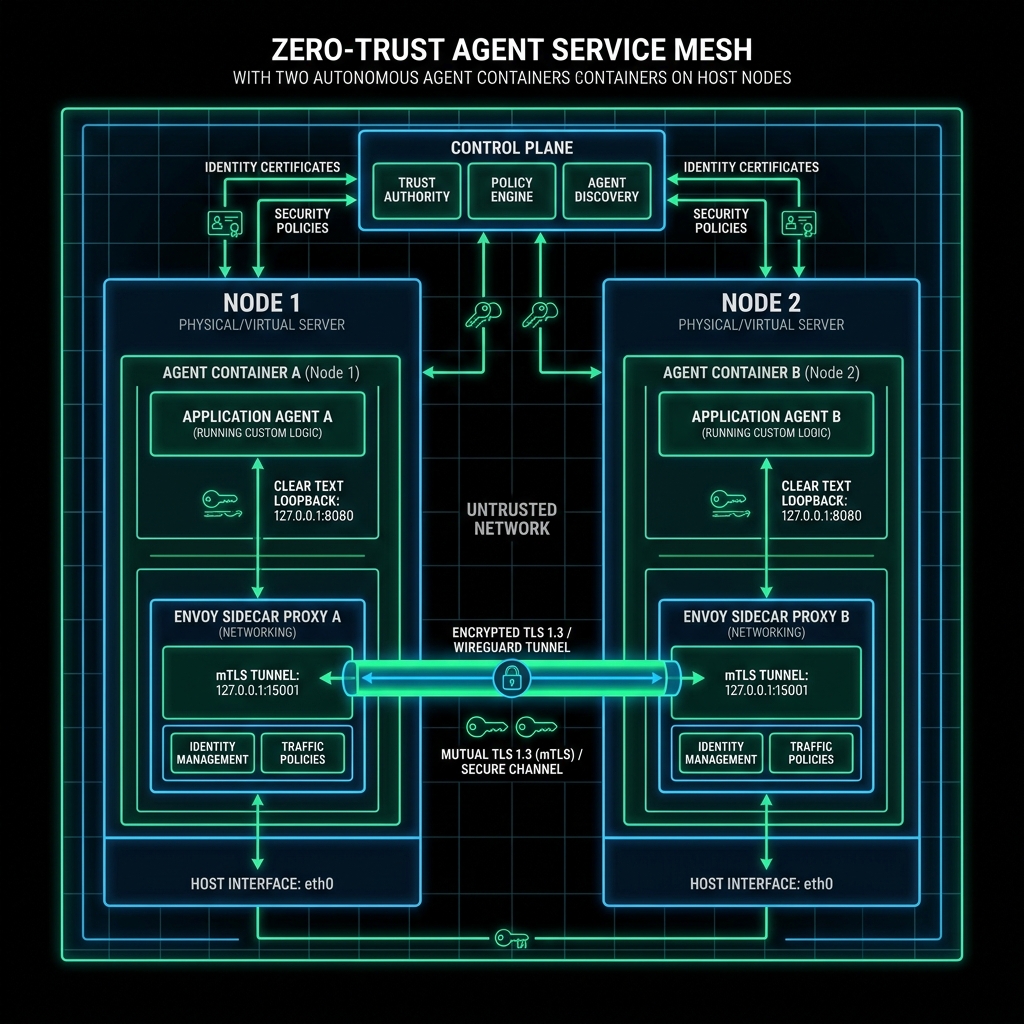
This whitepaper introduces a hardened, production-ready specification for a Zero-Trust Agent Service Mesh (ZT-ASM). By deploying local, out-of-process Mutual TLS (mTLS) sidecar proxies operating strictly over TLS 1.3 alongside agent processes, we eliminate in-application cryptographic overhead while enforcing strict, cryptographically verified identities (SPIFFE IDs). We present the theoretical underpinnings of explicit trust verification, analyze the cryptographic efficiency of TLS 1.3, establish dynamic X.509 certificate rotation routines without connection drops, and deliver a fully functional reference implementation written in Python.
Zero Trust Architecture (ZTA) operates on a foundational axiom: Never Trust, Always Verify. In distributed agent systems—where non-deterministic Large Language Model (LLM) instances, code execution sandboxes, and vector memory databases continually intercommunicate—this mandate requires structural realignments across four core vectors.
In legacy systems, IP addresses and local ports served as surrogates for identity. In a ZT-ASM, IP addresses are treated as transient, unreliable network attributes. Every dynamic agent instance must possess an explicit, non-forgeable, cryptographically verifiable identity encoded within a standard format, specifically SPIFFE Verifiable Identity Documents (SVIDs) structured as X.509 certificates. Network routing decisions are fully decoupled from identity verification.
+-----------------------------------------------------------------------------------+
|                               AGENT HOST NODE                                     |
|                                                                                   |
|  +--------------------+    Cleartext Loopback    +-----------------------------+  |
|  |  Autonomous Agent  | <---------------------> | Local Proxy (Sidecar)        |  |
|  |  Process (LLM)     |   (127.0.0.1:9001)      | - TLS 1.3 Engine            |  |
|  +--------------------+                          | - Dynamic SVID Storage      |  |
|                                                  | - Cert Rotation Engine      |  |
|                                                  +--------------+--------------+  |
+------------------------------------------------------------------|-----------------+
                                                                   |
                                          mTLS 1.3 / SPIFFE Auth  |  Encrypted Wire
                                          TLS_AES_256_GCM_SHA384   |
                                                                   v
+------------------------------------------------------------------|-----------------+
|                               REMOTE HOST NODE                   |                 |
|                                                  +--------------+--------------+  |
|  +--------------------+    Cleartext Loopback    | Remote Proxy (Sidecar)      |  |
|  |  Target Tool/Agent | <---------------------> | - Subject Alt Name Checker   |  |
|  |  Execution Engine  |   (127.0.0.1:9002)      | - Local Ephemeral Storage    |  |
|  +--------------------+                          +-----------------------------+  |
+-----------------------------------------------------------------------------------+
By default, all ingress and egress communication channels are blocked. An agent cannot transmit a single payload without establishing a mutually authenticated, cryptographically verified session. Microsegmentation is enforced at Layer 7: proxies evaluate the client's SVID against fine-grained identity access policies before forwarding payload bytes to the target agent process.
Agents are transient, scaling up or down based on execution demands. Cryptographic identity provision must be automated and anchored in node-level attestation (e.g., AWS TPM attestation, GCP OS Login, or Kubernetes Service Account tokens). The Control Plane issues short-lived X.509 SVIDs (typically valid for 1 to 6 hours), dramatically reducing the blast radius of key leakage.
Embedding cryptographic operations directly within the agent runtime (e.g., Python, Node.js, Rust) introduces severe vulnerabilities:
- Runtime Vulnerabilities: Memory-unsafe dependencies or bug-ridden cryptographic bindings within standard LLM agent frameworks can leak private keys.
- Lifecycle Coupling: Certificate rotation and protocol updates require restarting the agent, terminating complex non-deterministic execution graphs.
- Language Fragmentation: Multi-language agent pipelines require re-implementing complex cryptographic verification in every execution stack.
The Local Proxy Sidecar isolates key management, protocol negotiating, and TLS state machines into a separate process co-located on the same loopback interface (127.0.0.1), completely transparent to the main agent loop.
The ZT-ASM explicitly mandates TLS 1.3 (RFC 8446). Older protocols—including TLS 1.2—are strictly forbidden due to legacy cipher suites, insecure key exchanges, and multi-RTT connection overhead.
TLS 1.3 completely removes insecure algorithms such as static RSA key exchange, Diffie-Hellman with static parameters, CBC mode ciphers, and SHA-1 hashing. It mandates Perfect Forward Secrecy (PFS) via Ephemeral Diffie-Hellman over Elliptic Curves (ECDHE).
| Parameter | TLS 1.2 (Deprecated) | TLS 1.3 (ZT-ASM Mandate) |
|---|---|---|
| Handshake Latency | 2 Round-Trip Times (2-RTT) | 1 Round-Trip Time (1-RTT) |
| Key Exchange | Static RSA, DHE, ECDHE | Strictly ECDHE / x25519 / P-256 |
| Symmetric Ciphers | AES-CBC, AES-GCM, RC4, 3DES | Strictly AEAD (AES-256-GCM, CHACHA20-POLY1305) |
| 0-RTT Mode | Not Supported | Supported (Disabled in ZT-ASM: Replay Risk) |
| Handshake Encryption | Cleartext Server Certs | Fully Encrypted Certificate Exchange |
In standard TLS, only the server proves its identity. In mTLS, both Proxy A (Client Initiator) and Proxy B (Server Receiver) present and verify certificates against a mutual Root of Trust (CA Bundle).
- ClientHello: Proxy A sends key share extensions (ECDHE public keys), supported TLS versions (TLS 1.3 only), and AEAD ciphers.
- ServerHello & Key Exchange: Proxy B selects the cipher suite (e.g.,
TLS_AES_256_GCM_SHA384), computes the shared secret, and immediately encrypts subsequent handshake traffic. - Encrypted Extensions & Certificate Request: Proxy B requests Proxy A's client identity certificate (
CertificateRequestmessage). - Server Certificate & Verify: Proxy B sends its SVID, signs the handshake context with its private key, and sends a
Finishedpayload. - Client Certificate & Verify: Proxy A validates Proxy B's CA signature and SPIFFE SAN extension, then sends its own SVID and signature verify block.
- Application Data: Bi-directional, securely spliced stream commences over the encrypted tunnel.
Although TLS 1.3 allows 0-RTT data transmission to speed up resumption, 0-RTT traffic is susceptible to network replay attacks. In an agent ecosystem executing autonomous, state-modifying actions (e.g., financial transfers, database updates), replay attacks are critical vulnerabilities. Thus, 0-RTT data is strictly disabled across the service mesh.
Standard domain-name validation (X.509 Common Name or Domain SAN) fails in dynamic agent topologies where containers or processes lack static DNS entries. Instead, ZT-ASM adopts the SPIFFE (Secure Production Identity Framework for Everyone) standard.
An agent identity is structured as a Uniform Resource Identifier (URI) embedded directly within the SubjectAlternativeName (SAN) extension of the agent's X.509 certificate:
spiffe://mesh.agent.internal/ns/production/sa/financial-reasoning-agent
This identifier is decomposed into structural constraints during validation:
- Trust Domain:
mesh.agent.internal— Validates that both agents belong to the same organizational authority. - Namespace:
ns/production— Isolates dev, staging, and production agents. - Service Account / Agent Workload:
sa/financial-reasoning-agent— Identifies the structural capability of the process.
During the TLS handshake, standard socket validation verifies cryptographic chain-of-trust up to the root CA. Once complete, our proxy executes a custom L7 Identity Verification Callback:
+-----------------------------------------------------------------------------------+
|                            mTLS CRYPTOGRAPHIC VERIFIER                            |
+-----------------------------------------------------------------------------------+
                                         |
                                         v
                      [ 1. Validate X.509 Chain to Root CA ]
                                         |
                                +--------+--------+
                                |                 |
                             (FAILED)          (PASSED)
                                |                 |
                                v                 v
                         [ Abort TLS ]    [ 2. Extract SAN URIs ]
                                                  |
                                                  v
                                     [ 3. Match SPIFFE Schema ]
                                                  |
                                         +--------+--------+
                                         |                 |
                                      (NO MATCH)        (MATCHED)
                                         |                 |
                                         v                 v
                                  [ Terminate ]   [ 4. Evaluate RBAC Policy ]
                                                           |
                                                  +--------+--------+
                                                  |                 |
                                             (DENIED)           (ALLOWED)
                                                  |                 |
                                                  v                 v
                                            [ Terminate ]   [ Allow Socket Splicing ]
To minimize the risk window of compromised private keys, SVIDs in the ZT-ASM maintain short lifespans (typically 1 hour). Certificate rotation must occur seamlessly in the background without dropping long-lived bidirectional streaming connections (e.g., WebSockets, gRPC calls) or restarting the proxy daemon.
The Proxy maintains an in-memory DynamicSSLContext wrapper that acts as an atomic container for the active ssl.SSLContext instance. The rotation workflow operates as follows:
- An asynchronous background worker watches a secure local directory or listens to Control Plane mTLS push events.
- Upon receiving a new X.509 SVID and private key pair, the engine constructs a secondary, isolated
ssl.SSLContextin memory. - The worker validates the keypair consistency (ensuring the private key matches the certificate public key) and verifies the cert chain against the trust bundle.
- Upon successful validation, an atomic pointer swap updates the active context reference.
- New inbound and outbound socket connections immediately adopt the new context. Existing, already-established sockets continue using their negotiated parameters until gracefully disconnected.
If the rotation engine detects a malformed or expired certificate during the swap sequence, a fallback mechanism activates: the previous valid ssl.SSLContext is retained as a standby and automatically restored. This prevents a single bad certificate push from taking the entire proxy offline. Additionally, a circuit breaker monitors consecutive connection failures—if the failure rate exceeds a configurable threshold (e.g., 5 consecutive failures in 10 seconds), the proxy enters a temporary open state, rejecting new connections to avoid cascading failures while the control plane resolves the issue.
Below is a concise reference implementation demonstrating the core mTLS 1.3 context configuration for both client and server roles using Python's standard ssl module, along with the SPIFFE SAN verification hook.
import ssl
import socket
import logging

logger = logging.getLogger("ZT-ASM-Proxy")

# --- Server-side mTLS 1.3 Context ---
def build_server_context(
    cert_file: str,
    key_file: str,
    ca_bundle: str
) -> ssl.SSLContext:
    """Build a TLS 1.3-only server context requiring client certificate."""
    ctx = ssl.SSLContext(ssl.PROTOCOL_TLS_SERVER)
    ctx.minimum_version = ssl.TLSVersion.TLSv1_3
    ctx.maximum_version = ssl.TLSVersion.TLSv1_3
    ctx.load_cert_chain(certfile=cert_file, keyfile=key_file)
    ctx.load_verify_locations(cafile=ca_bundle)
    ctx.verify_mode = ssl.CERT_REQUIRED   # enforce mTLS
    ctx.check_hostname = False            # SPIFFE IDs, not hostnames
    logger.info("[SERVER] TLS 1.3 mTLS context ready.")
    return ctx

# --- Client-side mTLS 1.3 Context ---
def build_client_context(
    cert_file: str,
    key_file: str,
    ca_bundle: str
) -> ssl.SSLContext:
    """Build a TLS 1.3-only client context presenting its SVID."""
    ctx = ssl.SSLContext(ssl.PROTOCOL_TLS_CLIENT)
    ctx.minimum_version = ssl.TLSVersion.TLSv1_3
    ctx.maximum_version = ssl.TLSVersion.TLSv1_3
    ctx.load_cert_chain(certfile=cert_file, keyfile=key_file)
    ctx.load_verify_locations(cafile=ca_bundle)
    ctx.verify_mode = ssl.CERT_REQUIRED
    ctx.check_hostname = False            # SPIFFE SAN checked manually
    logger.info("[CLIENT] TLS 1.3 mTLS context ready.")
    return ctx

# --- SPIFFE SAN Verification ---
def verify_spiffe_id(ssl_sock: ssl.SSLSocket, allowed_ids: set) -> bool:
    """Post-handshake: verify peer's SPIFFE ID from SAN extension."""
    peer_cert = ssl_sock.getpeercert()
    sans = peer_cert.get("subjectAltName", [])
    for san_type, san_value in sans:
        if san_type == "URI" and san_value.startswith("spiffe://"):
            if san_value in allowed_ids:
                logger.info(f"[AUTH] SPIFFE ID verified: {san_value}")
                return True
    logger.warning("[AUTH] No valid SPIFFE ID found in peer certificate.")
    return False

# --- Example Usage ---
if __name__ == "__main__":
    SERVER_CERT  = "certs/server.crt"
    SERVER_KEY   = "certs/server.key"
    CLIENT_CERT  = "certs/client.crt"
    CLIENT_KEY   = "certs/client.key"
    CA_BUNDLE    = "certs/ca-bundle.crt"
    ALLOWED_IDS  = {"spiffe://mesh.agent.internal/ns/production/sa/tool-executor"}

    # Server side (illustrative)
    server_ctx = build_server_context(SERVER_CERT, SERVER_KEY, CA_BUNDLE)

    # Client side (illustrative)
    client_ctx = build_client_context(CLIENT_CERT, CLIENT_KEY, CA_BUNDLE)
    raw_sock = socket.create_connection(("127.0.0.1", 9002))
    tls_sock = client_ctx.wrap_socket(raw_sock, server_hostname=None)
    if not verify_spiffe_id(tls_sock, ALLOWED_IDS):
        tls_sock.close()
        raise ConnectionRefusedError("SPIFFE identity verification failed.")
    print("[+] Secure mTLS 1.3 channel established.")
In a ZT-ASM, agents do not address each other via raw IP addresses or hostnames. Instead, a Control Plane Registry—analogous to Consul or etcd—maintains a cryptographically signed mapping of SPIFFE IDs to network endpoints. When Agent A needs to communicate with Agent B, it queries the registry with Agent B's canonical SPIFFE ID and receives a dynamically allocated loopback port, behind which Agent A's local sidecar proxy has already pre-established or will establish an mTLS 1.3 tunnel to Agent B's sidecar.
This architecture eliminates service coupling at the DNS layer. Agent processes are entirely agnostic to the network topology of their peers. The mesh handles all TLS negotiation, SPIFFE verification, and fallback rerouting transparently. Load balancing within the mesh operates at the L7 identity layer: the control plane distributes connections across multiple SVID-verified replicas of a service based on identity policy, not IP affinity.
The Zero-Trust Agent Service Mesh represents a necessary architectural evolution for autonomous, multi-agent systems operating across heterogeneous infrastructure. By anchoring trust in cryptographically verified SPIFFE identities rather than network topology, deploying TLS 1.3 as the exclusive transport security protocol, and implementing non-disruptive certificate rotation with fallback resilience, organizations achieve a security posture that scales with the inherent dynamism of autonomous agent workloads.
The sidecar proxy pattern decouples cryptographic complexity from agent business logic, enabling consistent enforcement across polyglot agent runtimes. The Python reference implementation provided herein demonstrates that production-grade mTLS 1.3 adoption requires only minimal dependencies on the standard ssl module, making it immediately accessible to engineering teams without deep PKI expertise.
As agent architectures grow in capability and autonomy, the imperative for Zero Trust networking intensifies. Organizations that invest in this infrastructure layer today are best positioned to operate secure, auditable, and high-performance agent ecosystems at enterprise scale.
Zero Trust is not a feature—it is the foundational contract of every inter-agent communication in a distributed autonomous system. Every byte transmitted must be cryptographically verified, identity-bound, and auditable. There is no trusted perimeter. There is only verified identity.
- Get link
- X
- Other Apps


